
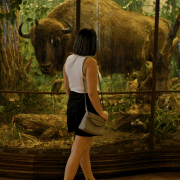
Museum Of Zoology In Cambridge Is Utilizing Artificial Intelligence To Give Animals A Voice
A month-long project at Cambridge University’s Museum of Zoology will utilize artificial intelligence to give deceased animals, extinct and common, the ability to share their life stories and experiences of the afterlife.
According to reports, the museum will feature more than a dozen exhibits including ones of an American cockroach, dodo, red panda, and skeleton parts of a whale fin, all of which will be able to “speak” to visitors.
The models of the various species will each have their own personalities and accents to reflect the regions they’re from and their known personalities in the wild. Visitors can converse will the models through voice or text on their phones. One of the major goals of this is to emphasize the crisis of dwindling biodiversity in our world.
“Museums are using AI in a lot of different ways, but we think this is the first application where we’re speaking from the object’s point of view,” said Jack Ashby, the museum’s assistant director.
“Part of the experiment is to see whether, by giving these animals their own voices, people think differently about them. Can we change the public perception of a cockroach by giving it a voice?”
Nature Perspectives is the name of the company behind the exhibit. Their overall goal as an organization is to build AI models that will help connect humans to the natural world more, especially now that the Earth is really feeling the impact of climate change.
When it came to bringing the collection together, each exhibit was equipped with AI that was given specific details on where the specific species lives, its natural environment, and how it arrived in the collection. Additional information is also provided, according to the Guardian.
The exhibits will also motif their language and tone based on the age of the visitor interacting with it. Each can communicate in over 20 languages as well.
Ashby is hoping “visitors will learn more than can fit on the labels that accompany the specimens.”
“When you talk to these animals, they really come across as personalities, it’s a very strange experience,” Ashby said.
“I started by asking things like ‘where did you live?’ and ‘how did you die?’, but ended up with far more human questions.”
The exhibit officially opened this week and will be within the museum for the next month, or until November 15th. To learn more about it, visit their website!

Eric Mastrota is a Contributing Editor at The National Digest based in New York. A graduate of SUNY New Paltz, he reports on world news, culture, and lifestyle. You can reach him at eric.mastrota@thenationaldigest.com.