Posts

shark

Blue Sharks Use Nanotech To Shift Color Underwater, Scientists Discover

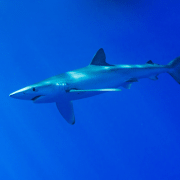
Blue sharks are known for their glorious shimmer and glow with one of the rarest colors found in nature. Scientists have now discovered how the shark’s bodies are able to pull this off, and it involves microscopic crystals and pigments hidden within their skin. 

A new study on the blue shark has shown that intricate nanostructures within their skin created the animal’s blue hue and allows for its subtle shifts in color, according to Sci Tech Daily

“Blue is one of the rarest colors in the animal kingdom, and animals have developed a variety of unique strategies through evolution to produce it, making these processes especially fascinating,” says Dr. Viktoriia Kamska, a post-doctoral researcher in the lab of Professor Mason Dean at City University of Hong Kong.

Embed from Getty Images

More specifically, the researchers found that the vivid blue appearance is from structures located inside the pulp cavities of dermal denticles, which are tiny, tooth-like scales that form a layer of protection over the shark’s skin. 

The cavities contain what are known as guanine crystals which reflect blue light. They also have melanin-filled vesicles called melanosomes that absorb other wavelengths. 

“These components are packed into separate cells, reminiscent of bags filled with mirrors and bags with black absorbers, but kept in close association so they work together,” explains Dr. Kamska. 

“When you combine these materials together, you also create a powerful ability to produce and change color,” says Professor Dean.

 “What’s fascinating is that we can observe tiny changes in the cells containing the crystals and see and model how they influence the color of the whole organism.”

 “We started looking at color at the organismal level, on the scale of meters and centimeters, but structural color is achieved at the nanometer scale, so we have to use a range of different approaches,” he stated

Dr. Kamska and her collaborators used simulations to confirm which architectural parameters the nanostructures within the sharks are credited for the specific wavelengths. 

“It’s challenging to manually manipulate structures at such a small scale, so these simulations are incredibly useful for understanding what color palette is available,” says Dr. Kamska, who added that certain environmental conditions can also impact how the shark shifts its color. 

Embed from Getty Images

 “In this way, very fine scale alterations resulting from something as simple as humidity or water pressure changes could alter body color, which then shapes how the animal camouflages or counter-shades in its natural environment,” says Professor Dean.

Dr. Kamska added that as the sharks swim deeper, the increase in pressure causes the guanine crystals to get tighter and closer together, so the color darkens to better suit their surroundings. 

“The next step is to see how this mechanism really functions in sharks living in their natural environment,” says Dr. Kamska.

 “Not only do these denticles provide sharks with hydrodynamic and antifouling benefits, but we’ve now found that they also have a role in producing and maybe changing color too,” says Professor Dean. 

“Such a multi-functional structural design —a marine surface combining features for high-speed hydrodynamics and camouflaging optics— as far as we know, hasn’t been seen before.”

“A major benefit of structural coloration over chemical coloration is that it reduces the toxicity of materials and reduces environmental pollution,” says Dr. Kamska. 

“Structural color is a tool that could help a lot, especially in marine environments, where dynamic blue camouflage would be useful.”

“As nanofabrication tools get better, this creates a playground to study how structures lead to new functions. We know a lot about how other fishes make colors, but sharks and rays diverged from bony fishes hundreds of millions of years ago – so this represents a completely different evolutionary path for making color,” said Professor Dean. 

sea otter

Sea Otters Use Tools To Combat Food Competition Amid Climate Change, According To Study 

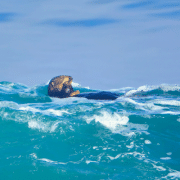
In certain parts of the ocean, sea otters are facing major competition for food, partially due to climate change limiting food supplies. However, they’ve adapted by utilizing “tools” such as rocks or even glass bottles to open tougher prey, like clams, giving them an opportunity to maintain their diet. 

These observations were recently published as a part of a new study published in the journal Science. The study analyzed sea otters in Monterey Bay, California, and was specifically looking at how individual otters used various tools they found, and how utilizing them impacted their health and nutrition. 

The findings also concluded that this skill set could increase sea otters chances of survival in ocean environments that are constantly changing as a result of climate change. 

Embed from Getty Images

Sea otters often spend their days foraging for food in kelp forests by diving to the bottom of a body of water to grab morsels of food and rocks that they can use as tools. The study stated that they then bring their food and rocks to the surface of the water, float on their backs, and use their stomach as a table to open and eat their snacks. 

“Their preferred prey are usually urchins and abalone,” says Chris Law, a biologist at the University of Texas and the University of Washington involved in the study. 

Law stated that urchins and abalones are a part of sea otters diets and are typically easy for them to break apart and open. 

“Unfortunately, all those prey items have been declining or have declined,” especially in highly populated areas like Monterey Bay, says Law.

A big part of a sea urchin’s diet is kelp, and they can consume a lot at a relatively quick rate. When large groups of urchins go through a kelp forest, they can completely decimate it, which can in turn make the urchins “calorie-poor” with little nutritional value for the otters that consume them. 

“So that means otters have to eat alternative foods. A lot of those alternative foods are those super-hard-shell prey items that really require some kind of external force to break into,” said Law. 

Law added that “snails are abundant in the bay, but they’re low-calorie and basically like a rock that you have to break into to eat the insides.”

Law and his colleagues looked at data from 196 otters in Monterey Bay. They tagged the otters, and volunteers involved in the study monitored the marine mammals closely to see what they were eating, how large and tough their prey is, and if the otter utilized a tool to eat it. 

Embed from Getty Images

According to the report, otters who used tools were able to eat larger prey. Female otters’ use of tools is important for their overall nutrition because they’re smaller than males and don’t have the ability to bite down as hard.  

“They [female otters] typically wouldn’t be able to break into harder prey. But they use tools more than males, so they’re able to gain access to these novel sources of food items,” said Law. 

The use of tools also work to protect otters’ dental health. The otters monitored in the study received dental assessments as well, and the researchers found that those who used tools had less damage to their teeth than those who didn’t use tools, because they just bite down on the hard shells to break them open. 

“Without their teeth, they clearly can’t eat anything. So then they die. What we’re suggesting is that this behavior really allowed them to continue living on despite not having their preferred prey.”

“This is such an important paper,” says Rob Shumaker, president and CEO of the Indianapolis Zoo and one of the authors of a book called Animal Tool Behavior.

According to NPR, he said “scientists have spent decades documenting tool use in dozens of species; tool use in sea otters, for example, has been recognized since the 1960s. But now, studies like this one are showing that this field of research is starting to shift.”

“It’s not about describing the actual tool use or tool manufacture anymore. It’s describing the impact that it has on that animal’s life.”

Netflix

Netflix’s “The Witcher” Eclipses “The Mandalorian” as World’s Most Popular TV Show

The recent launch of Disney Plus was accompanied by a live-action TV show based on the Star Wars universe, which soon became one of the most-watched shows in the world, thanks in part to its adorable alien creature fans have nicknamed “Baby Yoda.” But Netflix, undoubtedly the fiercest competitor to Disney’s new streaming service, has years of experience producing TV shows that capture the attention of critics and audiences alike, and has done so yet again with “The Witcher.” According to the data company Parrot Analytics, “The Witcher” has surpassed Disney’s “The Mandalorian” in popularity, drawing 127 million viewers as opposed to “The Mandalorian’s” 115 million viewers for the week of December 22 to 28. Based on a series of fantasy novels by the Polish author Andrzej Sapkowski, “The Witcher” follows a monster hunter named Geralt of Rivia during his adventures in a medieval world. Though critics gave “The Witcher” a lukewarm reception, audiences flocked to the fantasy show, all but ensuring that Netflix will renew the series for several more seasons.

Embed from Getty Images

A number of factors could explain “The Witcher’s” sudden popularity. For one, audiences may be familiar with the world of “The Witcher” not only from the eight novels that inspired it but from the popular video game series of the same name, sparking their curiosity about how Netflix would handle a live-action adaptation. Additionally, the end of “Game of Thrones” left many viewers unsatisfied, and “The Witcher” provides an opportunity for fans of the genre to immerse themselves in a new fantasy world. Netflix has advertised “The Witcher” prominently, and as of this writing a trailer for the show loads immediately after visiting the website. And while Disney Plus has seen tremendous success in its first few months, many more people have Netflix subscriptions than Disney Plus subscriptions, as the former service has been around for more than a decade. All eight episodes of the show’s first season were released on December 20th in keeping with Netflix’s tradition of releasing all episodes of a season at once to facilitate binge-watching. “The Mandalorian’s” first season also had eight episodes, but these episodes were released weekly, with the season finale premiering on December 27th. The success of both shows demonstrates that both release models are viable for attracting large audiences, though most viewers likely prefer Netflix’s approach as it allows for instant gratification.

Despite the show’s popularity, reviewers had a number of complaints about “The Witcher.” Overall, it holds a 59% approval rating among critics on Rotten Tomatoes, who criticized the show for failing to establish a convincing, believable fantasy environment and for its “boring” characters. Critics also complained that the show is poorly paced and features excessively convoluted storylines, which are particularly hard to follow for people unfamiliar with the books or video games. General audiences were more approving of the show, as “The Witcher” holds a 93% audience rating on Rotten Tomatoes. Given the series’ high production values, engaging action sequences, and the audience’s familiarity with the source material, it is perhaps not surprising that “The Witcher” ended up being a crowd-pleaser. 

Embed from Getty Images

Unlike “The Witcher,” both audiences and critics approved of Disney’s “The Mandalorian,” as viewers around the world fell in love with the show’s infant alien character. On Rotten Tomatoes, “The Mandalorian” has a 94% approval rating among critics and a 93% audience approval rating, indicating near-universal acclaim. Viewers praised “The Mandalorian” for its compelling characters, its engaging action sequences, and its adherence to the style of the Star Wars universe. Considering that “The Mandalorian” was likely the most successful aspect of the launch of Disney Plus, Disney is likely to continue to produce the series for some time. That being said, as a result of “The Witcher’s” early success among audiences and the vast expanse of narrative content available for adaptation, both shows are likely to continue for many years to come.