
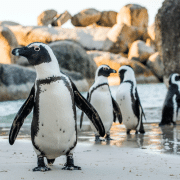
Endangered African Penguins Getting New Protections As South Africa Enforces No-Fishing Zones
Conservationists and fishing industry groups in South Africa have increased their efforts to protect the critically endangered African penguin through a legal settlement on creating no-fishing zones around the penguins major breeding colonies, according to reports.
Sardine and anchovy fishing is now banned within a 12 mile radius of a penguin colony in Cape Town on Robben Island, as well as Bird Island. According to the court order, the no-fishing zones will also be implemented around four other colonies.
Commercial fishing greatly impacts the African penguin population as it takes away a majority of their food source. Reports state that the species are currently threatened with extinction by 2035 if their population continues to decrease at the current rate, which is about 7.9% annually. 100 years ago there were about 1 million breeding pairs, today there’s less than 10,000.
“Today’s order is a significant step forward in our fight to save the African Penguin from extinction … However, while we celebrate today’s success, we remain acutely aware that our journey is far from over. The threats facing the African Penguin are complex and ongoing,” said Nicky Stander, head of conservation at the Southern African Foundation for the Conservation of Coastal Birds (SANCCOB).
The South African Pelagic Fishing Industry Association and the Eastern and Southern Cape Pelagic Association, stated:
“The perception that the fishing industry (or that fishing near to breeding sites) is the primary cause of the decline in the penguin population is a false one … We are especially pleased that this settlement will now allow scarce resources to be used constructively to scientifically determine the principal factors causing the decline in the penguin population and to ameliorate those where possible.”
“This agreement is a testament to what can be achieved when industries and conservationists unite for a common cause. It delivers on the DFFE’s vision of protecting our penguins and preserving our biodiversity, while ensuring the sustainability of our fishing industry,” said Dion George, South Africa’s environment minister.
“It is good to hear that the island closures have been agreed at last,” said Bob Furness, a University of Glasgow emeritus professor.
“These alone may not be sufficient if penguins continue to be under pressure from many factors and in particular if sardine total stock biomass remains vulnerable to overexploitation at low stock abundances.”
“The fishing closures now needed to be monitored,” said Phil Trathan, who was also part of the expert panel.
“It is now critical that the focus now turn to examining the industrial fisheries for sardine and anchovy.”

Eric Mastrota is a Contributing Editor at The National Digest based in New York. A graduate of SUNY New Paltz, he reports on world news, culture, and lifestyle. You can reach him at eric.mastrota@thenationaldigest.com.