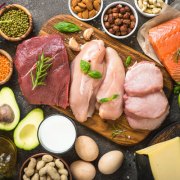
Eating Less Protein May Support Healthy Aging, Review Finds
Despite the popularity of high-protein diets and protein-fortified foods, many adults may not know how much of the nutrient they actually need.
A major scientific review suggests that healthy adults who already consume adequate protein may gain little from eating more. Some evidence suggests that moderately reducing protein intake, or limiting certain amino acids that make up protein, could support metabolic health and biological processes associated with aging. In some organisms, lower protein intake has also been associated with a longer lifespan, even when total calorie consumption remained unchanged.
The review was led by pathologist and biomedical researcher Dudley Lamming, who studies aging at the University of Wisconsin-Madison School of Medicine and Public Health. It analyzed more than 350 studies involving people, mice, insects, yeast and other organisms. It was published in the journal Cell Press Blue.
Scientists have long studied calorie restriction as a possible way to extend lifespan and lower the risk of age-related illnesses, including cancer. But maintaining a reduced-calorie diet over long periods can be difficult, leading researchers to investigate whether limiting protein could produce some similar effects without requiring people to eat substantially less food.
“It’s absolutely crystal clear that there are benefits of protein to muscle growth and exercise response of active individuals. But because most people are relatively sedentary, many people are likely consuming more protein than they actually need, which probably has negative health consequences.”
The amount a person needs varies according to age, body size, activity level, pregnancy status and overall health. For a generally healthy adult, the recommended daily amount is about 0.36 grams per pound. A person weighing 140 pounds would need approximately 50 grams a day under that guideline.
The review comes amid a broader debate over protein guidance in the United States. Updated recommendations cited by the researchers call for some adults to consume between 1.2 and 1.6 grams per kilogram of body weight, or roughly 0.5 to 0.7 grams per pound, nearly twice the longstanding minimum recommendation.
Many American adults already exceed that amount.
An analysis of national health data found that adults who met exercise recommendations consumed about 82 grams of protein each day. Those who did not meet the exercise guidelines still averaged about 79 grams.
A single meal can provide a substantial portion of the daily recommendation. A 3- to 6-ounce serving of meat, chicken or fish often contains 20 to 30 grams of protein.
“It’s probably safe to say that for sedentary individuals, maybe [follow] the original [recommended daily amount of] 0.8 grams per kilogram,” said Lamming.
Manufacturers now add protein to coffee drinks, breakfast cereals, chips, ramen and other products that were not traditionally promoted as major protein sources. Packaging and advertising often suggest that a higher protein content makes a product healthier.
Consumer interest has grown alongside that marketing. A 2025 survey from the International Food Information Council found that 70% of U.S. adults said they “try” to eat protein. High-protein diets were the most popular diet pattern for the third year in a row.
At the same time, many survey respondents said they were unsure how much protein they should consume.
Physically active people may need more protein to support muscle repair, growth and recovery. Pregnant people and those recovering from surgery, injury or illness may also have higher requirements.
Protein can also be important during weight loss. People who are reducing calories may need adequate protein to help preserve muscle while losing body fat. Older adults may have different needs as well.
That does not mean inactive adults should immediately cut back on protein intake. The findings instead suggest that people who already consume enough may not need to keep seeking additional sources. For sedentary adults, increasing physical activity could have a greater effect on health than adding more protein to meals and snacks.
“These studies show that the amount of protein sedentary people are eating today may have negative health consequences, at least at the population level.”
The review also examined what may happen inside the body when protein intake is reduced. One potential effect involves FGF21, a hormone that helps regulate energy use and metabolism.
“There’s an increase in a hormone called FGF21 that promotes energy expenditure [when protein intake is reduced]. It essentially increases thermogenesis in your adipose tissue, so you don’t just store fat, but actually burn it as fuel.”
That mechanism may help explain why some studies have linked lower-protein diets to reduced body fat, improved blood sugar control and healthier metabolic function.
Recent human clinical trials reviewed by the researchers found that participants who reduced protein lost weight and body fat and improved their fasting blood sugar levels, even though some consumed more calories overall.
FGF21 has also been associated with lower inflammation. In mouse studies, animals with elevated levels of the hormone lived longer than typical mice, although the effect was greater in males than in females. Researchers have also observed that reducing protein raises FGF21 levels in people.
Lower protein intake may also alter signals that tell cells when to grow, repair damage or break down and reuse old cellular components. Those maintenance processes are believed to play a role in the aging process.
Some studies reviewed by Lamming also found potential benefits from reducing individual amino acids rather than lowering all dietary protein.
The evidence does not support protein deficiency, researchers said. Protein restriction in scientific studies is not the same as depriving the body of a nutrient it needs.
Aging is associated with sarcopenia, a gradual loss of muscle mass, strength and physical function. Eating enough protein and participating in strength or resistance exercise may help slow that decline.
The evidence on weight management and aging is not entirely one-sided. Other studies have found that higher-protein diets can support weight loss and help older adults maintain muscle, particularly when protein intake is paired with regular exercise.
People with kidney disease, liver disease and other medical conditions may also require individualized guidance. In some cases, they may be advised to limit their protein intake. In others, maintaining sufficient intake may be especially important.
Anyone considering a substantial change in protein consumption should consult a doctor or registered dietitian.
The review leaves several questions unresolved. The studies included in the analysis differed in their protein levels, dietary patterns, duration and design. Those differences make it difficult to determine exactly how much protein should be reduced or for how long a lower-protein diet should be followed.
Many of the studies were also conducted in animals, insects, yeast or other organisms. Findings from those experiments can help scientists identify biological mechanisms, but they do not always translate directly to people.
More long-term human research is needed to determine which adults could benefit from lower protein intake and whether reducing specific amino acids has the same effects as reducing total protein intake.
Researchers also continue to study whether the source of protein changes its health effects. Protein from beans, lentils, nuts and other plant foods may affect the body differently than protein from processed meats or fortified snack foods.
For now, the findings do not dispute that protein is necessary. They question whether healthy adults who already get enough need to add it to every meal, snack and beverage.

Moumita Basuroychowdhury is a Contributing Reporter at The National Digest. After earning an economics degree at Cornell University, she moved to NYC to pursue her MFA in creative writing. She enjoys reporting on science, business and culture news. You can reach her at moumita.b@thenationaldigest.com.