Posts

wildfire

Europe’s Wildfire Weather Is Being Fueled By The Climate Crisis 

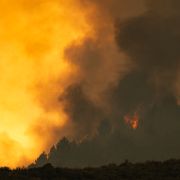
Major wildfires have been spreading throughout Europe, specifically in Spain and France. According to a scientific analysis, the extreme heat and drought that is fueling these fires is only being exacerbated by the climate crisis. 

Experts from the World Weather Attribution (WWA) consortium calculated that global heating has made hot, dry, and windy weather 20 times more likely in Spain and twice as likely in France. Constant and increased burning of oil, gas, and coal has warmed the planet making extreme weather events such as wildfires much more common in recent years. 

Embed from Getty Images

The end of June saw a major heatwave spread throughout Europe, and has caused an estimated 20,000 deaths. This heat, according to another WWA study, could not have accumulated without the extra heat that has been trapped in the atmosphere from climate change. 

Another study from the group also found that the climate crisis is causing soils to become extremely dry, leading to major drought throughout the continent as well. 

Between the heatwaves and dry lands, a perfect storm was created for wildfires. Studies performed last year also showed that the 2025 wildfires were fuelled by the climate crisis. 

Europe also experienced a wet winter and spring, which allowed extra vegetation to grow, and eventually dry out from the summer’s intense heat, and further allowing wildfires to spark and spread. 

Dr Clair Barnes, a research associate at Imperial College London and part of the WWA study team, said: 

“We’ve seen repeatedly how climate change increases hot, dry, flammable conditions that are extremely conducive to wildfires.”

“What’s unique about [the July fires in Spain and France] is that it’s still early in the season – and with another heatwave looming, these findings are extremely scary. What we’re seeing is a clear sign of the escalating impacts of [human-caused] warming.”

“What we are seeing now in Spain and France goes well beyond what we would expect from past events,” said the director of programs at Red Cross Red Crescent Climate Center, Julie Arrighi. 

Embed from Getty Images

Dr. Augustin Colette at the French National Institute for Industrial Environment and Risks stated

“The smoke increased particulate [pollution] peak levels up to 20 times above what is considered ‘fair air quality’, and extremely poor air quality was felt up to 400 km away from the fires.” 

Since early July, severe wildfires have been burning across Spain and France. More than 300,000 people were forced to leave their homes with thousands being destroyed. The WWA specifically analyzed the seven-day period in which the highest daily severity ratings for each country was recorded. 

They used weather records to establish statistical methods to estimate how much more likely a week of extremely high DSR is in today’s world when compared to the world before mass fossil-fuel burning raised the global temperature, according to the Guardian

The UN’s climate chief, Simon Stiell, said: 

“These European mega-fires show how fast climate-driven extreme heat and dry landscapes can turn wildfires into devastating national disasters.”

“Humanity continuing to burn colossal amounts of coal, oil and gas is making these conditions more dangerous, and these megafires more deadly and destructive. But the solutions are equally clear: all countries must move faster from fossil fuels to renewables and protect people from worsening climate impacts, from wildfires, to megastorms and floods, to droughts hitting food production.”

drought

Bogotà, Colombia Starts Rationing Water For 9 Million People

Bogotà, Columbia is currently experiencing a severe drought due to El Niño, as reservoirs have been pushed to record lows, according to reports. The city’s authority announced this week that residents would have to start rationing water as a result. 

The rationing itself came into effect on Thursday, with Bogotà and dozens of surrounding towns being divided into nine zones. Domestic running water is cut off for 24 hours in each zone on a specific rotation that resets every 10 days. This new rationing system is set to impact around 9 million people. 

Embed from Getty Images

There are additional plans to ensure that hospitals and schools have a continuous water supply, according to authorities. 

The Chuza and San Rafael reservoirs, part of the Chingaza System which provides 70% of the city’s drinking water, are in critical positions according to local authorities. 

“Let’s not waste a drop of water in Bogotá at this time, that will help us so that these restrictions can be lifted more quickly or reduced,” Mayor Carlos Fernando Galán said in a news conference.

According to Stefano Pozzebon, writer for CNN, “It’s not unusual for cities in Latin America to face water crises. Bogotá joins Mexico City to its northwest, which could also be on the brink of running out of water, as the combination of climate change, El Niño, geography and rapid urban development put immense strain on its water resources. But this marks the first time in recent history that Bogotá has been forced to implement water rationing measures.”

Embed from Getty Images

“Most cities around the world depend on aquifers for their water supplies. Bogota is different in that almost all our supply comes from surface waters like reservoirs, which are more susceptible to rain patterns,” said Armando Sarmiento, an ecology professor at Bogotá’s Javeriana University.

“It’s this dependence on rain that makes Bogotá particularly vulnerable to drought,” Sarmiento told CNN.

“Since last year, the city has experienced long dry periods due to the impact of El Niño,” according to local authorities.

Bogotá’s water rationing plans have been endorsed by the nation’s president. A civil authority tasked with protecting civil and human rights in Columbia, issues a statement this week that stated “a long-term reliable water supply is a basic human right, and the environment ministry in February launched a campaign with the hashtag #ElNinoNoEsUnJuego (El Niño is not a game) to warn Colombians not to underestimate the crisis.”

“We got to a point where we can’t expect water to come down like it used to be if we don’t respect the reservoirs’ natural supply cycle, if we don’t respect water’s natural cycle,” Sarmiento, the ecologist, told CNN.

Colorado River

The Colorado River Is Drying Up, Putting 40 Million Americans At Risk For Drought

The Colorado River provides water that supports more than 40 million Americans. Anyone living between Denver and Los Angeles, can most likely thank the massive river for a renewable and clean source of water. However, like most natural resources on Earth in 2020, climate change is beginning to take its toll. 

Scientists have found that there has been a 20% decrease in the Colorado River’s flow within the 21st century, when compared to the rate at which the flow was decreasing last century; an issue that they are blaming climate change on. Researchers who worked on a recent study, posted last week in the Journal Science, found that more than 50% of the river’s flow decline is due to increasing global temperatures. This is becoming a major issue that will only get worse; the biggest concern being the extreme water shortage that scientists are predicting millions of individuals who rely on the river as a water source will endure within the coming years. 

Embed from Getty Images

“For each 1.8 degrees Fahrenheit of warming averaged across the river’s basin, its flow has decreased by nearly 10%. Over the course of the 20th and early 21st centuries, the region has already warmed by an average of roughly 1.6 degrees Fahrenheit. The study also examined the impact that pollution and heat-trapping gases could have on the river’s water supply. Without any cuts to [these] emissions, the river’s discharge could shrink by between 19% and 31% by the middle of this century,” (National Climate Assessment).

The Colorado River is one of the most vital rivers in the United States because of how much land it covers, and how many people rely on it as a renewable resource. The river itself begins at a high altitude in the Rocky Mountains of Colorado and Wyoming. It stretches throughout the Southwest of the U.S. and ends up in the Gulf of California. However, according to the study, by the time the river gets to California its reduced down to nothing more than a trickle of water. 

On its journey from the mountains down to the golden state, the river makes a few detours to supply fresh water to cities like Denver, Los Angeles, Las Vegas, San Diego, Phoenix, and a multitude of farms that reach all the way down to Mexico. If the river continues to slow down, a majority of these places will be left at serious risk for drought, and will likely dry up.  

Embed from Getty Images

According to the study, “Global warming is taking a severe toll on the snowpack that feeds the river, the scientists found. As temperatures increase, snow cover in the region is declining, meaning less energy from the sun is reflected back into space and more warms the ground as heat. This triggers a vicious cycle that leads to even more evaporation and therefore, less water supply.”

Increasing global temperatures has also already had a multitude of negative effects on the planet, obviously, that have already begun affecting the river as well. Lake Powell and Lake Mead are two of the Colorado river’s main reservoir sources, and they both are currently half full, to what’s considered their normal/sustainable volume of water, due to a 20-year-long severe drought brought on by climate change. 

In total, seven states rely on the river for water. Last year, the federal government reached an agreement regarding the rights of the river and how it should be governed within the next decade or so; the deal will protect the river until 2026, and negotiations are scheduled to take place at some point this year to determine which sectors of the river are the driest, and thus need to greatest protections/rehabilitation efforts. 

In general, a reduction of greenhouse gas emissions brought on by new technology, federal policies, and true systematic/economic change will help reverse the extensive damage this river has endured, as well as protect the rest of the planet from the massive amounts of destruction it’s already been through thanks to humanities ignorance on global warming.