Posts

phones

Phone Bans Increase Throughout US Schools To Better Student Engagement 

Throughout the US, school districts are implementing bans and restrictions on cellphones in the classroom in order to better student engagement and behavior. In fact, according to a new survey from Education Week’s Research Center, 95% of educators say that their school or district has an official policy restricting students’ access to their phones during school hours. 

The survey was conducted from mid-February to mid-March and included 596 teachers and school and district leaders. 

Embed from Getty Images

The report showed that, in general, teachers, principals, and district leaders reported positive results from their restrictions, specifically pointing out improvements in student participation and behavior. 7 in 10 educators said that phone limits have had a positive impact within those two areas. 

“A lot of educators are seeing benefits from the cellphone restrictions on engagement, behavior, well-being, and learning,” said Bridgette Whaley, an associate professor of education at West Texas A&M University. 

“The survey also made it clear to me that having a policy is not the same thing as implementing it well. How the policy is designed and how consistently it’s enforced really seem to matter a lot.”

On the other end, educators said that attendance is one area where cellphone restrictions are not impacting student behavior. 7 in 10 reported that cellphone restrictions didn’t have a positive nor negative impact.

A district-level administrator in Oklahoma who participated in an open-response section of the survey discussed how the state recently “mandated a cellphone policy that restricts the usage of personal devices during the school day.” 

“It has been a game changer regarding student engagement, focus, and minimizing poor student behavior.” 

A high school teacher in Tennessee said that for them, “the state, district, and school policies have helped to foster more person-to-person interaction and people skills. The policies have also focused student attention more on learning content.”

In recent years there has been a very rapid increase in policy and lawmakers from both parties placing restrictions on cellphones in schools in the US. Education Week reported that at least 37 states and the District of Columbia require school districts to ban or restrict students’ use of cellphones in school. Some of the other states not in that group are either incentivizing or recommending local districts enact their own policies. 

Embed from Getty Images

Whaley pointed out that many schools do not require students to lock their phones away in lockers during the day. 

“Instead, they seem to be relying more on compliance-based approaches, like keeping [phones] turned off or placed in backpacks or maybe somewhere else in the classroom,” she said. 

“That really matters because it suggests that many schools may have restrictions on paper, but the actual enforcement often depends on the people rather than the policy or the structure.”

The survey also showed that some educators don’t see cellphone rules being enforced with 64% saying they are and 36% saying they were not. 

“A policy can look consistent from a leadership perspective, but not be as consistent in classrooms. That’s why I think that the teacher’s perspective matters so much to the conversation,” Whaley said

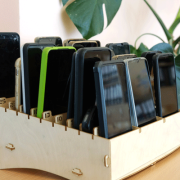
A high school teacher in California: “While the school rule is no cellphone use in the classroom except for at the teacher’s discretion, not all teachers enforce this rule. Last year, fed up with fighting students’ cellphone use, I bought and began using cellphone pockets. For the most part, this has eradicated the cellphone distraction in my class, but not all teachers do this.”

“We are starting to make changes to reduce technology usage across the district and implementing a stricter cellphone policy due to parent [and] community requests,” a Minnesota high school teacher said. 

“The enforcement is what is the most difficult. We are not consistent in classrooms.”

“With our cellphone policy, we see very few cellphones in classes, but many students still don’t turn them in like they are supposed to,” said a school leader of a middle school in Massachusetts. 

“I think students are still definitely using phones in the bathroom and during breaks. One of the biggest challenges that I see with phones is what happens outside of the school building that then is brought in here.”

Singapore Announces Separate Rules For People Who Received Their Covid-19 Vaccines 

Singapore is introducing new health and safety measures for those who are vaccinated against Covid-19. New cases are continuing to rise in the city, so only fully vaccinated individuals and people who have recovered from Covid-19 will now be able to dine in groups of five without taking a Covid test.

The health ministry made the announcement this week, stating these rules would go into effect on July 19th. Any food and beverage establishment must implement a system so that they can check every patrons vaccination status. 

Embed from Getty Images

Children under the age of 12, who are not yet eligible for the vaccine, are able to dine together with members of their household without taking a Covid test. The press release from the health ministry claimed that individuals are fully vaccinated once it’s been two weeks since their second dose of either the Pfizer or Moderna vaccine. 

Authorities have also stated that those who receive shots developed by China’s Sinovac Biotech will not be given the same perfs as those who have received a Pfizer or Moderna vaccine. Sinovac’s vaccine has not yet been included in Singapore’s national vaccine program, and is only available in the city-state through a special access route. 

A cluster of about 120 new Covid cases have been linked to a KTV lounge in Singapore. Nightclubs, bars, KTV/karaoke lounges have all been banned from operating in Singapore since the beginning of the pandemic. 

Embed from Getty Images

A number of these establishments have been able to remain open, however, by just serving beverages and food and not providing any other entertainment services. The number of new infections hit 127 this week; up 23 from the week before according to the health ministry. 

Singapore in total has experienced about 63,000 cases of Covid-19. Health Minister Ong Ye King recently told reporters that 73% of the population has received at least one dose of their vaccine while 45% of the population is fully vaccinated. 

That figure is currently set to rise by 50% in the coming weeks based on currently scheduled vaccination appointments in the city-state. 

“Our  country is well on track to meet its target of having two-thirds of its population to be fully vaccinated by August 9.”

Unvaccinated parties can still go out to eat at certain establishments, however, they need to endure testing and contact-tracing efforts beforehand.

The Rules Athletes Will Need To Follow To Participate In The 2021 Olympic Games 

The Olympics are officially going to happen this year on July 23rd in Tokyo, Japan. After the Games were postponed last year due to the Covid-19 pandemic, many individuals behind-the-scenes have been working hard this past year to make sure these Games happen as safely and efficiently as possible, which means all the athletes will need to abide by a strict set of rules to keep themselves and others safe. 

11,500 athletes are expected to travel to Japan from hundreds of countries this July. Additionally, about 79,000 journalists, officials, and staff will be in attendance. 

Embed from Getty Images

The individuals working behind the scenes have created an official list of rules that all parties involved must follow to avoid being potentially barred from competing or having their credentials completely stripped. 

The International Olympic Committee announced last month that Pfizer would be donating Covid-19 vaccines to all athletes and country delegates before they travel to Japan. While taking the vaccine isn’t a requirement for attending and participating in the Games, it’s highly encouraged for obvious safety reasons. 

All competitors from outside Japan must be tested for Covid-19 twice, on two separate days within 96 hours of their flight to Japan, they will then be tested again upon arrival. Athletes will be expected to download an app that will monitor their location and be used for contact tracing purposes as well. 

Athletes will also be required to quarantine for three days after they arrive. They will be allowed to participate in Game related activities during quarantine as long as they continue to test negative; they will be tested daily. 

Embed from Getty Images

Athletes will also be required to do daily reporting of their temperature and any potential symptoms that appear within the app. Temperatures will be checked upon entry to every Olympic venue. 

If an athlete does test positive for the virus, they will immediately go into isolation and their apps will be used to contact and trace any other individual they may have been in contact with. 

Social distancing protocols will also be enforced as all athletes will be competing at least six-and-a-half feet apart from each other. All physical interactions are discouraged as a means of preventing potential spreading of the virus. 

Athletes will be able to eat within the Olympic village or at specially-permitted venues and locations; they won’t be able to explore Japan during their downtime. 

Unless athletes are eating, drinking, sleeping, training, or competing, they will also be expected to wear a mask the whole time they’re at the Games. These rules will ideally keep all athletes, journalists, and behind the scenes workers safe and healthy throughout the entirety of the summer Games.