Posts

eta

Americans Officially Need An ETA, In Addition To A Passport, To Visit The United Kingdom 

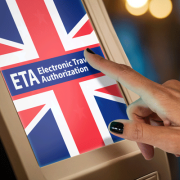
In order for Americans to now travel to the United Kingdom, they will need more than just a passport. As of the end of February, the British government started requiring an electronic travel authorization (ETA) or visa for foreign tourists to enter the UK. 

Embed from Getty Images

Starting on April 23rd, an ETA will also be required to visit the Channel islands of Jersey and Guernsey off the coast of France, and the Isle of Man in the Irish Sea, according to USA Today

“Visitors without an ETA will not be able to board their transport and cannot travel to the UK, unless exempt,” the UK’s interior department posted on its official blog.

“You usually need an ETA rather than a visa if you’re from Europe, the USA, Australia, Canada or certain other countries,” according to the British government.

The ETA can be used for up to six months of visa-free tourism, family visits, and other select activities outlined by the UK government. Each traveler will need their own ETA including babies. 

For foreign tourists hoping to travel to the UK, the fastest way to get an ETA is through the official UK ETA app, however, applications can also be filled out and submitted through the Home Office’s website for anyone who may not have access to the application. 

Applicants using either the app or website will need to upload a photo of their passport and a photo of themselves. They will also need to answer a series of questions and pay an application fee. Applicants who are 10-years-old or over will also need to scan their face. 

Embed from Getty Images

An ETA will cost 20 pounds through the UK ETA app or gov.uk. That’s about $28, according to Western Union’s exchange rates as of this month. 

The British government has also pointed out third-party sites could charge more for applications and also is warning travelers to “avoid websites that imitate government services.” 

The Home Office, UK’s interior department, stated that most applicants will get an automatic decision within minutes of applying through the app. However, if an application is rejected, applicants will be given a direct reason and will also be able to reapply. 

If an application is refused, “they cannot appeal and instead need to apply for a visa if they still wish to seek permission to come to the UK.” 

The government also said that individuals with criminal records may want to apply for a Standard Visitor visa.

ETA’s are valid for two years or until the individual’s passport expires, whichever one comes first. An ETA can be used for multiple visits during that two year period, but the trips must be less than six months. 

British and Irish citizens do not need an ETA. Travelers with a UK visa, permission to live, work, or study in the UK, a British overseas territory citizens passport, or a British national passport will also not need an ETA. 

credit card

Visa and Mastercard Settle 20-Year Swipe-Fee Dispute With Merchants

Visa and Mastercard have reached a revised settlement with U.S. merchants who spent two decades accusing the card giants and their partner banks of inflating fees to process credit card payments. The new agreement comes months after a federal judge dismissed an earlier $30 billion proposal, calling it insufficient.

The latest accord aims to end the long-running antitrust battle that began when merchants claimed the card networks conspired to maintain high “swipe fees,” also known as interchange fees. These fees are paid each time a customer swipes or taps a card.

Under the new proposal, Visa and Mastercard would reduce swipe fees, which typically range from 2% to 2.5% by 0.1 percentage point for a period of five years.

Merchants would also gain the right to choose which types of cards to accept. Categories include commercial cards, standard consumer cards, and premium or rewards cards.

Rates for standard consumer cards would be capped at 1.25% for eight years, a reduction of more than 25%. Businesses would also have expanded options to add surcharges when customers pay with credit cards.

Despite the new concessions, some of the nation’s largest merchant groups argue that the deal still falls short of their expectations.

The National Retail Federation (NRF) and the Merchants Payments Coalition, among others, have voiced strong opposition, insisting the settlement fails to address the very concerns that led U.S. District Judge Margo Brodie in Brooklyn to reject the previous version in June 2024.

The previous $30 billion proposed settlement had promised a modest 0.07 percentage point reduction in fees over five years, along with more leeway for merchants to impose surcharges.

Embed from Getty Images

Judge Brodie dismissed that version as insufficient, saying it would still leave fees above competitive levels and describing the projected $6 billion in annual merchant savings as “paltry.”

She also criticized the plan’s continuation of the controversial “Honor All Cards” rule, which forces merchants to accept every Visa and Mastercard product—or none at all.

Merchants have also long accused the networks of using “anti-steering” rules to prevent them from encouraging customers to choose cheaper payment methods.

Stephanie Martz, general counsel for the NRF, pointed out the unique position of power that card companies hold over businesses.

“You can’t just suddenly tell more than 80% of your card customers you’re not going to take their cards. You would lose a lot of business.”

According to NRF data, swipe fees in the U.S. totaled $111.2 billion in 2024, up from $100.8 billion in 2023, and roughly four times higher than in 2009.

“This is the third attempt to settle this case, and the card industry either just doesn’t get it or just doesn’t care. Once again, this proposal is all window dressing and no substance. The reduction in swipe fees doesn’t begin to go far enough, and the change in the honor-all-cards rule would accomplish nothing. If the courts can’t fix this, it’s time for Congress to take action.”

Although the overall settlement value has not been disclosed, it’s expected to exceed the earlier deal.

In a statement to CNN, Visa, headquartered in San Francisco, said the agreement will ultimately give businesses more agency over their payment structures.

Embed from Getty Images

“After more than 20 years of litigation, Visa and Mastercard have reached a proposed settlement with U.S. merchants of all sizes that would provide meaningful relief, more flexibility and options to control how they accept payments from their customers.”

Mastercard, based in Purchase, New York, echoed the sentiment, noting that “smaller merchants will gain in this settlement – more acceptance choices, reduced costs and simplified rules.”

“Even more, it allows us to focus our energies on continuing to give consumers, small businesses, and larger merchants what they expect from Mastercard – a better payments experience, strong value and peace of mind,” the company told Fox Business.

Neither company admitted wrongdoing as part of the deal. Shares of both card networks rose less than 1% in morning trading.

While retailers remain skeptical, the Electronic Payments Coalition, which represents major card issuers such as Bank of America, Chase, Capital One, and Citibank, is firmly in support of the settlement.

Its executive chairman, Richard Hunt, said the accord would actually reduce swipe fees more effectively than a bipartisan Senate bill proposed by Sen. Richard Durbin (D-Ill.) and Sen. Roger Marshall (R-Kan.), legislation that much of the banking industry opposes.

“You tell me the last time Walmart reduced any of its prices by more than 25%, and kept it for eight years.”

However, Doug Kantor, general counsel for the National Association of Convenience Stores and a member of the Merchants Payments Coalition’s executive committee, argued the deal doesn’t go far enough.

The settlement doesn’t give banks any incentive to lower rates, Kantor said. It lets Visa and Mastercard, “without any limitation,” raise theirs. “Merchants ought to be able to negotiate and get prices set with different banks, but this settlement prohibits that.”

US Immigration Label

House Passes Immigration Bills To Grant Citizenship For Dreamers And Farmworkers

This week the House passed two proposals that would legalize the subsets of around 11 million immigrants who are living in the US without legal permission. The hope is to get the bill to President Biden’s desk as quickly as possible to give immigrants an easier chance at gaining citizenship and remaining in the US safely. 

All House Democrats and nine Republicans voted to approve the American Dream And Promise Act, which passed with a vote of 228 to 197. The proposal would “allow more than 2.3 million Dreamers, or unauthorized immigrants who came to the US as minora, as well as beneficiaries of certain temporary humanitarian programs, to gain permanent legal status and eventually, U.S. citizenship,” according to news sources. 

The House also passed the Farm Workforce Modernization Act with a vote of 247 to 174. This act will grant legal status to the hundreds of thousands of farmworkers in the US who don’t have the proper paperwork but provide some of the most essential services and labor to the entire nation. Thirty Republicans voted in favor of the bill and one Democrat voted against it. 

Embed from Getty Images

Biden has continuously claimed that he plans to legalize most of the country’s undocumented population which has been met with a lot of Republican push-back. The two bills on their own are Democrats best chance at advancing these bills and getting these citizens documented. Nancy Pelosi recently spoke on the two bills:

“It’s always been a pleasure for me to sing praises of our Dreamers. They make us proud, for us, this is a day not only passing legislation, but a cause for celebration.”

If signed into law the American Dream And Promise Act would make all DACA recipients and other undocumented immigrants who were brought into the US before they were 18 eligible to apply for a 10-year period of conditional permanent residency. 

Embed from Getty Images

Applicants would be eligible to apply for permanent residence if they earn a college degree, enroll in a bachelor’s program for two years, serve in the military for two years, or if they work in the US for a three-year period. 

More than 300,000 immigrants currently live in the US with Temporary Protected Status and Deferred Enforced Departure, all of which could be eligible to apply for permanent residency under the bill if they meet all the requirements. 

“The Farm Workforce Modernization Act would allow immigrant farmworkers to apply for a temporary and renewable immigration status if they have worked at least 180 days in the U.S. during a two-year period. Eligible workers would be allowed to request green cards if they complete four or eight years of additional agricultural work, depending on whether they have performed such work for more than or less than 10 years,” according to CBS. 

The proposal would also make visa’s valid for three years. Congressional Democrats proposed to expand legal immigration and invest in Central American border controls as well. Dreamers, TPS holders and farmworkers could automatically be eligible for a green card under the proposal.

Where Can US Citizens Travel Without A Visa?

While international travel is likely the last thing on all of our minds thanks to the Covid-19 pandemic, the rolling out of multiple vaccines and promise of new health and safety procedure enforcement from the president-elects administration gives us the freedom to start fantasizing about what we want to do once this pandemic is truly over. 

Before you take any international flight in a non-pandemic context, there are a few things that you’ll need to consider. One of the biggest is if you’ll need a visa to enter the country you want to go to. While current restrictions exist due to the pandemic, others have always existed when it comes to allowing international travelers in. 

Embed from Getty Images

US citizens with passports typically don’t need a visa to enter most countries around the globe; it’s believed that American citizens have some of the world’s most powerful passports in terms of access. In fact, the Henley and Partners Passport Index ranked the US passport as seventh on its 2020 list of the world’s best passports, as it allows citizens visa-free access to 185 countries; this includes countries that require Electronic Travel Authorization or a visa upon arrival to the country. 

Americans with a passport can travel to a majority of countries in Europe, the Caribbean, and Central/South America. Countries like Russia, India, China, Vietnam, Turkey, and many others require American citizens to have at least an e-visa to visit, regardless of if they have a passport or not. 

Luckily, the Henley and Partners Passport Index provide an easy searching tool for Americans to see where they can travel throughout the world without needing a visa. Users can simply log in and select the country that their passport is from (in this case the US) and the Index will provide you with a list of countries that you are able to visit. 

Embed from Getty Images

The US Department of State Travel also provides an easy-to-use tool on their site that allows users to simply search a country by name to see the visa requirements they would need to visit. Even countries that allow Americans to travel there without a visa have restrictions on the length of time one is allowed to stay.

You can use both of the websites above to receive information about specific countries and their restrictions on things like length of stay, visa requirements, and cost for those visa requirements. More times than not getting a visa to visit a foreign country can be a lengthy and expensive process, so individuals tend to do it months in advance of their trip. 

The future of these requirements will also likely depend on how every country recovers from the Covid-19 pandemic. Currently there are a multitude of countries that prohibit American tourists from visiting due to the severity of the pandemic in this country. Click here for a list of countries that are currently allowing American travelers to visit, and in the meantime start planning for a Covid-free future.