Posts

volcano

Icelandic Volcano Erupts For Seventh Time In One Year

This week, a volcano located near Iceland’s capital erupted for the seventh time in a one-year span, according to the nation’s meteorological office. 

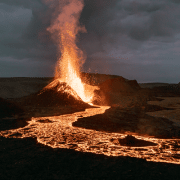
The eruption began sporadically at 11:14 p.m. Wednesday and created a fissure about two miles long, spewing lava and smoke, according to reports from NBC News. The activity is shown to be considerably smaller than the last eruption that took place in August. 

Embed from Getty Images

Iceland’s meteorological office that monitors seismic activity stated that the first signs of an eruption were recorded about 45 minutes before a massive ground fissure opened up with magma coming through the earth’s crust. 

The office also said that authorities did previously warn of volcanic activity with magma accumulating 20 miles southwest of the capital Reykjavik beneath the Reykjavik peninsula. The same location just experienced an eruption that ended on September 6th.

“In the big picture, this is a bit smaller than the last eruption, and the eruption that occurred in May,” said Magnús Tumi Guðmundsson, a professor of geophysics, who traveled to the site of the eruption along with the Civil Protection agency.  

These specific outbreaks on the peninsula are called fissure eruptions, and they haven’t directly impacted the city or caused any traffic disruptions. 

Embed from Getty Images

Flights through Reykjavik’s Keflavik Airport were also unaffected and no crucial infrastructure is in danger, however, luxury spa Blue Lagoon had to shut down and evacuate their guests due to their proximity to the eruption, according to RUV.

Grindavík, a fishing town, is typically the home to about 4,000 residents, however, it’s remained mostly deserted since December of last year due to consistent eruption threats. 

“There was no indication that lava was flowing towards the town, but some 50 houses occupied by people who have returned were evacuated,” the civil protection agency said in a statement according to NBC

“Grindavík is not in danger as it looks and it is unlikely that this crack will get any longer, although nothing can be ruled out,” Magnús Tumi said.

Experts in the area have now warned that Reykjanes will likely experience repeated volcanic eruptions for decades to come.

search

Eastern Indonesia Experiences Major Volcanic Eruption, Destroying Homes And Causing Thousands To Flee 

Indonesia’s National Disaster Management Agency reported this Monday that at least six people have passed away after a series of intense volcanic eruptions occurred on the remote island of Flores in eastern Indonesia. 

Mount Lewotobi Laki erupted just after midnight on Monday, releasing thick ash clouds up to 6,500 feet into the air. The hot ashes quickly reached a nearby village causing multiple properties to burn down, including homes, and a convent for Catholic nuns, according to Firman Yosef, an official at the Mount Lewotobi Laki Laki monitoring post. 

Embed from Getty Images

The Disaster Management Agency hasn’t fully confirmed the amount of people who have died as they’re consistently receiving updated information from local authorities. 

Authorities have also been raising the danger level and extending the danger zone for Mount Lewotobi Laki Laki today. The mountain experienced a series of other eruptions that began last week. 

Indonesia’s volcano monitoring agency has increased their volcano alert status to the highest level possible and has vastly increased their exclusion zones to a 4.3 mile radius after the eruptions early Monday morning became more frequent. 

The agency also stated that at least 10,000 people have been impacted by the eruption, which took place in the Wulanggitang District, including the six nearby villages of Pululera, Nawokote, Hokeng Jaya, Klatanlo, Boru, and Boru Kedang. 

Embed from Getty Images

The Dulipali Village, Nobo, Nurabelen, and Riang Rita were the villages impacted in the Ile Bura District. In the Titehena District, the Konga Village, Kobasoma, Bokang Wolomatang, and Warowara were affected. 

Yosef stated that volcanic material erupted 3.7 miles above its crater, which forced thousands of residents to flee as the ashes and volcanic debris covered nearby villages and towns. 

“A nun in Hokeng village died and another was missing,” said Agusta Palma, the head of the Saint Gabriel Foundation.

“Our nuns ran out in panic under a rain of volcanic ash in the darkness,” Palma said.

Updates are set to continue to roll out as the damage is further assessed. One of the biggest priorities is search and rescue for any missing residents and impacted people who had to quickly leave their homes. 

Spanish Volcano Falls Silent After Months Of Eruption, Leaving Scientists Wary

For the first time in months, the Cumbre Vieja volcano has stopped spewing lava – although scientists are still concerned that the silence doesn’t mean the eruption is over.

Cumbre Vieja, located in Spain’s La Palma Island — part of the Canary Islands — started erupting back on Sept. 19, sending the lives of thousands spiraling. The volcano’s awakening now holds the record for La Palma’s longest eruption, having been active for 88 days.

Embed from Getty Images

Experts have not detected any seismic activity since Monday night. However, according to Involcan, Canary Islands’ Volcanology Institute, it “does not imply a terminator of the eruption, as its cessation has sometimes been followed by a further increase in activity.” Involcan did note this has been the longest tremor-free interval since the eruption began.

There’s no doubt the experts have a right to be cautious – after several days of low activities, the volcano once again sprung to life on Sunday. Authorities noted the eruption also triggered more than two dozen earthquakes from Saturday into Sunday, though none of which were felt by residents.

Talking to Spanish public broadcaster RTVE, state official Mariano Hernández called the situation stable, but admitted that scientists have not given an estimate as to when the unpredictable eruption will finally come to a close. Hernández added that experts continue to monitor the number and magnitudes of the earthquakes.

On Monday, Spain ordered 30,000 people on La Palma — which has a total population of over 84,000 — to remain indoors due to the toxic gases and ash emitted from the eruption. Authorities advised the residents to close their doors, windows, and shutters in order to prevent air from coming in, as well as to turn off their air conditioning and heating.

Embed from Getty Images

According to CBS News, more than 7,000 have been evacuated since the volcano first erupted. Although there have been no related injuries or deaths and the majority of the Island has been unaffected, more than 3,000 buildings were destroyed throughout the process.

The streams of lava and ash have covered 1,220 hectares — or 3014 acres — of land, which much of that area being farmlands. Deltas around 50 hectares — 123 acres — have also formed on the La Palma coast as a result. Deltas are viewed as hazards, as they are unstable and prone to collapse or explosions.

Despite the dangerousness of the situation, that didn’t stop tourists from flocking to see the eruptions with their own eyes – even having a drink while they watch. That lack of care has clearly stuck with those affected, as La Palma Island resident Estefania Martin showed while speaking with NPR.

“People who visit cannot imagine the worry, the sadness, the uncertainty about where you’ll be tomorrow and what to do with your life, and that you might have even lost your job.”

The volcano has only erupted three times since 1900. The first came in 1949, and lasted for 37 days. The second eruption occured in 1971, which lasted 24 days. Both instances, as well as the current eruption, hold a VEI (volcanic explosivity index) of two. That number classifies them as being between “small” and “medium.”

Asteroids kill dinosaurs

New Study Says an Asteroid, Not Volcanic Activity, Killed the Dinosaurs

For decades, scientists have argued about what caused the global mass extinction event that killed the dinosaurs. While there is general consensus that climate change is to blame, scientists disagree over what event occurred that triggered a rapid transformation of the planet’s weather systems. Though some believe that the environmental impact was caused by massive volcanic eruptions in India, most scientists think that an asteroid impact is to blame. Now, a new research paper published in Science is hoped to end the debate, as the researchers found that the volcanic eruptions occurred too far before the extinction event that took place 66 million years ago to have been its cause.

With this research, the scientists are hoping to put to rest the theory that K-Pg, which is the scientific notation for the Cretaceous-Paleogene extinction event, was caused by volcanic activity. According to Yale assistant professor of geology & geophysics Pincelli Hull, who helped author the research paper, “a lot of people have speculated that volcanoes mattered to K-Pg, and we’re saying, ‘No, they didn’t.’” 


Embed from Getty Images

According to Hill, “volcanic activity in the late Cretaceous caused a gradual global warming event of about two degrees, but not mass extinction.” In other words, although climate change caused by volcanic activity had an impact on the global ecosystem, it was not rapid or dramatic enough of a warming event to cause the extinction of 75% of life on Earth, as is observed in K-Pg. The study also offers an answer to a question that has for years remained a mystery, which is why massive eruptions that took place in India in the immediate aftermath of the extinction event did not cause a corresponding warming event. According to this study, the ocean absorbed an enormous amount of CO2 in the aftermath of the asteroid impact, which may have hid the warming effect of the volcanic activity.

The asteroid impact which is now widely believed to have been the cause of K-Pg was first discovered in 1990, after samples from the Chicxulub crater in Mexico were analyzed by scientists who determined that the crater was caused by an asteroid impact that took place around 66 million years ago, at precisely the same time as the extinction event. Since the discovery of the crater, further research has produced evidence that this in fact was the impact site of the asteroid that killed the dinosaurs. In 2016, for instance, a drilling project drilled into the impact crater, obtaining rock core samples that seemed to confirm the theory, as materials extracted from the impact site match the geological record across the world that was formed in the wake of the asteroid impact.