Posts

Can Ozempic Treat Alcohol Use Disorder? Early Research Says Yes

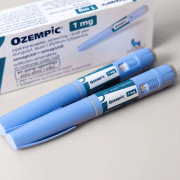
For years, individuals using Ozempic and similar medications aimed at managing diabetes and shedding pounds have observed side benefits. These drugs not only diminish their appetite but, for some, also seem to reduce their desire to drink alcohol. Now, a new study confirms that drugs that target the hormone GLP-1 may help in the treatment of alcohol use disorder.

drinks

Alcohol Consumption In The US Has Been On The Rise Since The Covid-19 Pandemic 

According to Dr. Brian Lee, a transplant hepatologist at Keck Medicine of the University of Southern California, an increase in stress-related drinking and alcohol-related deaths brought on by the Covid-19 pandemic in the US has continued to rise. 

“I was hopeful that we would see declines in alcohol use, but I’m a practicing liver specialist, and the reality is, we have definitely seen a rise in patients with liver failure, which is really an extreme, I think, clinical condition from excessive alcohol use,” Lee said

“So we had definitely seen a surge with the pandemic. And if you look at my clinic and in the hospital, at least from my experience, it hasn’t gone down.”

Embed from Getty Images

Lee led new research that was published this month in the Annals of Internal Medicine which found that an increase in alcohol consumption among people in the US in 2020 continued to rise in 2021 and 2022. 

The study utilized data from the National Health Interview Survey which compared recent data to 2018 as a baseline. “The study included almost 25,000 respondents from 2018, about 31,000 from 2020 and almost 27,000 from 2022,” according to CNN

There was an increase in drinking among men and women across all race and ethnic groups. The data revealed in 2022, 69.3% of Americans reported some level of alcohol consumption in the previous year, a .3% increase from 2020. 

“While the findings are troubling, they are not surprising,” said Dr. Jagpreet Chhatwal, director of the Institute for Technology Assessment at Massachusetts General Hospital.

“Alcohol consumption has been steadily increasing over the past several years.”

“It doesn’t take much alcohol to increase health dangers. If you’re drinking more than one drink per day as a woman, you can be at risk for having liver disease,” Lee stated. 

The National Institute on Alcohol Abuse and Alcoholism defines heavy drinking for women as four or more drinks per day or eight or more per week. For men it’s five or more drinks per day or 15 or more per week. 

Lee stated that the increase during the pandemic was likely caused by a few factors. 

“They had really disruptive pandemic-related effects to their careers, losing jobs or losing their routine. Some of them have young children, too. We know that alcohol is used as a coping mechanism for stress. What starts as a habit can become addictive or a substance disorder,”  he said.

Embed from Getty Images

“Increasing stress and burnout in society exacerbate this tendency,” Chhatwal stated. 

“The normalization of drinking culture also contributes to increased and excessive consumption. Unfortunately, most people recognize the damage caused by alcohol only in the later stages of liver disease, when treatment options are limited.”

In 2020, there were over 49,000 alcohol-related deaths in the US.

“We’ve shown in studies that liver transplants for alcohol have increased fivefold in the last 20 years. We’ve also shown that alcohol deaths due to liver disease are surging,” Lee said. 

“Now, it’s about intervention. What interventions could actually work to save lives and what policies can we enact to stem the surge?”

“People need to know what is harmful alcohol use and what it does to your body,” Lee said. 

“Medical professionals really need to speak to their patients about alcohol use openly and nonjudgmentally. Alcohol has been implicated in more than 200 diseases, whether it’s heart disease, cancer, pancreatic disease – it really can affect your body, and both patients and doctors really need to be aware of this.”

Alcohol

Americans Are Drinking More Today Than During Prohibition

With many of us struggling to get to the end of one of the many health kicks that appear in January, we may be starting to wonder whether what we are doing is really necessary. Alongside Veganuary there is also Dry January, a movement that has seen many around the world opt to abstain from alcohol for 31 days in an attempt to get healthier.

But do we as a nation have an issue with alcohol? The answer apparently is yes. It has recently been announced that Americans are consuming more alcohol than during Prohibition, and with the trend for drinking increasing steadily over the last twenty years, is there really an option for the trend to stop?

Federal health statistics has shown an increase in per-capita alcohol consumption, and has seen a shocking increase in the number of hospitalizations, emergency room visits, and even deaths that are linked to drinking.

However, there has been some good news. Teenagers are drinking less than before, a sign that they may be witnessing the destruction that alcohol can cause. The influence of social media has also been cited as a reason for the decline. However, public health experts are still concerned over the drinking problem that is on-going.

Dr Tim Naimi, an alcohol researcher at Boston University confirmed that “consumption has been going up. Harms [from alcohol] have been going up. And there’s not been a policy response to match it.”

Before Prohibition was implemented in 1920, the average American adult – and teenager – was drinking around two gallons of alcohol each year. However nowadays the figure is nearer 2.3 gallons, equating to around 500 drinks – or nine drinks a week.

Embed from Getty Images

However historians have confirmed that America’s biggest drinking problem was during the early 1800’s with 1830 reaching a peak of nearly seven gallons of alcohol being consumed by the average American.

With such a large alcohol problem the temperance movement campaigned for moderation on alcohol, followed by abstinence and eventually called for the national ban, which was passed in 1919. Prohibition commenced on January 17th 1920 and continued for a further 13 years until it was ended under President Franklin D. Roosevelt’s administration.

Prohibition clearly had an affect on the nation’s drinking habits as following the lifting of the ban the per-capita alcohol consumption was at nearly one gallon, however, the figures have fluctuated ever since. The 1970’s and 1980’s saw an increase to 2.75 gallons, although some have blamed this increase on the recession that was affecting the majority of the developed world at the time.

The mid-1980’s saw attention being focused on the increase in deaths due to drink driving and Congress increased the drinking age from 18 to 21, leading to a fall in alcohol consumption, however it increased again around the mid-1990’s.

William Kerr, senior scientist at Public Health Institute’s Alcohol Research Group commented, “I think people sort of forgot all the problems with alcohol.”

As well as the damage to the bank balance, excessive drinking has many significant health problems including high blood pressure, stroke, liver damage, liver cancer and heart disease. Alcohol is discouraged during pregnancy as it could lead to birth defects, stillbirth or miscarriage. It has also been confirmed that alcohol is responsible for around 30-35% of injuries within the elderly generation.

Embed from Getty Images

Alcohol can also be a danger to those around us,  as fighting is way more likely to occur due to a higher level of alcohol in our systems. Domestic violence can also be alcohol fueled and of course, there can be damaging results from drink driving.

The Centers for Disease Control and Prevention have confirmed that over 88,000 Americans die annually due to excessive drinking, a figure that is higher than those who have died during the recent opioid drug epidemic.

With the number of deaths relating to alcohol issues doubling since 1999 it has been suggested that there are links with the growing overdose epidemic as many drug users drink alcohol at the same time.

Although nearly 75% of those that had alcohol related deaths were male, there has been a significant increase in the amount of alcohol women are now drinking, a fact that has been put down to the increase in binge drinking, where you consume around four or five drinks within two hours.

Aaron White, lead researcher on a recent study by the National Institute on Alcohol Abuse and Alcoholism, confirmed that the study – which saw researchers scan death certificates from the last two years looking for those mentioning alcohol problems -had seen the amount of women dying from drinking related causes had increased by 85%. Although the highest age range were those between 55 and 74 it also discovered the number of younger women dying was increasing.

There has also been a change in our attitude towards drinking with many memes ‘promoting’ wine as ‘mommy juice’. And of course, we have all heard of ‘wine o’clock’.

Alcohol

Light Alcohol Consumption Linked with Higher Cancer Risk

It’s previously been reported that no amount of alcohol consumption is good for your health, though the negative effects of light consumption are less severe than the effects of heavy consumption. However, a new study conducted in Japan has concluded that light to moderate alcohol consumption is also linked with elevated cancer risk. The study, which was published in CANCER, a peer-reviewed journal of the American Cancer Society, found that one’s overall risk of cancer was lowest when they did not consume any alcohol at all.

The recent student contradicts previous research on the subject, which has linked limited alcohol consumption with lower risks of some types of cancer. The new study, however, is much broader in scope than previous research that has been conducted on the topic, as it examines information from 33 Japanese general hospitals, totalling 126,464 patients, half of which belong to a control group and half of which were patients with cancer. The collected data spanned over a decade, from 2005-2016, and was controlled for sex, age, hospital admission date, and admitting hospital.

Embed from Getty Images

The research is based in large part on patients’ self-reported amounts of daily alcohol consumption, using the measurement of standardized alcohol units. For example, one standardized alcohol unit is equivalent to one cup of Japanese sake, one 17-ounce bottle of beer, one 6-ounce glass of wine, or one 2-ounce cup of whiskey.

The correlation between alcohol consumption and cancer risk was almost linear, meaning that one’s risk of developing cancer increases at the same rate that one consumes alcohol. The cancer risk was lowest at no alcohol consumption, and one drink per day for ten years increased patients’ cancer risk by five percent. This finding held true regardless of a person’s sex, drinking and smoking behaviors, and social class. The most common areas in which cancer develops relating to alcohol consumption include the colorectum, stomach, breast, prostate, and esophagus.

Embed from Getty Images

In Japan, as well as in many places around the world, the primary cause of death is cancer. While this study is limited to patients in Japanese hospitals, it is likely that the findings apply to other populations as well. Hopefully, this study will help to dispel ongoing myths that a small amount of alcohol consumption has a neutral or even positive effect on one’s health, as cancer is a debilitating and terrible disease. Cancer is not the only health risk associated with alcohol consumption; excessive use of alcohol has also been linked to high blood pressure, mental health issues that affect both one’s mood and cognition, and addiction. 

While binge drinking or other forms of excessive alcohol consumption pose much more substantial health risks than more responsible forms of drinking, many still believe that having a glass of wine with dinner several times a week, for instance, is good for one’s health. As the science surrounding the health effects of alcohol consumption continues to evolve, it becomes increasingly clear that this widespread belief is not based in fact.

Man with Alcohol

Ketamine Studied as Treatment for Alcoholism

Ketamine is a powerful drug with a number of medical applications. While it is sometimes taken recreationally for its sedative and hallucinatory properties, it has also been used as a surgical anesthetic, particularly during the Vietnam War. It can also provide pain relief, and is even being used in the treatment of severe depression. Now, recent research shows that the drug may also be useful for treating alcohol addiction by disrupting positive memories associated with drinking in patients.

Drug addiction is a serious illness, and while alcohol is a legal drug, the effects of alcoholism are devastating, causing psychological and physical problems and leading in some cases to death. Alcohol is also a notoriously difficult drug to quit, as the drug causes physical dependency as well as withdrawal symptoms upon cessation. As such, there exists significant interest in exploring pharmacological aids that can help with alcoholism, and ketamine has emerged as an unlikely candidate.

Embed from Getty Images

The theory for how ketamine can help with alcoholism has to do with the role memory plays in perpetuating addiction. One of the most difficult things for people who are looking to free themselves from drug addiction to navigate is the numerous positive memories they have built up in association with the drug over time, and how these memories inform their decision making. Ketamine is well-known for causing memory loss, and this is the effect that doctors hope will soon be widespread in treating alcoholism.

The research in question involved the use of anesthetic ketamine to deliberately dismantle positive associations people had with alcohol. In the study, heavy drinkers who used ketamine under the direction of the researchers “reduced their alcohol consumption for at least 9 months,” a promising development for the long-term treatment of alcoholism. While ketamine is not a drug that is fully understood, scientists have determined that the drug blocks NMDA receptors in the brain, which are instrumental in allowing the brain to form and restabilize memories.

Embed from Getty Images

In the study, the treatment was targeted to only disrupt positive memories associated with alcohol use. Volunteers were initially presented with images of alcoholic beverages and then prompted to drink a beer. On their next visit, these volunteers were shown the images again, but instead of drinking alcohol received a high dose of intravenous ketamine. The researchers wanted to surprise the volunteers in order to allow the brain to re-write some of the memories associated with alcohol, using ketamine to break the brain’s association between alcohol and rewarding feelings. This group of volunteers was tested against a control group, who received a placebo instead of ketamine, and a third group who were shown pictures of orange juice instead of beer.

After ten days, the group who were shown images of beer and then given ketamine reported a significant decrease in their urge to drink a beer, while the other two groups showed little change. In the following days and months, all three groups reduced their drinking, but the first group showed the most significant reduction in alcohol consumption. After nine months, they had cut their weekly beer intake approximately in half, while the control groups saw a reduction of 35%.

While the results are impressive, the subject needs more research to determine whether the effects can be replicated and exactly how ketamine works in the brain to change memories. The study did not involve brain imaging data, and as such, scientists don’t know exactly what happened to the volunteers’ memories. Also, as ketamine is not completely understood, it’s not clear if there are other effects of the drug that affect alcohol consumption. However, given these promising early results and the relatively good safety record of ketamine use, this recent study provides a good foundation for further research.