Posts

rover

Curiosity Rover Uncovers Ancient Carbon on Mars, Hinting at Lost Habitability

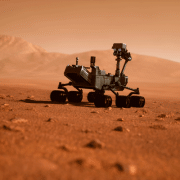
NASA’s Curiosity rover uncovered significant new data while ascending the rugged terrain of Mount Sharp within Mars’ vast Gale Crater, where it detected extensive carbon-rich deposits inside carbonate minerals. The discovery carries profound implications, suggesting the Red Planet may have once been capable of supporting life.

Carbonate minerals, which form when carbon dioxide interacts with water and rocks, serve as critical markers of historical environmental conditions. Scientists had already documented sparse carbonate occurrences on Mars through various exploration methods, including satellite observations, rover analyses, and meteorites originating from the planet that had tumbled toward Earth. Yet, Curiosity’s newest discoveries offer newfound clarity about these deposits.

The findings were published this week in the journal Science. “It tells us that the planet was habitable and that the models for habitability are correct,” Dr. Ben Tutolo, lead author and associate professor at the University of Calgary’s Department of Earth, Energy, and Environment, said in a statement. Tutolo is a participating scientist on the NASA Mars Science Laboratory Curiosity Rover team.

“The discovery of large carbon deposits in Gale Crater represents both a surprising and important breakthrough in our understanding of the geologic and atmospheric evolution of Mars. The abundance of highly soluble salts in these rocks and similar deposits mapped over much of Mars has been used as evidence of the ‘great drying’ of Mars during its dramatic shift from a warm and wet early Mars to its current cold and dry state.”

Embed from Getty Images

The carbonate minerals identified appear to have crystallized in environments characterized by extreme aridity, emerging from reactions between scarce Martian water and surface rocks followed by significant evaporation. These conditions suggest that Mars once boasted a thicker, warmer atmosphere abundant in carbon dioxide, sufficient to maintain liquid water on its surface. However, as Mars gradually lost its atmospheric density, gaseous carbon dioxide became permanently locked into rock formations.

One mineral, siderite, stands out due to its surprisingly high concentration, constituting approximately five to ten percent of the discovered deposits in three drill sites. The rover also detected iron oxyhydroxides within these carbonate deposits alongside soluble salts.

These minerals also suggest Mars once possessed a dynamic carbon cycle similar to Earth’s, in which carbon trapped in rocks could eventually return to the atmosphere, influencing the planet’s climate.

“The question looking forward is how much of this CO2 from the atmosphere was actually sequestered? Was that potentially a reason we began to lose habitability?”

Tutolo emphasized the significant impact of this discovery on our understanding of how the planet’s atmosphere changed over time. “Studying the collapse of Mars’ warm and wet early days also tells us that habitability is a very fragile thing,” Tutolo said.

Embed from Getty Images

“The broader implications are the planet was habitable up until this time, but then, as the [carbon dioxide] that had been warming the planet started to precipitate as siderite, it likely impacted Mars’ ability to stay warm.”

Curiosity’s findings intersect compellingly with ongoing climate initiatives. Tutolo is actively researching ways to mitigate climate change by converting industrial carbon dioxide emissions into stable, solid carbonate minerals, a method analogous to what likely occurred naturally on Mars.

“What we’re trying to do on Earth to fight climate change is something that nature may have already done on Mars. Learning about the mechanisms of making these minerals on Mars helps us to better understand how we can do it here.”

This new data highlights the delicate and fleeting aspects of planetary habitability, offering essential insights for our comprehension of the environmental futures of both Mars and Earth.

NASA has indicated that upcoming missions and further examination of additional sulfate-rich regions on Mars may validate these findings, contributing to a deeper understanding of the planet’s early history and the transformations it underwent as its atmosphere dissipated.

“The most remarkable thing about Earth is that it’s habitable, and it has been for at least four billion years. Something happened to Mars that didn’t happen to Earth.”

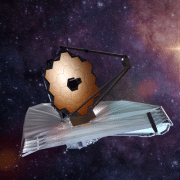
Webb Telescope

Webb Telescope Detects Potential Signs of Life on Distant Exoplanet

Scientists utilizing NASA’s James Webb Space Telescope (JWST) have captured what they describe as compelling indicators of potential life on an exoplanet beyond our solar system. The telescope detected gases in the atmosphere of exoplanet K2-18b that, on Earth, can only be produced by living organisms.

Specifically, the gases identified, dimethyl sulfide (DMS) and dimethyl disulfide (DMDS, are predominantly produced by marine phytoplankton, a form of algae. Although the findings are promising, scientists emphasize caution, highlighting that these gases represent potential biosignatures rather than direct evidence of extraterrestrial life.

“These are the first hints of a world that is possibly inhabited,” explained astrophysicist Nikku Madhusudhan from the University of Cambridge’s Institute of Astronomy at a press briefing on April 15. Madhusudhan was the lead author of the study, which was published in The Astrophysical Journal Letters.

“This is a transformational moment in the search for life beyond the solar system, where we have demonstrated that it is possible to detect biosignatures in potentially habitable planets with current facilities. We have entered the era of observational astrobiology.”

K2-18b is a sizable planet, approximately 8.6 times Earth’s mass and has a diameter about 2.6 times as large as our planet. It orbits its host star, a red dwarf smaller and cooler than our sun, in the “habitable zone,” where liquid water could potentially exist—a critical factor for life as we understand it.

Situated about 124 light-years away in the constellation Leo, K2-18b falls into a category scientists refer to as “Hycean” worlds, planets hypothesized to possess vast oceans conducive to microbial organisms beneath hydrogen-rich atmospheres.

Embed from Getty Images

Prior studies using Webb had already revealed the presence of methane and carbon dioxide in K2-18b’s atmosphere, marking the first identification of carbon-based molecules on an exoplanet within a habitable zone. “This is an independent line of evidence, using a different instrument than we did before and a different wavelength range of light, where there is no overlap with the previous observations,” Madhusudhan said. “The signal came through strong and clear.”

“The only scenario that currently explains all the data obtained so far from JWST, including the past and present observations, is one where K2-18b is a Hycean world teeming with life. However, we need to be open and continue exploring other scenarios.”

Madhusudhan clarified that while these environments suggest simple microorganisms, they do not yet indicate the existence of more complex or intelligent life forms.

Still, he described the findings as “potentially one of the biggest landmarks in the history of science,” stating, “I know this sounds grand, and it’s not my intention to make it sound grand, but there’s no other way to put it.”

DMS and DMDS were detected at atmospheric concentrations exceeding 10 parts per million by volume, much higher than those found naturally on Earth.

“For reference, this is thousands of times higher than their concentrations in the Earth’s atmosphere and cannot be explained without biological activity based on existing knowledge.”

However, the scientific community remains skeptical. Christopher Glein, principal scientist at the Southwest Research Institute’s Space Science Division in Texas, underscored the necessity of cautious optimism.

“The rich data from K2-18b make it a tantalizing world. These latest data are a valuable contribution to our understanding. Yet, we must be very careful to test the data as thoroughly as possible. I look forward to seeing additional, independent work on the data analysis starting as soon as next week.”

Embed from Getty Images

Astronomers determine the composition of exoplanet atmospheres using the transit method, analyzing starlight filtering through planetary atmospheres as the planet passes in front of its star. This technique allowed Webb to confirm the gases’ presence with a 99.7% confidence level, still leaving a slight possibility of 0.3% that the findings are a statistical anomaly.

Addressing the ultimate goal of exoplanet research, Madhusudhan deems discovering life on an Earth-like planet beyond our solar system as the “Holy Grail” of astronomy, noting humanity’s long-standing quest to answer whether we are alone in the universe.

“When you are seeing something like this, it’s like—this is a question humanity has been asking for thousands of years, and if you’re witnessing it for the first time, it is a shock to the system. And it takes a while to recover from that, from the enormity of it.”

Nevertheless, he emphasized the importance of rigorous validation, calling for repeated observations and further studies to rule out non-biological origins of these gases.

“First, we need to repeat the observations two to three times to make sure the signal we are seeing is robust and to increase the detection significance” to the level at which the odds of a statistical fluke are below roughly one in a million, Madhusudhan said.

“Additionally, further research is required to verify “whether or not there is another abiotic mechanism to make DMS or DMDS in a planetary atmosphere like that of K2-18b. Even though previous studies have suggested them [as] robust biosignatures even for K2-18b, we need to remain open and pursue other possibilities.”

For now, the discovery remains cautiously promising, marking an unprecedented step forward in our search for life among the stars.

Enceladus Planet

Enceladus, One Of Saturn’s Moons, Shows Evidence Of Life

Saturn’s moon Enceladus is making headlines for scientists this week as NASA has discovered one of its oceans may contain the basic building blocks of life. 

NASA analyzed data regarding the water that shoots out of ocean vents from below the moons icy crust. The ocean is under the crust, but the vents are able to shoot out water through cracks in the moon’s surface, and into space. To break down the findings, scientists found both nitrogen and oxygen in the water from the ocean that’s shot out into space. Nitrogen and Oxygen when together can be used as building blocks for amino acids. Amino Acids are complex molecules that connect like Lego’s to make proteins. As we know, without protein, life cannot exist, we all need proteins, carbohydrates and fats to stay alive, all of which we normally get through our diet. 

While the scientists only found the compounds that are used to build the actual building blocks of life, the discovery is still hugely significant. Scientists have long suspected that Enceladus would contain some sort of life creating compounds, and have even found organic molecules on the moon before, however, this time they discovered them in the water under the moon’s surface, which is a game changer. The presence of nitrogen and oxygen in the deep parts of Enceladus’s ocean means that the two could undergo a chemical reaction in the water which would turn them into amino acids, and thus, proteins. 

Embed from Getty Images

Saturn with six of its moons

“This work shows that Enceladus’ ocean has reactive building blocks in abundance, and it’s another green light in the investigation of the habitability of Enceladus,” Frank Postberg, a co-author of the study at NASA, said in a press release

According to the press release, these compounds were dissolved in the ocean water below the crust’s surface and evaporated as they reached the surface. Since the moon is extremely cold, the compounds froze into the icy crust, the only thing that made them detectable to scientists were the ocean vents that sent plumes of the ocean water out through the cracks in the surface. This evidence shows that Enceladus could potentially develop the same life creating process that occurs here on Earth. 

Embed from Getty Images

Surface level image of an underwater volcano erupting 

In Earth’s oceans, underwater volcanoes under the ocean floors produce magma that is shot out in the same way the plumes of water are on Saturn’s moon. However for Earth, the magma then breaks through the ocean floor through cracks in the surface and it then mixes with the surrounding seawater. According to the National Oceanic and Atmospheric Association (NOAA), this interaction of magma and seawater creates something known as a hydro-thermal vent. These vents spew water that is now rich in hydrogen which induces a chemical reaction that turns organic compounds into amino acids which then work together to build proteins that are “crucial for replicating the genetic information that creates life,” according to the NOAA.

“If the conditions are right, these molecules coming from the deep ocean of Enceladus could be on the same reaction pathway as we see here on Earth. We don’t yet know if amino acids are needed for life beyond Earth, but finding the molecules that form amino acids is an important piece of the puzzle,” said Nozair Khawaja, who led the research team behind the latest discovery, said in a release.

This discovery has inspired NASA scientists to develop even more missions that will further investigate Enceladus and the chemical properties and processes the moon endures to see if the creation of life is actually possible. Additionally, NASA is now planning another mission to Titan, another one of Saturn’s moons, which is known for containing a lot of organic compounds as well. The mission plans to launch a spacecraft to the moon in 2026 and have it arrive on Titan by 2034, and the search for signs of alien life will continue.