Posts

shein

Shein’s Paris Launch Sparks Outrage Over Fast Fashion and ‘Childlike’ Sex Dolls

In the global capital of fashion, the arrival of the Chinese ultra-fast fashion giant Shein has sparked a storm. The brand plans to open its first-ever permanent store on Wednesday inside BHV, one of the best-known department stores in Paris. But instead of applause, Shein’s debut has been met with outrage, not only for its reputation for cheap, disposable clothing, but also for a shocking scandal involving the sale of “childlike” sex dolls.

The backlash has been going on for weeks. On Tuesday, Paris Deputy Mayor Nicolas Bonnet-Oulaldj stated that “The city of Paris reaffirms that Shein is contrary to its values.”

“We ask the Minister of the Economy to go further than just making threats and to ban the Shein platform in France.”

The controversy has divided France’s retail scene. Both Galeries Lafayette and BHV belong to the Société des Grands Magasins (SGM) group, but Lafayette issued a rare public rebuke in late October, condemning the decision to host Shein, calling the brand “in contradiction with their offer and their values.”

In response, SGM reportedly ordered five Galeries Lafayette locations to rebrand as BHV, a move seen as a major blow to Lafayette’s legacy.

“Our capital cannot become the showcase for disposable goods and exploitation,” said Ian Brossat, a Paris senator from the French Communist Party, in a statement on X.

Embed from Getty Images

Facing intense scrutiny, SGM President Frédéric Merlin defended his decision on RTL radio on Tuesday, citing Shein’s immense popularity.

“We’re speaking of a brand that is regularly bought by 25 million French customers, who are today considered bad people because they buy from this platform?”

But for many in France, Shein’s image sits uneasily alongside Paris’ heritage of haute couture, where craftsmanship, exclusivity, and sustainability are prized. Critics say Shein embodies everything Paris has fought to move beyond—waste, mass production, and environmental neglect.

The irony isn’t lost on observers: Shein landing in the same city that hosted the 2016 Paris Climate Agreement feels almost symbolic of fashion’s ongoing contradictions.

Shein, often described as the face of fast fashion’s excesses, has been accused of ignoring sustainable manufacturing and contributing to massive global shipping emissions. The company insists its “on-demand” production model limits overproduction and waste, a claim skeptics call greenwashing.

Paris, meanwhile, has been working to position itself as a sustainability leader by investing in cycling infrastructure, promoting low-carbon businesses, and making environmental responsibility a central focus of the 2024 Paris Olympics.

The fallout has been swift. At least a dozen French brands, including Armor Lux and Figaret, have announced plans to pull their products from BHV in protest. Even Disneyland Paris reportedly scrapped its plans to design BHV’s iconic Christmas window displays this year.

BHV’s director, Karl-Stéphane Cottendin, appeared unfazed while speaking to BFMTV, and brushed off the departures as insignificant among the “more than 2,000 brands” sold at BHV. “Everyone is free to make their own decisions. We have no problem at all with that,” he said.

If Shein’s debut wasn’t controversial enough, a giant poster of Merlin standing beside Shein executive Donald Tang appeared on the BHV façade last week, captioned, “The poster that we shouldn’t have made?”

Embed from Getty Images

The banner’s placement directly across from Paris City Hall, one of Shein’s loudest critics, made the provocation even clearer.

Shein’s Paris launch was nearly derailed days earlier by revelations that the company’s site sold “childlike” sex dolls. France’s finance minister threatened to ban Shein altogether, while the Children’s Commissioner, Sarah El-Haïry, condemned the products, calling buyers “potential predators.”

“No one has the right to buy pedo-criminal dolls. These are deliberate miniature copies of children that hold teddy bears, that wear children’s clothing.”

Prosecutors have opened investigations into Shein, Temu, AliExpress, and Wish for allegedly distributing “violent, pornographic, or degrading content accessible to minors,” and further probes into Shein and AliExpress for spreading “images or depictions of minors of a pornographic nature.”

Shein told CNN that it had banned all sex doll listings and strengthened internal controls, emphasizing that “every seller is responsible for their own listings.” Speaking to the BBC, Shein stated it “has also strengthened its keyword blacklist to further prevent attempted circumvention of product listing restrictions by sellers.” Tang further emphasized that the allegations were being taken seriously.

“The fight against child exploitation is non-negotiable for Shein. These were marketplace listings from third-party sellers, but I take this personally. We are tracing the source and will take swift, decisive action against those responsible.”

SGM’s Merlin said he had been prepared to cancel the Shein partnership after hearing about the dolls, but the swift ban convinced him to proceed. BHV’s Cottendin defended the store’s decision, arguing that scandals like this highlight “the necessity of a physical store, because in a physical store these types of situations would never have taken place.”

temu

EU Regulators Say Temu Isn’t Doing Enough to Prevent Sale of Illegal Products

The European Commission has issued a sharp warning to Chinese e-commerce giant Temu, accusing the fast-growing online retailer of exposing European consumers to a flood of potentially illegal and unsafe products.

In preliminary findings released Monday, the Commission outlined multiple concerns about the platform’s compliance with the Digital Services Act (DSA)—a sweeping set of rules enacted to better protect internet users across the European Union.

The investigation into Temu, launched last year, is part of a broader effort by EU regulators to hold digital marketplaces accountable for what they host and promote.

According to the Commission, Temu’s current safety protocols may fall well short of the standards required by EU law. Investigators say a recent “mystery shopping” operation uncovered several non-compliant items being sold on the platform, including baby toys and small electronic devices.

While the Commission did not specify which laws these items violated, it noted that the rapid growth of online shopping in the EU has led to a corresponding spike in counterfeit and unsafe products entering the market. There is “a high risk for consumers in the EU to encounter illegal products” on Temu’s website, the Commission said in its statement.

It pointed to “inadequate mitigation measures” and criticized Temu’s internal risk assessments for being overly reliant on generic industry benchmarks rather than on specific data from its own marketplace.

Embed from Getty Images

“Temu is a priority for us. The problems caused on the European market by non-compliant products coming from online marketplaces are an issue.”

Henna Virkkunen, the EU’s Executive Vice-President for Tech Sovereignty, Security, and Democracy, emphasized the seriousness of the situation in a news release.

“We shop online because we trust that products sold in our Single Market are safe and comply with our rules. In our preliminary view, Temu is far from assessing risks for its users at the standards required by the Digital Services Act.”

Temu, a subsidiary of Chinese tech firm Pinduoduo Inc., has seen explosive growth in recent years by offering ultra-low-cost products, ranging from fashion to home goods, primarily shipped from Chinese vendors.

Embed from Getty Images

It currently boasts 92 million users across the EU and 185.6 million in the United States. However, the platform’s rise has also drawn scrutiny for how it manages seller activity and monitors product safety.

When they launched the probe, EU authorities stated that they would examine whether Temu was taking sufficient action to find and combat “rogue traders” or vendors who allegedly sell non-compliant or counterfeit goods, get suspended, and then quickly return under new identities. In its preliminary findings, the Commission deemed Temu’s approach to be insufficient.

The Commission says it will also look into other suspected rule violations on Temu, including the platform’s “addictive design features, the transparency of its recommendation systems, and its access to data for researchers.”

In a brief response, Temu stated that it “will continue to cooperate fully with the Commission,” but did not address the specific findings.

Under the DSA, platforms found in violation could face fines of up to 6% of their global annual revenue. They may also be ordered to take concrete steps to bring their operations into compliance.

Before the EU watchdogs reach a final conclusion, the company will have the opportunity to review the Commission’s investigative files and address the allegations.

As European authorities ramp up enforcement of the DSA, the outcome of this case may set a significant precedent for how global e-commerce platforms are held accountable for the goods they deliver to doorsteps.

forever 21

Forever 21 Files for Bankruptcy Again as Shein, Temu, and Amazon Dominate Fast Fashion

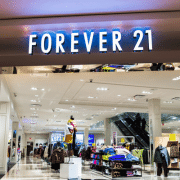
Forever 21 filed for bankruptcy protection for the second time in six years on Sunday, announcing plans to shutter its U.S. operations amid declining foot traffic in shopping malls and increasing competition from fast-fashion e-commerce giants such as Amazon, Temu, and Shein.

The retail chain’s U.S. operating arm has started liquidation sales across more than 350 locations and plans to cease operations entirely unless a suitable buyer emerges, according to recent court filings.

Forever 21 has actively searched for buyers over several months, reaching out to over 200 potential parties, with approximately 30 expressing serious interest by signing confidentiality agreements. However, none of these discussions yielded a viable agreement, leaving the retailer poised for liquidation.

In a statement, the company’s co-chief restructuring officer, Stephen Coulombe, attributed Forever 21’s latest financial struggles to heightened competition driven by online retailers Shein and Temu. Both companies exploit the “de minimis exemption,” a trade loophole allowing goods priced under $800 to enter the U.S. duty-free, significantly impacting domestic retailers like Forever 21, which must bear import duties.

“Certain non-U.S. online retailers that compete with the debtors, such as Temu and Shein, have taken advantage of this exemption and, therefore, have been able to pass significant savings onto consumers. Consequently, retailers that must pay duties and tariffs to purchase product for their stores and warehouses in the United States, such as the company, have been undercut.”

Coulombe added, “Despite widespread calls from U.S. companies and industry groups for the U.S. government to create a level playing field for U.S. retailers by closing the exemption, U.S. laws and policies have not solved the problem.”

Embed from Getty Images

Past attempts to counteract Shein’s dominance included a partnership initiated by Sparc Group, Forever 21’s operating company owner, in 2023. As part of the joint venture, Shein acquired about a third of Forever 21′s Sparc Group. Sparc also took a minority stake in Shein. The partnership allowed Shein to sell Forever 21 products on its site. It also allowed customers to return Shein-bought items in several hundred physical Forever 21 locations across the United States. However, the effort was insufficient to reverse losses or influence trade policy reform.

“The ability for non-U.S. retailers to sell their products at drastically lower prices to U.S. consumers has significantly impacted the Company’s ability to retain its traditional core customer base.”

While Forever 21’s U.S. operations face liquidation, the brand, owned by Authentic Brands Group, is expected to survive internationally. According to a recent CNBC report, the brand name and other intellectual property controlled are not for sale, and its international stores and website are anticipated to continue running.

Jarrod Weber, global lifestyle president at Authentic Brands Group, has expressed optimism about attracting new partners and operators interested in revitalizing the brand within the U.S. market, stating, “We are receiving lots of interest from strong brand operators and digital experts who share our vision and are ready to take the brand to the next level.”

“Our U.S. licensee’s decision to restructure its operations does not impact Forever 21′s intellectual property or its international business. It presents an opportunity to accelerate the modernization of the brand’s distribution model, setting it up to compete and lead in fast fashion for decades to come. We’re building a direct creation-to-shelf model that moves faster.”

Embed from Getty Images

After its initial bankruptcy filing in 2019, Forever 21 returned to profitability, reporting revenues of $2 billion and earnings before interest, taxes, depreciation, and amortization (EBITDA) of $165 million in fiscal 2021, under new ownership by Authentic Brands Group and major landlords Simon Property Group and Brookfield Property Partners.

Yet the company’s financial performance steadily deteriorated amidst rising inflation, supply chain issues, and shifting consumer preferences, accumulating over $400 million in losses in the past three fiscal years alone. Projected losses for fiscal 2025 stand at an additional $180 million.

Forever 21’s struggles also prompted drastic cost-cutting measures, including requests for rent reductions from landlords of up to 50%. Although these efforts secured around $50 million in savings, the amount was insufficient to offset mounting losses. Currently, the company carries debts totaling $1.58 billion, along with over $100 million owed to clothing suppliers, primarily in China and Korea.

The company, which was founded in 1984, was once a dominant force in fast fashion, employing over 43,000 people and generating annual revenues exceeding $4 billion at its peak. Its ongoing challenges highlight the rapidly changing dynamics within the retail and fashion industries.

Part of the problem, according to GlobalData managing director Neil Saunders, is that Forever 21 stores are too large for their present needs and are located in malls where there are not enough shoppers.

“Forever 21 was always a retailer living on borrowed time. Over recent years, it has been hit with dual headwinds from a weak apparel market and stiff competition from cheap Chinese marketplaces. Both things have eroded its standing and depleted its market share.”

shein

Shein And Forever 21 To Go Into Business Together 

Fast fashion retailers Shein and Forever 21 are going into business together in a new partnership agreement that was announced last Thursday. 

Under the agreement, Shein will acquire around one-third of the interest in Sparc Group, Forever 21’s operator. Sparc will also become a minority shareholder in Shein. 

Embed from Getty Images

In a joint release statement, the companies stated that the deal is expected to expand Forever 21’s distribution on Shein’s global e-commerce platform, which has around 150 million online users. The partnership will also “offer the opportunity to test” Shein product sales and returns in physical Forever 21 stores across the US. 

Forever 21 currently has over 540 locations worldwide and online, and the specific financial details have not been disclosed in the statement. 

Sparc is a joint venture company that also includes mall operator Simon Property Group and brand development company Authentic Brands Group. Sparc also distributes apparel for brands like Eddie Bauer, Reebok, and Aéropostale. 

Shein has had a major rise in popularity in the US due to their low-cost apparel and items. 

Neil Saunders, managing director of GlobalData Retail, according to AP, says that “the new partnership makes sense for both parties — Forever 21, which still struggles some in the fast-fashion world, could see fast growth on Shein’s sizeable online platform and that Shein will also hope that the addition of a well-known American name will help to lessen focus on its manufacturing practices, which have come under scrutiny.”

Embed from Getty Images

Both Shein and Forever 21 are also no stranger to controversy over the way they run their businesses. Between the environmental impact of the way the clothes are produced and distributed and the allegations of unethical labor practices, fast fashion companies have been consistently called out. 

There’s been many ongoing conversations and concerns from lawmakers and advocacy groups over the unethical practices that occur within these facilities. 

According to the Associated Press: “In May, a bipartisan group of two dozen lawmakers asked the Securities and Exchange Commission to put the brakes on an initial public offering by Shein until it verified that it does not use forced labor from the country’s predominantly Muslim Uyghur population. A June Congressional report also unloaded a blistering critique of Shein and another Chinese fashion retailer, Temu — which sued Shein last month, accusing its rival of violating U.S. antitrust law by preventing garment makers from working with it.”

Back in June Shein said that “the company’s policy is to comply with the customs and import laws of the countries in which we operate. [We have} zero tolerance for forced labor and have implemented a robust system to ensure compliance with U.S. law.”

When speaking of the partnership, Saunders said, “while both Shein and Forever 21 are expected to benefit from the newly-announced partnership, Shein still has an advantage as it is operating from a position of strength and is already taking share away from Forever 21, and others. This is something of an admission by Forever 21 that it is not able to engineer growth in its own business in the way that it would like. There is an element of ‘if you can’t beat them, join them.’”

Designer Fashion Labels Are Increasing Their Prices Post-Pandemic 

Top designer brands are currently increasing their prices as a means of making up for any economic loss that occurred within the past year due to the pandemic. Currently, there’s a high demand for luxury items among upper class individuals in the US. 

After nearly 18 months, designer fashion labels were finally able to revive the art of live fashion shows as well, which has brought back a certain cultural energy that the world was lacking throughout the past year of lockdown. 

Embed from Getty Images

Chanel, for example, as a brand has increased their handbag prices by at least 15% when compared to last year’s pricing. Chanel’s revenues have also declined by nearly 20% throughout 2020. 

A recent Bernstein industry report identified “Rolex, Dior, Prada, Gucci and Louis Vuitton as brands that had raised prices. The pricing of luxury bags had increased at twice the level of the broader consumer prices index over four decades. The most desirable brands had translated growth into increasing prices quickly in an unrealised pricing upside.”

Bernstein analyst Luca Solca said: “Most luxury brands increased prices during the pandemic in the attempt to cushion the impact of lower sales. Chanel has been particularly aggressive in this move. Very desirable brands have the ability to increase prices, if they so wish. This has the advantage of reducing the risk of overwhelming the market and putting perceived exclusivity in jeopardy.”

Embed from Getty Images

Orsola de Castro, founder of Fashion Revolution, a fashion activism movement, said: “The luxury industry needs to go back to some kind of semblance of luxury, because it’s hardly been immune to the low-quality, high-quantity bug. There is so much wrong with luxury these days, but the main issue is lack of transparency.”

“To imagine a luxury industry that really is luxurious, they need to reinvent their parameters, go back to the essence of what luxury is – craft, respect for human toil and skills, and beautiful materials. None of this can hurt people and nature, if we are to consider it a luxury product.”

There’s a major rise in the movement for sustainability in fashion, especially considering a lot of the more affordable brands that average working-class Americans can afford are produced in factories overseas, likely filled with harsh conditions and underpaid workers, however, the issue is clearly systemic. 

We can’t expect every American to shop sustainably when that’s just not possible for so many individuals, but we can reshape the brands that are deemed “luxury” to return back to a sense of craftsmanship and transparency, like de Castro explained, and hope that a larger revolution in the fashion industry can occur. 

Forever 21

Forever 21’s Landlords Will Buy It Out Of Bankruptcy

Forever 21 made major headlines back in September when it was revealed that they filed for a Chapter 11 bankruptcy. Now, as all of the documentation and business ends are being tied, it’s at the point in the bankruptcy process where buyers begin to enter the conversation and make some offers to the major retailing chain. 

As of this week, Simon Property Group and Brookfield Property Partners, both major mall owners in America, are at the top of the list, as both are offering to buy the rights to Forever 21 for $81 million in a joint deal. The two major companies decided to join forces due to the fact that they’re both Forever 21’s largest landlords, and this wouldn’t be the first time the two have joint forces to save a dying, yet loved, retail brand. 

Back in 2016 both Simon and General Growth Properties (which is now fully owned by Brookfield) saved Aeropostale, another popular teen retail giant who was filed for bankruptcy. Like Forever 21, Aeropostale was a major retailer in a majority of both companies mall properties throughout America. 

Embed from Getty Images

“Simon and others are trying to keep occupancy high at their malls. They don’t want to trigger a clause that lets other retailers at the shopping center ask for a lower rent or eventually get out of a lease. Still, Simon and others remain ‘strategic’ regarding which retailer to buy,” said Mark Hunter, managing director leading CBRE’s mall management.

Hunter’s point here is the exact same reasoning that both Simon and Brookfield (General Growth at the time) acquired Aeropostale in 2016. It’s the same concept as when one is trying to sell their home; when mall property owners have a greater demand on their end to fill hundreds of large retail spaces and sell, it’s more likely they’ll have to decrease the rent pricing to raise buyer interest. If this were to occur, other retailers within the mall would want their rent to match, as that just seems fair, so to save themselves from that hassle, it’s easier to just buy the retailer so they can remain exactly where they are. 

Embed from Getty Images

It’s an unfortunately common situation; as online retailers expand their product listings and market, and younger generations continue to change their shopping habits to match, even the “fast-fashion” giants can’t keep up. Back during the Great Recession, fast-fashion brands such as H&M, Forever 21, and Charlotte Russe really began thriving. There cheap pricing and imitation of other more expensively branded clothing from stores, such as Urban Outfitters, BDG, and Levi’s, appealed to the masses, especially in teen shoppers which make up a huge majority of the mall shopper market. 

However, because of their increase in success back in 2008 Forever 21, and other retailers who are now finding themselves in financial trouble, the brand thought they could survive a mass expansion of where their stores were located throughout the world. This over-compensation during a time when online shopping was really coming into fruition lead to the closing of hundreds of stores within the past decade that lead to their eventual filing for bankruptcy. 

“As of the bankruptcy filing, it operated about 800 stores worldwide, including more than 500 stores in the U.S. The company said at the time of the filing that it would still operate its e-commerce business, which accounts for 16% of total sales,” (ABC). 

While Simon and Brookfields offer is currently the top bid, other interested buyers still have until February 7th to make a higher offer. If Simon and Brookfield don’t acquire Forever 21, they’ll still be compensated $4.6 million as a sort of “break away” fee. The final ruling for the acquiring of the brand will be made on February 11th. 

Fast Fashion

How Sustainability Is Killing The ‘Fast Fashion’ Industry

When we typically think about sustainable ways of living, the first things that normally come to mind are reducing our plastic use, taking public transportation, using solar energy, recycling, and so on. However, we never think about how our fashion choices affect our carbon footprint. Sustainable fashion is a relatively new concept in relation to climate change, but thinking about the ways that we buy fashion and its environmental impact is actually very important in terms of fixing the damage that climate change has done. 

If you haven’t heard of “sustainable fashion,” you may have heard of its counterpart, fast fashion. Fast fashion refers to brands such as H&M, Fashion Nova, Forever 21, and basically any other big brand that carries mass-produced retail that embodies fresh runway looks that made it right onto the sale rack. Fast fashion has grown immensely in popularity, mainly because it allows consumers to by high-end looking garments that are fresh and trendy at an extremely reduced cost. The controversy lies within why the clothing is so cheap. There’s the obvious reasoning that these companies know cheaply made clothing is likely to wear down quicker, causing customers to have to repurchase items. Then there’s the greater concern over the ethics behind the clothing production in relation to its price point. How these companies source their labor overseas is a major concern, as most of these stores are constantly updating the items they carry to keep up with demand. So it’s assumed that there are extremely underpaid and overworked factory employees who are feeling the real effect of that demand through their long hours and low wages. 

Embed from Getty Images

As more individuals become aware of the many dilemmas in the fast fashion industry, sustainable fashion is rising to take over. Sustainable fashion is all about selling well-made pieces of clothing that get restocked at a slower rate. While that may slow distribution in some aspects, depending on where the clothing is coming from, it’s more green. The main reason sustainability in fashion hasn’t blown up in the way that fast fashion brands have is cost. Sustainable fashion requires higher quality materials and fair labor costs, which tends to get pricey but ethically, is completely necessary. 

When labor, material production, and distribution is all done at a local level, it’s always going to be more expensive as opposed to getting all of it done overseas. However, the environmental benefits of not receiving constant shipments from overseas of items made by underpaid and overworked laborers and flown out by cargo planes that are constantly emitting greenhouse gases is quite remarkable. 

Embed from Getty Images

Many individuals criticize the sustainable fashion movement because of the high price point, making it seem like it’s something only upper class individuals actually have access to, thus putting the blame for climate change on the lower class for buying fast fashion, just because it’s what’s affordable. However, sustainable fashion isn’t just about buying clothing from high-end, locally-produced boutiques that try to sell a dress for $400+. It’s about sustainability! In general, when it comes to how we make changes in our own lives to greater benefit the environment, there’s always multiple ways to go about it, and sustainable fashion is no different!

It’s always best to check out local brands for anything in your area and support that business. Local small businesses are the epitome of sustainability, as all their work and materials are typically accomplished at a regional level. As stated previously, however, this means that cost for goods can be more expensive, so what other options are out there? Thrift stores and second hand shopping in general is always an amazing way to contribute to sustainable fashion. Most thrift stores receive all of their second-hand items of clothing from local individuals, making the carbon footprint of that process close to nothing! In addition, thrifting is extremely cheap, especially compared to local boutiques. 

In the same light, donating and selling your clothes has the same impact as buying new ones from a local store/thrift shop. Instead, you’re just now contributing to someone else’s sustainable purchase. Additionally, always be self-aware of your retail buying habits and try to reduce excessive and needless shopping habits, as it all further contributes to climate change in regard to production, labor, shipment, and restocking. So the next time you need a new sweater for the Christmas party, check out your local Goodwill first.