Posts

crocodile

United Nation Reports Global Wildlife Trafficking Is Causing ‘Untold Harm Upon Nature’

A report from the United Nations has warned that more than 4,000 species of animals around the world are currently being targeted by traffickers, which is causing an unknown level of “harm upon nature.”

Crimes and trafficking involving wildlife are driven by demands for medicine, pets, bushmeat, ornamental plants, and trophies, according to reports. Of all the animals currently being trafficked, 40% are on the “red list” of threatened or near-threatened species. 

Embed from Getty Images

The wildlife trade is active in more than 80% of countries around the world, according to the report which came from the UN Office on Drugs and Crime (UNODC). 

“Despite gaps in knowledge about the full extent of wildlife trafficking and associated crime, there is sufficient evidence to conclude that this remains a significant global problem far from being resolved.”

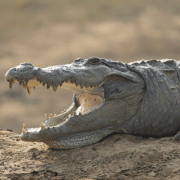
Researchers for the report looked at more than 140,000 wildlife seizures that took place between 2015 and 2021. They found that Corals, larger reptiles like crocodiles, and elephants had the largest number of individual seizures. 

These crimes are also actively driving extinction rates in species of rare orchids, succulent plants, reptiles, and fish, according to UNODC. 

“About 16,000 tonnes of goods were seized. Actual wildlife trafficking levels are of course far greater than the recorded seizures,” researchers say in the report.

“Wildlife crime inflicts untold harm upon nature, and it also jeopardizes livelihoods, public health, good governance and our planet’s ability to fight climate change,” said Ghada Waly, the executive director of the UNODC.

Embed from Getty Images

Separate research has found that specific populations of spider monkeys and Baird’s tapir have declined up to 99.9% due to the illegal wildlife trade exclusively. Researchers want the world to know that this illegal trading can lead to global extinctions of multiple species, which would also impact the overall environment. 

“Much wildlife crime is linked to large organized crime groups. Corruption plays a critical role in undermining efforts to stop wildlife trafficking, from bribes paid to inspectors, to government officials allowing fake permits,” the report says.

“An absence of seizures of a particular commodity or at a certain location could reflect lack of enforcement, rather than evidence that illegal trade was not taking place,” researchers said

It is estimated that the illegal wildlife trading industry could be worth around $23 billion annually, with over 100 million plants and animals being trafficked every year. While the UNODC has the goal of ending all trafficking of protected species, it seems unlikely that they’ll reach that by 2030 as they initially planned. 

“To address this crime, we must match the adaptability and agility of illegal wildlife trade,” said Waly.

Mouse Deer

“Mouse Deer” Thought To Be Extinct Photographed For The First Time In 30 Years

Southern Vietnam is making some wildlife history this week, as a tiny deer-like animal no bigger than a rabbit has been photographed and seen for the first time in almost three decades! The silver-backed chevrotain, more simply known as the Vietnamese mouse deer, was thought to be extinct by conservationists because the last recorded sighting of one was twenty five years ago. The last recording was made by Russian wildlife researchers who obtained a dead mouse deer from a local hunter who also believed the species was extinct. Ever since then the animals have remained completely off the radar. 

“For so long, this species has seemingly only existed as part of our imagination. Discovering that it is, indeed, still out there, is the first step in ensuring we don’t lose it again, and we’re moving quickly now to figure out how best to protect it,” said Vietnamese biologist An Nguyen, an associate conservation scientist with Global Wildlife Conservation.

The Global Wildlife Conservation (GWC) made the assumption thirty years ago that the chevrotain was yet another species that has fallen victim to intense deforestation/habitat loss as a result of climate change, or illegal poaching and trafficking. This was especially due to the fact that wire snares have become such an intense problem in the southern Vietnam region. Wire snares are homemade traps that hunters use to trap wildlife for trafficking purposes, more than anything, according to CNN. In fact, within the past five years patrol teams have seized over 200,000 of these illegal traps that were discovered in Vietnam alone. 

Embed from Getty Images

The discovery was made near the beach city of Nha Trang after a team of researchers and scientists working for the Journal of Nature Ecology and Evolution interviewed a slew of local villagers and forest rangers who reported potential sightings of the then thought to be extinct creature. After the documented villager accounts for the sightings, scientists set up hidden camera traps in the various areas where the reports came from and waited. The traps were set up for five months and in that time the team was able to record over 275 pictures of the silver-backed chevrotain. 

The result was way more than any of them expected, so they set up twenty nine more cameras around the same area based on where the previous photos were captured. After that, they were able to capture almost 2,000 pictures of the chevrotain, all occurring over the course of five short months. That’s a staggering amount of recorded data for an animal that was previously thought to be extinct. While the re-discovery of a “mouse-deer” like animal may not seem like a huge deal to some, to conservationists, it’s like discovering that the dodo bird still exists. 

Embed from Getty Images

The animals are quite adorable, weighing in at a maximum of ten pounds, they’re the world’s smallest hoofed mammals, and despite the nickname, they aren’t actually related to mice or deer. They are also no stranger to staying out of the spotlight. In the report covering the rediscovery, the team of researchers mention how the species was first discovered by scientists in 1910. After that initial discovery there were no more recorded verified records of chevrotain until 1990! Even then it was just one single animal which was seized from a hunter in Vietnam who captured it illegally.

“Before this we only had these two historical sightings separated by quite some distance—one in the southern part of Vietnam and the other much further north. But we knew that many people have camera-trapped in the wet evergreen forests and hadn’t seen it, so we thought we should look at the dry forest habitat that’s really different and where not many people have looked. To the scientific world this was a lost species, but local people had known about it. It was only by utilizing the local ecological knowledge that we were successful. That can be replicated for other species in other parts of the world,” said Andrew Tilker, Asian Species Officer at the GWC. 

Tilker along with the other researchers who participated in this amazing rediscovery made it a clear point that just because history shows that these animals survive under the radar, that doesn’t mean that there still isn’t a massive threat to the remainder silver-backed chevrotains. Local citizens most likely never reported sightings as a means to protect them from illegal wildlife poachers/traffickers.