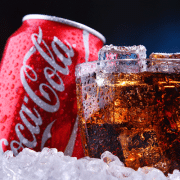
Coca-Cola has announced it will launch a new soda made with U.S. cane sugar this fall, expanding its portfolio with an alternative sweetener amid renewed scrutiny of high-fructose corn syrup (HFCS). The update was announced as part of the company’s quarterly earnings report on Tuesday and arrived just days after President Donald Trump took credit on social media for influencing the switch.
In a statement, the beverage giant described the new product as “an offering made with U.S. cane sugar” that aligns with its “ongoing innovation agenda.” While Coca-Cola already uses cane sugar in certain regional or specialty products, such as Mexican Coke, which is available in the U.S., and in beverages like its lemonade and coffee lines, this marks the first major U.S. release of a cane sugar cola in recent years.
“This addition is designed to complement the company’s strong core portfolio and offer more choices across occasions and preferences.”
In the U.S., Coca-Cola has been made with corn syrup since 1984, when the company announced its switch from cane sugar and sugar beets. Analysts suggest that the change occurred because the corn replacement was more cost-effective, and the sugar industry was weakening as more people began using artificial sweeteners.
CEO James Quincey emphasized that the new drink is about meeting consumer demand rather than replacing the classic formula. “We appreciate the President’s enthusiasm for our Coca-Cola brand,” Quincey said during a call with analysts, “We are definitely looking to use the whole toolkit of available sweetening options where there are consumer preferences.”
Embed from Getty Images
Trump had claimed on Truth Social last week that he had “convinced” Coca-Cola to ditch HFCS in favor of cane sugar, a declaration that, while partially grounded in timing, doesn’t reflect the reality of the company’s plans.
“I have been speaking to Coca-Cola about using REAL Cane Sugar in Coke in the United States, and they have agreed to do so. I’d like to thank all of those in authority at Coca-Cola. This will be a very good move by them — You’ll see. It’s just better!”
The president allegedly has a button at his desk in the Oval Office that requests a Diet Coke. It resembles a small wooden box with a red trigger, which notifies a staff worker to deliver a drink.
Despite speculation stirred by Trump’s comments, the classic Coca-Cola recipe in the United States will not be altered; it will continue to contain high-fructose corn syrup. Instead, the cane sugar version will be a separate product aimed at diversifying choices on the shelf rather than changing the brand’s most iconic offering.
The conversation around sugar in American beverages has become increasingly charged in recent years, with health advocates raising concerns about the prevalence of HFCS. One of the loudest critics is Robert F. Kennedy Jr., Trump’s Secretary of Health and Human Services, who has railed against artificial and ultra-processed ingredients in the U.S. food system.
In a recent appearance on Dr. Jordan Peterson’s podcast, Kennedy described HFCS as “a formula for making you obese and diabetic,” advocating for its removal from widely consumed foods and beverages. HFCS, while cheap and shelf-stable, has long been associated with America’s rising rates of obesity and metabolic disease.
Kennedy praised the Steak ‘n Shake restaurant chain over the weekend for announcing that it would begin selling Coca-Cola with real cane sugar rather than high-fructose corn syrup. Kennedy declared on X, “MAHA is winning,” in reference to the news and his “Make America Healthy Again” messaging.
Embed from Getty Images
However, public health experts caution that swapping out sweeteners may be more cosmetic than meaningful in terms of health outcomes. “Excess consumption of sugar from any source harms health,” Eva Greenthal, senior policy scientist at the Center for Science in the Public Interest, told CNN. “To make the U.S. food supply healthier, the Trump administration should focus on less sugar, not different sugar.”
Nutritionist and professor of food studies at New York University, Marion Nestle, told Associated Press last week that the switch was insignificant.
“For all practical purposes, they’re the same. I find the switch to be nutritionally hilarious. They taste the same. They have the same number of calories. They do exactly the same things in the body. Everybody would be healthier eating less of both of them.”
Coca-Cola’s move comes as the market sees a modest uptick in interest around more “natural” or “cleaner” sweeteners, particularly among younger consumers seeking transparency and simplicity in their food choices. Still, cane sugar is notably more expensive in the U.S. than HFCS, a fact that has kept many manufacturers from making the switch on a broad scale.
PepsiCo, Coca-Cola’s biggest rival, isn’t altering its flagship product but has dipped into the trend with new cane sugar-based offerings in its growing health-oriented lineup. Its prebiotic soda, as well as products from its recently acquired Poppi brand, use cane sugar as their primary sweetener.
PepsiCo CEO Ramon Laguarta recently weighed in on the economics of sugar reform during an interview on CNBC.
“Sugar is more expensive in the US than in many parts of the world, so I think there is a conversation with the government probably on how do we make sugar more affordable in the US, how do we have a farming strategy probably that reduces the cost of sugar and that will facilitate a lot of the transition for us and for the whole industry.”
Moumita Basuroychowdhury is a Contributing Reporter at The National Digest. After earning an economics degree at Cornell University, she moved to NYC to pursue her MFA in creative writing. She enjoys reporting on science, business and culture news. You can reach her at moumita.b@thenationaldigest.com.