This Wednesday, doctors at NYU Langone Medical Center announced that after 23 long hours in surgery they had performed the first successful face and double hands transplant on 22-year-old Joe Dimeo.
Back in 2018, 20-year-old Joe Dimeo fell asleep at the wheel of his car on Route 22 in New Jersey, causing him to lose control, hit a curb and flip his vehicle over, completely engulfing it in flames. Luckily a bystander was able to pull Dimeo out of the car before it exploded, but the young adult still suffered third-degree burns over nearly 80% of his body.
The damage was so severe that he was left without eyelids, ears, and parts of his fingers. The scarring from the burns limited his range of motion and partially covered his eyes making it difficult to see. It’s for these reasons that Dimeo was so motivated to work with his doctors in performing this historic surgery.
Dr. Eduardo Rodriguez is the head of the team that completed the surgery, and told the media this Wednesday that Dimeo is “the most highly motivated patient [he’s] ever met.” The surgery actually occurred in August of last year, however, the team of doctors wanted to wait and ensure that Dimeo’s body wouldn’t reject the transplants before calling the surgery a complete success.
Embed from Getty Images
“There have been over a hundred hand transplants performed successfully, and close to 50 face transplants, so fundamentally there was no reason why they couldn’t occur together, successfully.”
There have only ever been two other attempts to complete a double hand and face transplant simultaneously worldwide but both were unfortunately unsuccessful. “We needed to avoid infection, we needed to have this operation occur as fast as possible, we had to be very selective with the donor, and we had to implement every state of the art technology that would ensure complete success of Joe’s operation, and that’s exactly what we did.”
“Joe is healthy, he’s young, he’s strong, he loves to exercise, he eats healthy, and he has that one special element which is going to be required for this operation, a high level of motivation and a tremendous sense of hope.”
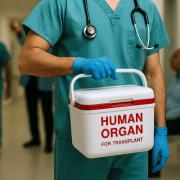
The operation took 80 healthcare professionals spread across six surgical teams and two adjoining operating rooms to complete. One of the operating rooms was used to carefully retrieve the hands and facial tissue from the dying donor, which are then typically replaced with 3D prosthetics according to Rodriguez.
Embed from Getty Images
“We always begin the operation with a moment of silence to honor the donor family, to respect their great loss, to never forget the donations that have been made. In all these operations it’s important to recognize that someone must give up their life so that others can continue living,” Rodriguez said.
In the other room Dimeo was being meticulously prepared to receive the transplants. The surgery itself is long, grueling, and dangerous, and if done incorrectly would have resulted in the end of Dimeo’s life as well. Rodriguez explained that for each hand they had to replace “21 tendons, three major nerves, five major vessels, and two major bones,” and that’s not even including the face.
After 23 hours in surgery and 45 days in intensive care, followed by two months of impatient rehab, Dimeo learned to open his new eyelids, more his new hands, and smile for the first time in years. Dimeo also recently spoke with the press about wanting to share his story and tell people to never give up on life.
“I want to share my story to give people hope in the world. I’d like to recognize the selflessness of my donor, and how none of this would be possible without his sacrifice. Thank you. I feel like I’ve been given a second chance at life. There’s no excuse to not be motivated, or not to do my therapy. My hands aren’t there yet. I have to keep practicing, it’s kind of like when you’re a baby, they’re just moving their hands all the time until they get that ability to do stuff. I’ve got new hands now, just like them. There’s always light at the end of the tunnel. You never give up.”
Eric Mastrota is a Contributing Editor at The National Digest based in New York. A graduate of SUNY New Paltz, he reports on world news, culture, and lifestyle. You can reach him at eric.mastrota@thenationaldigest.com.