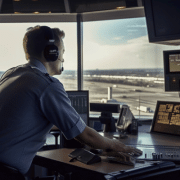
Air Traffic Staffing Shortages Worsen Amid Government Shutdown, Leaving Travelers Uncertain
Air traffic controller staffing shortages throughout the US have worsened over the past couple of weeks as the nation’s government shutdown officially hits one month. These shortages have led to a multitude of delays, cancellations, and traveler tension/anxiety. Experts are warning that air travel throughout the US will not improve until air traffic controllers get their proper payments.
Since Friday morning, more than 50 staffing shortages have been reported. This has caused delays in major cities such as Los Angeles and Washington DC. Controllers are considered to be essential workers, which means they have to work during the shutdown regardless of not getting paid.
In LA specifically, flights were temporarily halted on Sunday due to staffing shortages. Since the beginning of October there have been at least 264 instances of staffing problems reported at FAA facilities, according to CNN. These rates are four times the 60 shortages reported this time last year.
Transportation Secretary Sean Duffy said: “Just yesterday … We had 22 staffing triggers. That’s one of the highest that we have seen in the system since the shutdown began.”
Chad Mourning, assistant professor of computer science at Ohio University who specializes in aviation safety, told CNN he: “expects the shortage to continue and get worse as the shutdown goes on, because people can only work so much over time before they burn out.”
Air traffic controllers can route flights to airspace where more people are working, however, flights need to be slowed down regardless so that the controllers that do show up can maintain optimal levels of safety.
This Sunday, the US experienced more than 6,000 flight delays due to the shortages and weather, according to FlightAware. American Airlines reported 27% of their flights were delayed.
Since the beginning of the shutdown, on the worst days more than 50% of flight delays due to staffing shortages have occurred.
“The role of air traffic controllers is crucial because of how many flights take off every day in the United States,” Mourning said.
“There’s just too many airplanes, so we need someone else to sort of keep an eye out for if two planes are trying to land on the same runway. It is a heightened, hyper-vigilant job.”
Controllers are required to retire in their 50s.
“We have a lot of pent-up grievances on the part of air traffic controllers, and now you’re adding to the mix the fact that they’re not getting paid and that there’s no real end in sight for the shutdown,” said Jake Rosenfeld, a professor who studies labor organizing.
“[Calling in sick is a workaround] that we do see when there’s friction between employees and employers,” Rosenfeld said.
“Air traffic controllers are a real linchpin in the economy and actions, even by a really small number of them, can cause real pain,” he said.
The National Air Traffic Controllers Association said in a statement: “[We do] not endorse, support, or condone any federal employees participating in or endorsing a coordinated activity that negatively affects the capacity of the NAS, or any other activities that undermine the professional image and reputation of the people we represent. Participating in a job action could result in removal from federal service.”

Eric Mastrota is a Contributing Editor at The National Digest based in New York. A graduate of SUNY New Paltz, he reports on world news, culture, and lifestyle. You can reach him at eric.mastrota@thenationaldigest.com.