Posts

tariffs

JPMorgan CEO Jamie Dimon: Tariffs Could Slow Growth, Spark Inflation, Weaken America

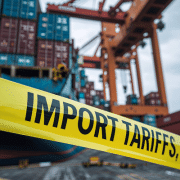
JPMorgan CEO Jamie Dimon delivered a stark warning regarding President Donald Trump’s recent tariff policies, cautioning that they could lead to rising prices, trigger an economic slowdown, and diminish America’s prominent global status.

In his annual letter to shareholders, Dimon stated plainly, “The recent tariffs will likely increase inflation and are causing many to consider a greater probability of a recession.”

While he did not definitively claim that tariffs alone would cause a recession, Dimon asserted confidently, “It will slow down growth.”

“As for the short-term, we are likely to see inflationary outcomes, not only on imported goods but on domestic prices, as input costs rise and demand increases on domestic products. How this plays out on different products will partially depend on their substitutability and price elasticity.”

Dimon, considered one of the world’s most influential business executives, emphasized that America’s unique global standing has historically been reinforced by the strength of its economy, military power, and moral leadership. Yet, he argued that Trump’s “America First” foreign policy approach and tariff strategy could inadvertently undermine this carefully cultivated global influence.

“America First is fine, as long as it doesn’t end up being America alone. If the Western world’s military and economic alliances were to fragment, America itself would inevitably weaken over time.”

Embed from Getty Images

Highlighting the interconnectedness of economic and geopolitical stability, Dimon noted that economic disruptions often precede broader security issues. “It is extremely important to recognize that security and economics are interconnected – ‘economic’ warfare has caused military warfare in the past,” he stated.

“Comprehensive strategies, diligently deployed, are required to address challenges on many fronts: the war in Ukraine; terrorism in the Middle East and the real possibility that Iran may develop a nuclear weapon; Europe’s potential fragmentation; and ongoing trade disputes and the rise of China. If Iran acquires a nuclear weapon, many other nations around the world will seek to acquire nuclear weapons, presenting us with a catastrophic situation.”

This pointed criticism marks a notable shift from Dimon’s earlier, more restrained comments. Previously, Dimon had minimized concerns about tariffs. In a January CNBC interview, he suggested that mild inflation resulting from tariffs would be manageable, advising critics to “get over it” if tariffs helped rejuvenate U.S. manufacturing sectors.

However, Trump’s recent tariff announcements have been unexpectedly aggressive, far surpassing the severity and breadth that many anticipated. Dimon’s current tone now urges caution and preparedness, contrasting his earlier optimism.

“Even with the recent decline in market values, prices remain relatively high,” Dimon stated, hinting that the recent plunge might just be the beginning.

Embed from Getty Images

Stocks, he indicated, could fall further, pushing the market firmly into bear territory. After reaching an all-time high on February 19, the U.S. stock market now stands near bear market levels, potentially marking the second-fastest transition from peak to bear market in history—second only to the rapid descent during the 2020 pandemic.

“Despite the unsettling landscape, the U.S. economy, at least until recently, continued to be resilient, with consumers still spending (though with some recent weakening) and businesses still healthy.”

Yet, Dimon’s broader outlook remains guarded. He highlighted persistent geopolitical and economic challenges facing both the United States and the global economy. His warning was explicit: “We face the most perilous and complicated geopolitical and economic environment since World War II.”

While Dimon recognized the legitimacy of addressing harmful trade practices, particularly China’s, which have impacted American workers negatively, his critique underscores a delicate balancing act. The potential benefits of rectifying unfair trade, he implied, must be carefully weighed against the severe economic consequences tariffs may impose.

Dimon’s explicit caution is rare for a business leader of his stature, signifying the grave uncertainty and concern permeating America’s financial institutions amid evolving trade tensions and shifting geopolitical dynamics.

earthquake

Over 2,700 Killed after Two Major Earthquakes Rock Syria and Turkey

Over 2,700 people were killed, and thousands more were injured when two major earthquakes struck Turkey and Syria on Monday. Hundreds of buildings collapsed and buried residents under their wreckage.

Impeachment Trial

Marie Yovanovitch Testifies as Impeachment Hearings Continue

Congressional hearings aren’t exactly known for being entertaining or dramatic spectacles. Nevertheless, one of the major criticisms of the first round of public impeachment hearings was that it was boring, and not exciting enough to capture the attention of the American public. This opinion was offered both by Republicans in an attempt to discredit the hearings as well as certain members of the press, who judged the event as if it were a television spectacle rather than a serious, sober government proceeding. Predictably, these comments were mocked on Twitter and elsewhere on the Internet, with Jonathan Allen’s complaint that the witnesses called on Wednesday lacked “pizazz” drawing significant attention.

It’s harder to make this criticism of today’s hearing, during which lawmakers questioned former ambassador to Ukraine Marie Yovanovitch, who was ousted from her position in Ukraine despite 33 years of highly celebrated public service during which she received numerous awards and being told she had done nothing wrong. Yovanovitch testified that she believed the reason for her ouster was to establish a shadow foreign policy, separate from the official channels of international diplomacy, to allow the president to pressure Ukraine to announce an investigation that would hurt Joe Biden and help Trump’s reelection campaign. Yovanovitch’s testimony corroborates Wednesday’s testimonies from Bill Taylor and George Kent, two government officials with experience in similar matters.

Embed from Getty Images

During his opening remarks, Adam Schiff explained Yovanovitch’s relevance to the impeachment hearings in an attempt to make the case that Trump removed Yovanovitch in order to facilitate his bribery attempt of Ukraine. Representative Devin Nunes spent much of his opening statement reciting a transcript released today by the Trump administration of a phone call between Trump and the newly-elected president of Ukraine, which was largely congratulatory and included an invitation from Ukrainian President Zelensky for Trump to attend his inauguration. This recitation bore little relevance to the matter at hand, and was likely performed in order to distract from the substance of the hearing, as the presence of a non-incriminating preliminary conversation does not negate a later, incriminating one.

Despite Trump’s attack on Yovanovitch, Republicans in the House of Representatives were careful not to deride Yovanovitch’s character, instead thanking her for her decades of service and praising the importance of her work.

Donald Trump, despite saying repeatedly that he would not be watching the hearings, was nonetheless active on Twitter throughout, providing commentary and denigrating Yovanovitch’s character. This gave chairman Adam Schiff a rare opportunity to respond to the president in real-time; during his questioning, Schiff mentioned the tweet, posted just minutes prior, which claimed that Yovanovitch’s conduct led to disastrous outcomes in Ukraine and Somalia, and asked Yovanovitch whether those accusations were accurate. She replied that they were not. Schiff suggested comments like these were destructive to the impeachment process, as they would discourage other witnesses from coming forward, and took the opportunity to assure Yovanovitch that the Committee takes witness intimidation very seriously. Notably, Trump’s tweet may form the basis for an additional article of impeachment, as witness intimidation is a crime and facilitates obstruction of justice.

Embed from Getty Images

Despite Trump’s attack on Yovanovitch, Republicans in the House of Representatives were careful not to deride Yovanovitch’s character, instead thanking her for her decades of service and praising the importance of her work. This discrepancy is just one example of the rift between Republicans in Congress, who are doing everything in their power to defend the president throughout the impeachment hearings, and the president himself, who frequently undermines these attempts by publicly contradicting them. As the president is quick to deride anyone who displays the slightest bit of disloyalty to him, even members of his own party who attempt to defend him but don’t do so strongly enough for the president’s liking, this rift has the potential to lead to further isolation of the president even from his allies.

Coincidentally, the trial of Roger Stone, a former advisor to the president, concluded today, and Stone was found guilty of lying to the FBI among other charges. In an obvious display of his anger and frustration, the president took to Twitter to complain about this outcome, and called for the jailing of his political opponents, including Adam Schiff and former special counsel Robert Mueller. Lately, it seems that news breaks every day that damages Trump’s presidency, and today is certainly no exception.

Tourist

Growing Tourism Market Means An Increase In Tourist Misconduct

Tourism is beginning to become a bad word in many parts of the world. Headlines regarding tourists complete disregard and disrespect for local values have only increased within the past years and a big part of the blame is to be placed on social media. 

According to the United Nations World Tourism Organization (UNWTO), there was a record of 1.4 billion tourists visiting various places around the globe in 2018, making the tourism market a $1.7 trillion industry. While many places around the world are highly dependent on the high grossing tourism market, many popular destinations are trying to restrict the market. Venice, Italy, for example, is affected every year by the population spikes during the vacation season, causing the water levels to continue to rise at astronomical rates. Places such as Ibiza and Barcelona have even implemented tourism taxes to make up for the amount of water and food waste they go through yearly, according to CNN

Embed from Getty Images

One of the biggest reasons behind an increase in tourism over the years is social media and influencer culture. Trendy tourist destinations see a major increase in their normal tourism rates when highly followed influencers visit them. In addition, the mending of cultures between traditional and sacred locations and social media stars just looking for a quick photo-op is causing a lot of the worlds “anti-tourism” attitude. 

“Currently, there are no statistics to suggest that misconduct by tourists is increasing. However, in this digital era, things can go viral easily, giving the impression that inappropriate conducts are increasing in number. This is actually an important reminder for the security forces and tourism industries to continue to educate tourists on respecting local culture and rituals. It’s possible that recent misconduct by tourists in Bali may relate to the individual’s lack of awareness and understanding of local wisdom and values of the Balinese people. The trend for sharing these types of videos on social media only serves to worsen the relationship between tourists and locals,” Michael O’Regan, a former assistant professor at the Institute for Tourism Studies Macao, said to CNN Travel

Embed from Getty Images

Tourists in general are becoming less socially aware of foreign policies and using the fact that they’re a tourist as an excuse to behave recklessly. According to CNN, so much so that places like Italy have taken action with its tourism laws. Italy has banned street drinking, any public fountain swimming, and pub crawls. Different areas of Europe have also banned any sort of food products in areas of historic value. Drinking is one of the main reasons behind so many tourist horror stories. Individuals, especially in Europe, assume that the alcohol is always flowing, and therefore you can act as such 24/7.

The best way to combat the increasing levels of disconnect between a culture’s values and tourists rule breaking naive way of thinking is through education. Not the type of education that they receive on a tour bus, but preliminary research instead. It’s the tourists responsibility to be fully aware and educated on the are that they will be travelling too, especially if it’s a completely different culture. 

“Usually these incidents are related to abuse of alcohol and ensuing behavior related to drunk and disorderly conduct. At the national level we would say that the best way to deal with this is to work on public awareness and education about respecting the destination one is visiting, there’s no evidence to suggest codes of conduct actually work, pointing out that many tourists won’t even be aware of them in the first instance. Tourism is meant to educate. Travelers should go to a different destination, adapt to different cultures and come back somewhat changed. Educational outreach about expectations before tourists even arrive can help reduce tensions. We can’t expect ready made, perfect tourists as soon as they land at a destination. It’s a learning process,” says Ina Rodin, director of North America at the Croatian National Tourist Office to CNN.