Latin American Countries Label Ultra-Processed Foods, Inspiring Others
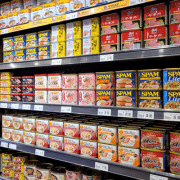
Latin America is currently leading the world in a nutritional initiative that puts warning labels on the fronts of ultra-processed food packages. The labels specifically warn consumers if a certain product contains more than the daily recommended value of certain nutrients; mainly salt, sugar, and saturated fats. Some countries have also placed warnings for excessive artificial sweeteners, caffeine, and trans fats.
Latin America is responsible for some of the most efficient global research into the health impacts of ultra-processed foods. These foods often contain high levels of fats, starches, sugars, and additives like colorings and preservatives. Latin America initially began labeling and researching these additives in the early 2000s, according to reports from The Guardian.
Research has shown that many Latin Americans get up to 20% to 30% of their daily caloric intake from ultra-processed foods. In the US, the average is as high as 60%.
The idea for labeling these products was first brought up in the early 2010s at the Pan American Health Organization, a regional office for the World Health Organization. One of the goals of these labels is to combat the rising rates of disease in the region.
“The initial proposals for front-of-pack labeling emerged because the information for consumers based on the nutrition facts table was completely insufficient for consumers to have a quick and easy understanding”, said Fabio Da Silva Gomes, the regional adviser on nutrition and physical activity for the Americas at the PAHO.
In 2010, Mexico became the first nation in the region to move their “daily guidance amounts” nutritional label to the front of food packaging. In 2014, Ecuador began adding a label that looked like a traffic light to their packaging. Each color of the traffic light (red, yellow, and green) represent a level of different nutrients in the food itself. The same kind of label is also used in parts of Europe.
Chile also changed how seriously Latin American nations took labeling these foods in 2014/2016. In 2014, they implemented a tax on sugary drinks and began seriously studying proper package labeling.
In 2016, they began adding a black, stop-sign shaped label to their ultra-processed foods, after finding that the traffic-light labels were too colorful for consumers to really take in what it was portraying. The Guardian also reported that Chile banned the sale and promotion of products with these warning labels in schools to reduce harmful marketing to children.
Chile’s warning label implementation quickly spread throughout Latin America. Peru, Uruguay, Mexico, Argentina, and Colombia now all mandate warning labels be placed on ultra-processed foods, and Venezuela is planning to join in December.
Some of them have even taken it a step further by adding the labels to more food groups that include high levels of artificial sweeteners and caffeine.
“The evidence suggests that right now in Argentina, in Mexico, in Colombia, with the warning labels that we have applied with nutrient profile models, we can with very good confidence state that these countries are regulating at least 97, 98% of ultra-processed foods,” Gomes stated.
“Although the science around the various components of ultra-processed foods is still emerging, the components still warrant labels because their purpose is simply to make unhealthy foods more appealing. Think of tobacco legislation, we do not necessarily need evidence on the harms of cosmetic additives to regulate them because they are used only for the purpose of stimulating the consumption of products that are harmful,” Gomes says.

Eric Mastrota is a Contributing Editor at The National Digest based in New York. A graduate of SUNY New Paltz, he reports on world news, culture, and lifestyle. You can reach him at eric.mastrota@thenationaldigest.com.