Posts

swim

Michael Phelps Discusses Money, Success, And The Business Lessons That Shaped His Career 

Michael Phelps recently sat down to discuss his iconic career, money, what life looks like in retirement, and the initial business lessons that he held with him throughout his time as one of the most successful Olympic athletes of all time.

Real Estate Powerhouse Barbara Corcoran Offers Top Homebuying ‘Rule’ To Guarantee You Can Always Sell 

Real estate mastermind Barbara Corcoran recently revealed one of her biggest rules for buying homes and how it’s always helped ensure her that she “can always sell” the property later on.

sleep

Study Shows Many Americans Can’t Sleep For More Than 6 Hours, Experts Offer Tips 

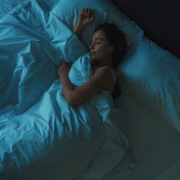
Getting a solid amount of sleep every night is an integral piece of living a happy and healthy life, both physically and mentally. When we don’t get enough sleep, we become more irritable, fatigued, and our body can’t properly function throughout the day, which can lead to a multitude of health issues. 

It’s recommended that adults get between 7-9 hours of sleep a night to remain healthy, however, many Americans claim that they can’t sleep for more than 6 hours. According to a poll from Gallup that was published last year, 53% of Americans reported getting between 6-7 hours of sleep a night, and 20% said they get 5 hours or less. 

Embed from Getty Images

Throughout the population surveyed, only about 36% of women and 48% of men said they got what’s considered a healthy amount of sleep daily. There’s a handful of reasons why one may not be getting enough sleep, however, there is hope for improvement. A group of experts recently gave their thoughts to Tom’s Guide on how you can help yourself get enough sleep to wake up feeling refreshed and healthy. 

“Waking up after 6 hours of sleep can be due to several factors and a combination of these factors,” says Dr. Leah Kaylor, a licensed clinical psychologist specializing in sleep and trauma. 

Stress, anxiety, and mental health issues in general have a major impact on our sleep. Dr. Kaylor stated that “stress, anxiety, or an overactive mind (your brain may be alert before your body is ready to be),” are key factors when it comes to the amount of sleep we get. 

“One of the most common [reasons] that I see as a sleep psychologist is untreated mental health conditions such as anxiety, depression, and trauma that are not addressed,” Dr. Kaylor stated.

Prioritizing your mental health is important in general, and if you find yourself not getting enough sleep because of the issues you’re struggling with, talking to a professional will help guide you in the right direction.

Experts also recommend creating a calming and consistent nighttime routine to help your body understand it’s ready for sleep. 

“Another huge problem is poor sleep hygiene, like inconsistent bedtimes and heavy meals before bed. Sleep hygiene can include environmental disruptions like light, noise, or temperature, as well as alcohol and caffeine,” Dr. Kaylor explained. 

“One of the most common reasons is changes in our internal clock as we get older. We naturally tend to go to bed a bit earlier and wake up earlier with age, and our sleep also becomes lighter,” Dr Pamela Walters, an MD and consultant psychiatrist.

“Another factor is your cortisol rhythm. Cortisol naturally starts to rise in the early hours, and in some people, that rise comes too soon and wakes them.”

Embed from Getty Images

Most adults need 7-9 hours of sleep every night. Naturopathic sleep expert and founder of Skilled Sleeper, Dr. Catherine Darley, states: “What’s most important is to know your personal sleep setpoint, or where you fall on that bell curve. The tails of the bell curve are 6 and 10 hours.”

“The key is how you feel during the day—if you’re alert, focused, and emotionally stable without needing naps or caffeine to function, you’re likely getting enough rest,” says Dr. Kaylor.

“Feeling sleepy and unfocused or irritable after six hours is a sign that you’re not getting enough restorative sleep.”

“Quality matters just as much as quantity when it comes to sleep so even if you’re in bed for six hours, if that sleep is light or interrupted, your brain and body won’t have time to go through all the essential stages of sleep.”

“If you’re routinely getting six hours or less and struggling with tiredness, your body is probably telling you it needs more rest,” she said. 

Looking at your diet can also help improve your sleep cycles. Caffeine stays in your system from 3-10 hours, so reducing your intake and ensuring you stop drinking it later in the day can help. The same goes for alcohol. While alcoholic beverages can sometimes help you feel sleepy, that impact doesn’t last. 

“Although alcohol can help us fall asleep at night, once it’s metabolized it can cause us to wake later in the night. Stop alcohol three hours before bed,” says Dr. Darley.

It’s important to reflect on the specific issues your finding within your sleep schedule, and to look at your daily routine 

Camp Tent

Things To Keep In Mind If You’re Planning On Going Camping For The First Time

With the Covid-19 pandemic hindering everyone’s summer plans, many are turning to alternative means of travel to itch their vacation scratch this year. Camping has become one of the most popular modes of vacation this year as it’s one of the only ways that individuals can get out of their house while remaining socially distant from others. For those of us who have never been camping before but are ready to finally try it out given the circumstances, there are some things we must avoid in order to ensure we have a fun and safe time in the wilderness. 

First and foremost, do your research, especially if this is your first time. Luckily the internet has millions of resources one could use to find the perfect spot to camp. Apps like Campspot have grown in popularity within the past few years. Campspot specifically makes it easy for users to find campsites that fit their budgets while also listing all the surrounding amenities in the area you’re planning on travelling too. The app also helps individuals with disabilities find more accessible campgrounds so they don’t have to worry about getting around complex terrains or running into any seriously dangerous wildlife. 

Embed from Getty Images

For your first time camping it’s also important that you don’t choose a location that’s too far from your home. Being relatively close to your house will make you feel more secure if you’re a little nervous about your first night in the great outdoors, and you’re more likely to find private campgrounds as opposed to more open ones that are popular in National parks. 

CEO of the app Campspot, Caleb Hartung, recommends going no further than 130 miles from your home for the first time. This way you’re still distanced enough to feel like you’re in a completely new environment, but are close enough to leave if you feel so inclined. 

“I wouldn’t recommend a national park for a first-time camper.  There’s just a lot more staffing on a private campground, and these private campgrounds are also more common, meaning they’re within an hour to an hour and a half from home.”

Campot operates in 47 states and some parts of Canada, so Hartung is referring to a majority of America when he says private sites are more common. When it comes to actually preparing for your trip, don’t over-pack/over-invest in new camp gear. It’s easy to feel pressured to buy everything at a camping store when it’s your first time because you don’t know what to expect and want to be prepared for everything, but it’s just not necessary.

Embed from Getty Images

Again, do your research on the area you’re planning on camping at and look up other more experienced campers testimonials of their experiences at the same sites. Listen to what they brought and read up on recommendations for the specific campsite, it’s likely if the grounds have a website they’ll have a section that tells you what you should be bringing. 

Make sure you pack a variety of clothing for your trip as well. This is yet again dependent on where you plan on camping, however, in most wilderness areas the temperatures drop heavily at night. Pack a lot of layers and also plenty of light clothing for during the day in case it gets really hot. 

Make sure you’re packing enough water and food provisions for yourself as well especially if the area you’re heading to doesn’t have a lot of convenient store establishments around. This is the part of packing that Hartung always encourages campers to over-pack on. 

To that same extent you must also over-pack on things that are meant to protect your skin. Sunscreen/SPF lotions, bug spray, and closed-toed shoes are all necessities anywhere you camp. The American Academy of Dermatology recommends wearing a sunscreen with an SPF of at least 30, and to reapply it every two hours, maybe even every hour depending on how much time you’re spending in the sun. 

Do your research, read up on where you’re going and get organized. Camping can be a fun spur-of-the-moment experience, however, for your first time it’s best to be as prepared as possible.