Posts

Astronomers Tracking An Asteroid That Has Potential To Hit Earth In 2032

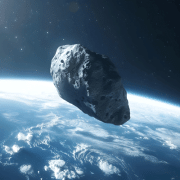
Astronomers have identified a new asteroid that’s the size of a football field. This discovery is significant considering that the asteroid has more than a 1% chance of creasing into Earth on December 22nd, 2032. 

moon

Earth’s ‘Second Moon’ Is Officially In Orbit For The Next Two Months

NASA scientists have announced that Earth’s orbit has captured a “second moon” on Sunday September 29th. The “mini-moon” is technically a small asteroid referred to as 2024 PT5. The asteroid typically orbits the sun as a part of an asteroid belt that follows Earth, and now, it’s orbiting Earth the same way the moon does. 

Earth’s moon has been orbiting our planet for around 4 billion years. 2024 PT5, however, won’t be in our specific orbit for that long, and should exit its current course in November. 

Embed from Getty Images

“According to the latest data available from NASA’s Jet Propulsion Laboratory Horizons system, the temporary capture will start at 15:54 EDT (1954 UTC) and will end at 11:43 EDT (1543 UTC) on November 25,” mini-moon event expert and Universidad Complutense de Madrid professor Carlos de la Fuente Marcos told Space.com

“The object that is going to pay us a visit belongs to the Arjuna asteroid belt, a secondary asteroid belt made of space rocks that follow orbits very similar to that of Earth at an average distance to the sun of about 93 million miles (150 million kilometers),” Marcos said last week. 

“Objects in the Arjuna asteroid belt are part of the near-Earth object population of asteroids and comets.”

These “gravitational capture events” are actually fairly common in our solar system, according to Marcos. 

“Some Arjuna asteroid belt objects can approach Earth at a close range of around 2.8 million miles (4.5 million kilometers) and at a relatively low velocity of less than 2,200 miles per hour (3,540 km/h),” Marcos explained. 

Embed from Getty Images

“Asteroid 2024 PT5 will not describe a full orbit around Earth. You may say that if a true satellite is like a customer buying goods inside a store, objects like 2024 PT5 are window shoppers.”

After asteroid 2024 PT5 finishes its short journey around Earth in November, it will continue to orbit the sun with the Arjuna family of asteroids. 

“The object is too small and dim for typical amateur telescopes and binoculars. However, the object is well within the brightness range of typical telescopes used by professional astronomers,” Marcos concluded

“A telescope with a diameter of at least 30 inches plus a CCD or CMOS detector is needed to observe this object; a 30-inch telescope and a human eye behind it will not be enough.”

The research is currently published in the journal The Research Notes of the AAS.

asteroid

NASA Launching Spacecraft On Six-Year Journey To Research Asteroid Made Of Metal 

NASA is gearing up to launch a spacecraft on a six-year journey to research a very unique asteroid that seems to be mainly made up of metal. 

The principal investigator for the mission, Lindy Elkins-Tanton, stated that“this will be our first time visiting a world that has a metal surface,” explaining how previous NASA missions mainly looked at “worlds made of rock or ice or gas,” according to NPR.

The asteroid itself in this specific mission is named “Psyche,” and could help scientists understand exactly how violent collisions and space events in our solar system’s initial years of creation led to the formation of our planets. Many planets in our solar system, including Earth, have metal-rich cores, so the asteroid could provide some further insight into that history. 

Embed from Getty Images

Psyche was discovered in 1852, and according to Elkins-Tanton, it’s likely the size of the state of Massachusetts and shaped like a potato. Researchers believe that the asteroid is about 30 to 60 percent metal. 

Once the spacecraft arrives at the asteroid in August 2029, it will be able to send images back to NASA so they can see what Psyche looks like, because as of right now, “we do not know what Psyche looks like,” according to Elkins-Tanton. 

The probe will blast off from the Kennedy Space Center in Florida on a SpaceX rocket and will have its initial opportunity to launch on Thursday morning. 

“Researchers believe the asteroid might have craters that are ringed with iron spikes, because an impact might send up streams of molten metal that then solidify. The asteroid might also have huge metal cliffs, and the remnants of greenish-yellow lava flows,” says Elkins-Tanton.

Psyche is reported to be over 150 million miles away at its closest approach to Earth, and for now all scientists are able to see of it is just a point of light due to its distance. It’s also in the outer part of the main asteroid belt between Mars and Jupiter, according to reports

Embed from Getty Images

“Since asteroids are leftovers from when the planets formed, Psyche is like an exposed version of what lurks at the center of rocky planets,” said Elkins-Tanton.

“We’re trying to understand the metal core of the Earth. We are never, ever going to go to those cores — way too hot, way too deep — so this is our one way to see a core.”

“There are other metallic asteroids that represent this kind of planetary building block, but Psyche is by far the largest, and the one that is most likely to tell us the most about cores,” Elkins-Tanton stated

“The planet Mercury has an unusually high amount of iron beneath a rocky shell, and there are some planets outside the solar system, around distant stars, that also seem to mostly be made of metal,” says Ben Weiss, the deputy principal investigator for the mission.

“So even though Psyche’s metal-rich nature makes it an unusual asteroid, it’s also kind of representative of a diverse range of bodies that we think are maybe metal worlds,”  he says. 

“Because we don’t know what its surface looks like, we’re not ready to land. We’re not ready to sample. We have to have some sense of what this object is like before we can take that next step,” says Elkins-Tanton.

asteroid

Asteroid Orbiting With Earth, Known As ‘Quasi-Moon,’ Will Be Around For Hundreds Of Years, Scientists Say 

Astronomers have recently discovered an asteroid that joined Earth’s orbit around the sun. The asteroid has been named 2023 FW13, and is also referred to as a “quasi-moon” or “quasi-satellite” since it orbits the sun in a similar time frame as the Earth does.

However, the asteroid is only “slightly influenced” by Earth’s gravitational pull, according to reports from Earth.com.

Embed from Getty Images

The asteroid itself was initially discovered on March 28th, 2023 by the Pan-STARRS survey telescope, which is located on the top of Haleakalā, a dormant volcano in Maui, Hawaii. Data shows the asteroid is only 50 feet in diameter, and is orbiting about nine million miles away from Earth. 

The Canada-France-Hawaii telescope, the Kitt Peak National Observatory, and the Mount Lemmon SkyCenter soon after confirmed the asteroid’s presence in the Earth’s vicinity. 

The Minor Planet Center officially listed the asteroid at the International Astronomical Union; an organization that is responsible for identifying and designating titles to new planets, moons, and other astronomical objects in our solar system. 

Journalist and astronomer Adrien Coffinet was the first one to classify the asteroid as a “quasi-moon,” after using an orbit simulator developed by Tony Dunn, another astronomer. Coffinet used the model to find that 2023 FW13 travels around the sun the same amount of time the Earth does, while also circling our planet. 

Embed from Getty Images

2023 FW13 has seemingly been joining Earth in its orbit since 100 BCE, and is likely to continue following our planet until 3700. 

“It seems to be the longest quasi-satellite of Earth known to date,” Coffinet said.

“Fortunately, despite hovering relatively close to our planet, this asteroid is unlikely to be on a collision course with the Earth. The good news is, such an orbit doesn’t result in an impacting trajectory ‘out of the blue,’” Harris said.

According to Richard Binzel, an astronomer at MIT, “astronomical objects such as this one could act as stepping stones to Mars, meaning that they could soon be accessed by spacecraft due to their relative low velocity caused by their near-match to the Earth’s orbit. A space mission trying to reach such asteroids makes sense as a way to practice deep-space missions, before committing a crew and hardware to a longer mission to Mars. It’s a shakedown cruise.”

asteroid

NASA To Slam Probe Into Asteroid for Planetary Defense Test

On Sept. 26, NASA will slam a probe into an asteroid during its Double Asteroid Redirection Test mission. The mission is part of NASA’s larger planetary defense plan against any asteroids that may someday impact the Earth.

If an asteroid were to hurl toward Earth in the future, a probe like the one used in DART should be able to realign its trajectory or destroy it, neutralizing its threat.

One of the engineers orchestrating the mission acknowledges, “this is an amazing moment for our space program.”

“For the first time, we will move a celestial body intentionally in space, beyond Earth’s orbit! This test goes beyond international borders and really shows what we can accomplish if we all work together as one team and as one on Earth.”

NASA mapped the orbits of 30,000 nearby asteroids and determined that, as of right now, most of them are unlikely to collide with Earth or are so small that they would burn up in the atmosphere before any significant impact.

Embed from Getty Images

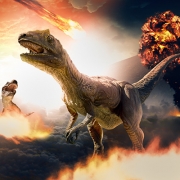
The last time an asteroid collided with Earth, it ended the age of dinosaurs some 66 million years ago. The 6-mile wide asteroid Chicxulub killed over 75% of the Earth’s species, triggering a mass extinction event. Earthquakes reverberated throughout the crust; wildfires spread in all directions from the asteroid’s impact, and mammoth tsunamis engulfed dry land.

NASA does not want to rule out that an asteroid may hit Earth in the future. The probe will impact an asteroid named Dimorphos, which orbits another asteroid named Didymos, nearly the Earth’s size. Its mission is to realign Dimorphos and change the duration of its orbit by 11 minutes.

The agency says this will determine if a strategy like DART would successfully prevent planetary threats posed by asteroids by gauging how asteroids respond to kinetic impact. The stakes of the test are low since it poses no threat to Earth, but the agency says the difficulty of the maneuver will remain the same.

Embed from Getty Images

During a news conference, Andrea Riley, a program executive at NASA, spoke on the importance of the DART test. The probe will only be able to detect Dimorphos an hour and a half before impact, making this an accurate test of its precision. Once the probe detects the asteroid, it will autonomously guide itself into a collision.

“If it misses, it still provides a lot of data. This is a test mission. This is why we test; we want to do it now rather than when there is an actual need.”

NASA will hold a televised briefing for the test at 6 p.m. on Sept. 26. NASA TV will then provide live coverage of the impact, predicted to be at 7:14 p.m. EDT the same day.

Asteroids kill dinosaurs

New Study Says an Asteroid, Not Volcanic Activity, Killed the Dinosaurs

For decades, scientists have argued about what caused the global mass extinction event that killed the dinosaurs. While there is general consensus that climate change is to blame, scientists disagree over what event occurred that triggered a rapid transformation of the planet’s weather systems. Though some believe that the environmental impact was caused by massive volcanic eruptions in India, most scientists think that an asteroid impact is to blame. Now, a new research paper published in Science is hoped to end the debate, as the researchers found that the volcanic eruptions occurred too far before the extinction event that took place 66 million years ago to have been its cause.

With this research, the scientists are hoping to put to rest the theory that K-Pg, which is the scientific notation for the Cretaceous-Paleogene extinction event, was caused by volcanic activity. According to Yale assistant professor of geology & geophysics Pincelli Hull, who helped author the research paper, “a lot of people have speculated that volcanoes mattered to K-Pg, and we’re saying, ‘No, they didn’t.’” 


Embed from Getty Images

According to Hill, “volcanic activity in the late Cretaceous caused a gradual global warming event of about two degrees, but not mass extinction.” In other words, although climate change caused by volcanic activity had an impact on the global ecosystem, it was not rapid or dramatic enough of a warming event to cause the extinction of 75% of life on Earth, as is observed in K-Pg. The study also offers an answer to a question that has for years remained a mystery, which is why massive eruptions that took place in India in the immediate aftermath of the extinction event did not cause a corresponding warming event. According to this study, the ocean absorbed an enormous amount of CO2 in the aftermath of the asteroid impact, which may have hid the warming effect of the volcanic activity.

The asteroid impact which is now widely believed to have been the cause of K-Pg was first discovered in 1990, after samples from the Chicxulub crater in Mexico were analyzed by scientists who determined that the crater was caused by an asteroid impact that took place around 66 million years ago, at precisely the same time as the extinction event. Since the discovery of the crater, further research has produced evidence that this in fact was the impact site of the asteroid that killed the dinosaurs. In 2016, for instance, a drilling project drilled into the impact crater, obtaining rock core samples that seemed to confirm the theory, as materials extracted from the impact site match the geological record across the world that was formed in the wake of the asteroid impact.

Asteroids kill dinosaurs

NASA Teams Up With ESA To Stop Earth Bound Asteroids

Scientist’s are preparing for the worst when it comes to an asteroid hitting the planet. Mass extinction impact asteroids are guaranteed to occur every few million years, which is why they’re not worried about very often. One of the most significant occurrences being when the dinosaur population was completely eradicated, which is what people remember the most.