Posts

delta

Delta Offering $30,000 To Passengers In Canada Plane Crash 

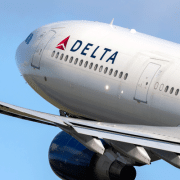
Delta Air Lines is offering passengers  who were on a plane that caught fire and flipped upside down on a Toronto runway $30,000 each with “no strings attached.”

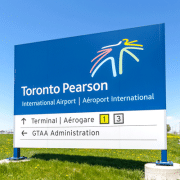
Flight 4819 crashed after touching down at Toronto’s Pearson airport this past Monday. Videos of the crash were recorded and posted online by witnesses and by passengers inside of the plane. 

Embed from Getty Images

According to a statement from Delta, “twenty-one of the plane’s 80 passengers and crew were initially transported to the hospital after the incident. All were released by Thursday,” the Guardian reported

The crashed flight was operated by Endeavor Air, a subsidiary of Delta. Both American and Canadian authorities are currently investigating the incident. 

“It’s horrifying when you look at the video,” Delta CEO, Ed Bastian, told CBS. 

“You can imagine when I received the text minutes after it happened, hearing there was a regional jet upside down on an active runway.”

“The reality is safety is embedded into our system. Air travel in the United States is the safest form of travel.”

Embed from Getty Images

“[The $30,000] gesture has no strings attached and does not affect rights,” a spokesperson for Delta said.

Paramedic Pete Carlson who was a passenger said: “For at least a brief period of time I thought ‘I’m not getting off this plane.’”

“The next thing I know, I’m upside down and my seatbelt was still belted.”

This crash comes after a series of serious incidents involving aircrafts around the nation, specifically in Washington DC where a passenger plane collided in midair with an army Black Hawk helicopter. 67 individuals were killed when both aircrafts crashed into the Potomac River. 

That crash was hailed as the worst air disaster in the US since 2001. Air traffic controllers have warned for years that employees in towers were overworked in understaffed environments.

toronto airport

Delta Flight Crashes, Turns Upside Down at Toronto Airport—21 Injured, No Fatalities

A Delta Airlines flight from Minneapolis crashed, turned upside down and caught fire as it tried to land at Toronto Pearson International Airport on Monday. The crash is the latest in a series of incidents involving passenger planes in North America since last December.

Delta Airlines confirmed that all 80 individuals aboard the CRJ900 twin-jet aircraft survived. However, 21 passengers were transported to hospitals for treatment of injuries. As of Tuesday morning, all but two individuals have been discharged from the hospital.

Footage acquired by CNN captured the moment the aircraft’s rear landing gear buckled while the right wing disintegrated into a fireball following a hard landing on the runway. The aircraft momentarily skidded on its underside before overturning, creating a plume of smoke and fine snow.

The person taking the video, observing from the interior of another aircraft near the runway, can be heard saying, “Oh no, no, no, no, no!” One passenger, John Nelson, told CNN what the crash felt like from inside the plane.

“When we hit, it was just super hard. It hit the ground, and the plane went sideways. It’s amazing that we’re still here. Even now, I smell like jet fuel.”

The wrecked Bombardier CRJ900 was designed to withstand a hard landing, according to Peter Goelz, a CNN aviation analyst and former managing director of the National Transportation Safety Board. This allowed for the rapid evacuation of passengers and crew.

Another passenger, Pete Koukov, said he “didn’t know anything was the matter” until the plane was on the ground. “We hit the ground, and we were sideways, and then we were upside down, hanging like bats.”

Embed from Getty Images

While several passengers required assistance removing themselves from their seats, Koukov was able to undo his seatbelt, lower himself to the floor, and exit the aircraft on his own.

“Just feeling lucky and happy I got to give the person I didn’t know sitting next to me a big hug, that we were OK, and see my friends who are here to pick me up from the airport and give them a big hug.”

Pete Carlson, an executive at a healthcare company, shared a similar experience.

“I took my seat belt off, which I’d obviously left fastened for the landing, and as I took it off, I crashed down onto the ceiling, which had become the floor.”

Delta Flight 4819, which is operated by Endeavor Air, a subsidiary of Delta, took off from Minneapolis/St. Paul International Airport before crashing at the airport located in a suburb west of Toronto at approximately 2:15 p.m. ET on Monday, according to a statement from Delta CEO Ed Bastian.

“The hearts of the entire global Delta family are with those affected by today’s incident at Toronto-Pearson International Airport. I want to express my thanks to the many Delta and Endeavor team members and the first responders on site. We are working to confirm the details and will share the most current information on news.delta.com  as soon as it becomes available. In the meantime, please take care and stay safe.”

Bastian also sent a memo to Delta employees stating, “I’m incredibly proud of the professionalism of the Endeavour crew members who evacuated the aircraft, as well as the first responders at Toronto Pearson International Airport and the airport leadership team.”

According to aviation analyst and former inspector general of the Department of Transportation Mary Schiavo, the typical “flare” of the jet—when the pilot lifts the nose shortly before landing to expose the wings to increased air resistance—does not seem to appear in the footage of the disaster. “There was no attempt to flare at all, which slows the plane down,” she said.

Embed from Getty Images

Former director of the FAA’s Office of Crash Investigation, Steven Wallace, suggested that videos of the crash may provide insights into why the aircraft flipped over after landing.

“You see, the right wing fails, but the airplane is still going quite fast, and that left wing is generating a tremendous amount of lift. So, that immediately causes the airplane to roll inverted. That’s quite clear.”

The crash occurred on a blustery day after significant snowfall in Toronto. Notably, the airport fire chief said, “The runway was dry, and there were no crosswind conditions.”

However, recordings from air traffic control towers conflict with this account. An air traffic controller informed the Endeavour pilot of winds measuring 26 mph, with gusts reaching up to 38 mph, crossing the plane’s trajectory at a 40-degree angle. Reports indicate that the wind at Pearson was stirring up snow into the air, resulting in a visibility of five miles. Retired jet pilot Les Abend told CNN this may have caused a situation that was hard to control.

“The weather conditions may have become treacherous before the pilots were able to adapt. With blowing snow, it may have changed rapidly, so the airplane that landed ahead of this aircraft may have had a different condition than this particular Delta regional jet.”

The crash on Monday marks yet another tragic event in what has been a perilous year for air travel across North America. In an incident earlier this month, a regional airline plane crashed in Alaska, resulting in the deaths of 10 individuals.

Less than three weeks ago, a midair collision between an American Airlines plane and a US Army Black Hawk helicopter resulted in the deaths of 67 individuals near Washington, DC. Just two days later, a medevac jet crashed in Philadelphia, resulting in the deaths of all six individuals on board, as well as one person on the ground.

The Transportation Safety Board of Canada is leading the investigation with assistance from the National Transportation Safety Board in the US. The runway involved in the plane crash is anticipated to stay closed until at least Thursday evening.

down

Global Cyber Outage Grounds Multiple International Flights 

A cyber update recently impacted computer systems internationally, causing flights all over the world to ground while broadcasters were taken off air and banking and healthcare services were affected. 

“An update to a product offered by global cyberscurity firm CrowdStrike (CRWD.O), appeared to be the trigger, affecting customers using Microsoft’s (MSFT.O)Windows Operating System. Microsoft said later on Friday the issue had been fixed,” wrote Reuters.

Embed from Getty Images

CrowdStrike CEO George Kurtz stated on social media that the company was “actively working with customers impacted by a defect found in a single content update for Windows hosts and that a fix was being deployed. This is not a security incident or cyberattack.”

American Airlines, Delta Airlines, and United Airlines grounded flights early on Friday as well as other international airports around the world, which also reported delays and disruptions. 

Banks and financial service companies in Australia, Germany, India, and beyond sent warnings to their customers regarding disruptions and issues relating to executing transactions. 

“We are having the mother of all global market outages,” one trader said according to Reuters

“Microsoft’s cloud unit Azure said it was aware of the issue that impacted virtual machines running Windows OS and the CrowdStrike Falcon agent getting stuck in a ‘restarting state,’ amid an ongoing global outage,” the publication wrote. 

Embed from Getty Images

“We’re aware of an issue affecting Windows devices due to an update from a third-party software platform. We anticipate a resolution is forthcoming,” a Microsoft spokesperson said.

CrowdStrike said in an alert its “‘Falcon Sensor’ software was causing Microsoft Windows to crash and display a blue screen.”

“Over half of Fortune 500 companies used CrowdStrike software,” the U.S. firm said.

“This is a very, very uncomfortable illustration of the fragility of the world’s core Internet infrastructure,” said Ciaran Martin, Professor at Oxford University’s Blavatnik School of Government and former head of the UK National Cyber Security Centre.

Some international airports in Singapore, Hong Kong, and India had to check in passengers manually over the cyber outage. 

While companies have been restoring their services, many analysts in different branches are calling this potentially one of the biggest cyber outages in the history of the industry and economy. 

“IT security tools are all designed to ensure that companies can continue to operate in the worst-case scenario of a data breach, so to be the root cause of a global IT outage is an unmitigated disaster,” said Ajay Unni, CEO of one of Australia’s largest cybersecurity services companies, StickmanCyber.

luggage

Lost Luggage Seeing A Surge During Summer Travel Months

Think of all the frustrations that could occur at the airport. Check-ins. Delays. Cancellations. All are sure to give you headaches, but perhaps the worst possible scenario is arriving at your destination, only to find that your luggage is nowhere to be seen.

Not only does lost luggage turn countless valuable hours into a full-on manhunt, but in the event that baggage isn’t found, money will have to be spent on clothes and other necessities. And unfortunately, that’s becoming more of a possibility than ever.

According to data by the Department of Transportation, almost 220,000 bags were “mishandled” — either lost, damaged, delayed, or stolen — by airlines in April. That’s 0.55 mishandlings per 100 bags enplaned.

Embed from Getty Images

American Airlines Network led the way in mishandling with nearly 65,000 (0.72 per 100), while Alaska Airlines Network came in second with almost 16,000. Those 220,000 mishandlings are up from around 93,000 in April of 2021.

The crisis of lost luggage could be seen as the result of a number of factors. For one, travel has seen rapid increases since the reduction of COVID-19 protocols. On July 20, 2.2 million passengers were screened by the Transportation Security Administration, up from 1.9 million a year ago.

Airline and airport staffing is also lacking. Those shortages have resulted in putting the industry on track for the most cancellations in a non-pandemic year, and have an equally frustrating impact on baggage handling.

“When you hit a rough patch in your operations, the bags are going to be affected probably even more so than customers,” Delta CEO Ed Bastian said, whose airline sent a whole plane to retrieve 1,000 stranded bags at London’s Heathrow Airport last week. It’s a problem some travel analysts expect to carry into 2023.

If you find yourself in this situation, there are a number of actions to take. The first should be to immediately go to the baggage claim office, as some airlines have a certain number of hours you must file a claim within.

One of the most important tips to remember is that airlines are required to compensate you for the bag’s content: domestic flights have a maximum of $3,800 in compensation, while international flights are $1,800. Bag check fees are also refunded.

Embed from Getty Images

“The financial compensation is helpful, because that’s not money you’d have spent ordinarily,” NerdWallet travel expert Sara Rathner told MSNBC. However, you won’t receive the money immediately. Airlines have different timelines for when they deem a bag lost, with some taking up to two weeks.

Traveling light by simply bringing a carry-on is also an excellent strategy, though one that might only work for a brief trip instead of a longer excursion. In the event you do check your bag, make sure to pack an additional set or three of clothes in your carry-on.

If your luggage gets lost and isn’t eventually found, you’ll at least have outfits to carry you over for a bit until you can replenish your wardrobe. The same applies to medicine and toiletries that might be critical to your health and hygiene.

Additionally, ensure that nothing of value, like electronics or jewelry, is placed into your checked bag as airlines are unlikely to cover the costs.

World Health Organization

WHO Director-General Worries COVID-19 ‘Tsunami Of Cases’ Could Drive Health Systems Towards Collapse

With COVID-19 cases once again rising — while breaking daily records — in countries like the United States, France, and Britain, the World Health Organization’s (WHO) Director-General, Tedros Adhanom Ghebreyesus, warned in a press conference that an uptick could put a strain on health systems globally.

“I’m highly concerned that Omicron, being more transmissible, circulating at the same time as Delta, is leading to a tsunami of cases,” Tedros stated, adding that the COVID-19 surges could force “immense pressure on exhausted health workers.”

Embed from Getty Images

Additionally, Tedros voiced his concerns that the new variants could grow further and become more resistant to the vaccines in place, putting greater importance on boosters. “As this pandemic drags on, it’s possible that new variants could evade our countermeasures and become fully resistant to current vaccines or past infection, necessitating vaccine adaptations.”

Tedros critiqued the failure of his goal for UN member states to reach 40% population immunization — only 102 out of 194 reached the mark — which he said was due to limited supply to low-income countries. “40% was doable. It’s not only a moral shame, it cost lives and provided the virus with opportunities to circulate unchecked and mutate.”

Tedros — who wants to reach 70% immunization in every country by July — encouraged nations to support each other in faster manufacturing and rollouts of vaccines, while also welcoming innovative solutions for reaching at-risk communities. Right now, only 48.3% of the entire world is fully vaccinated, while 57.5% have received at least one dose.

Despite the Director-General’s worrisome remarks, he expressed hope that 2022 could be the year that not only ends the “acute stage” of the pandemic, but puts the world on track for better health security while stating that “it’s never too late to do the right thing.”

As NBC News notes, 1.8 million COVID-19 cases were reported last week in the U.S., a 69.3% increase from the week prior. Dec. 27 saw 441,278 new cases, the highest total recorded since the pandemic hit the country in March 2020. Holiday travel played an obvious part in the rise, and continues a trend – Dec. 2020 and Jan. of this year saw high U.S. daily case increases as well.

Embed from Getty Images

According to the Center for Disease Control and Prevention (CDC), in the week ending on Dec. 25, Omicron made up 58.6% of total COVID-19 cases in the U.S., while Delta made up 41.1%. Omicron is up 36.1% from Dec. 18, while Delta is down 35.9%.

Meanwhile, Britain saw over 128,000 new cases on Dec. 27 — their highest ever recorded — while France saw over 104,000 on Dec. 25. Across the globe, over 2.5 million cases have been recorded since Monday, while the seven-day average is at 946,035.

Despite the increases and rapid transmissions, standard procedures continue to be relaxed. On Monday, the CDC lowered their recommended isolation time from 10 days to five days for both asymptomatic vaccinated and unvaccinated. The CDC also recommended the wearing of masks around people for five days after isolation time.

Similarly, the U.K. reduced their isolation period for those who have tested positive from 10 days to seven days, assuming they’ve received negative lateral flow tests. WHO has not given a firm opinion on the isolation changes, with emergencies chief Dr. Michael Ryan only saying that “these are judgement calls countries make.”

US Reaches 800,000 Covid-19 Deaths Due To Delta Variant And Unvaccinated Population 

This Sunday, the United States surpassed 800,000 Covid-19 related deaths according to Reuters. The nation is currently gearing up for another surge of infections due to the approaching winter months and highly transmissible Omicron variant of the virus. 

According to Reuters, the US death toll has now exceeded the entire population of North Dakota, and as a nation we lost more individuals in 2021 from the virus than in 2020 due to the highly contagious Delta variant and amount of people still refusing to get inoculated against Covid-19. 

Embed from Getty Images

Since the beginning of the year over 450,000 Americans have died after contracting Covid-19, accounting for 57% of the deaths that have occurred in the US since the start of the pandemic. 

Health experts stated that a majority of the deaths this year were among unvaccinated patients. Many advancements have been made in the way healthcare professionals can care for Covid patients, including monoclonal antibodies, however, getting vaccinated is the main way to protect yourself from this virus.

According to Reuters, it took 111 days for the US to get from 600,000 to 700,000 deaths, and the next 100,000 deaths took just 73 days. “Among the Group of Seven (G7) wealthiest nations, the United States ranks the worst in terms of per capita deaths from COVID-19 between Jan. 1 and Nov. 30,” according to the Reuters analysis.

Embed from Getty Images

The United States has the highest number of reported total Covid-19 deaths in the world, followed by Brazil and India. The US accounts for 4% of the world’s population, and 14% of all reported Covid-19 deaths, and 19% of cases worldwide. The nation is also projected to surpass 50 million cases within the next month. 

Scientists are continuing to study the new Omicron variant and whether or not vaccines could provide adequate protection against it. Currently, the Delta variant remains the most dominant version of the virus in the US. 

Around 60% of the US population has now been fully vaccinated against Covid-19, according to data from the CDC. The new variant has also motivated many vaccinated individuals to schedule their booster appointments once they are eligible. 

“We must act together in this moment to address the impact of the current cases we are seeing, which are largely Delta, and to prepare ourselves for the possibility of more Omicron,” U.S. Centers for Disease Control and Prevention Director Dr. Rochelle Walensky said at a White House briefing on Tuesday.

Dr. Fauci Says Early Reports On Omicron Covid-19 Variant Are Encouraging 

US health officials stated this Sunday that while the omicron variant is rapidly spreading throughout the world and country, early reports suggest it may be less dangerous than the delta variant, which is continuing to impact hospitalization rates across America. 

Dr. Anthony Fauci, President Joe Biden’s chief medical adviser, told the media that scientists do need more information before drawing any concrete conclusions about omicron and its severity. 

South Africa, where the variant initially emerged, reported that it is becoming the dominant strain for its citizens, but also suggested that their hospitalization rates haven’t increased exponentially like they did with delta initially. 

Embed from Getty Images

“Thus far, it does not look like there’s a great degree of severity to omicron, but we have really got to be careful before we make any determinations that it is less severe or it really doesn’t cause any severe illness, comparable to delta.”

Fauci also explained how the Biden administration is considering lifting travel restrictions between the US and noncitizens from several African countries. Initially, the US imposed heavy restrictions once the omicron variant first appeared. 

“Hopefully we’ll be able to lift that travel ban in a quite reasonable period of time. We all feel very badly about the hardship that has been put on not only in South Africa but the other African countries,” Fauci said.

According to reports the omicron variant has been detected in about a third of the US state’s as of this past Sunday. The Northeast, South, Great Plains, and West Coast have all reported omicron cases with Wisconsin, Missouri and Louisiana being the most recent states to confirm cases. 

Embed from Getty Images

Delta continues to remain the dominant variant in the US, as it’s currently driving a surge of hospitalizations in the North, and makes up about 99% of the confirmed Covid cases. The National Guard has been sent out to help overwhelmed hospitals throughout the Northeast, and many hospitals are rescheduling non-urgent surgeries to cope with the increase in Covid patients. 

A majority of these cases are among unvaccinated individuals as well, so US officials are working hard to continue to urge people to get vaccinated, receive their booster shots, and take all the necessary precautions when out in public. 

The World Health Organization’s (WHO) epidemiologist Dr. Maria Van Kerkhove told the media this week that even if the omicron variant continues to be less dangerous than the delta variant, it’s existence alone is still a major issue. 

“Even if we have a large number of cases that are mild, some of those individuals will need hospitalizations. They will need to go into ICU and some people will die. … We don’t want to see that happen on top of an already difficult situation with delta circulating globally.”

We are now about two years into the pandemic, and during that time about 780,000 Americans have died, and deaths remain at a rate of 860 per day, proving we still have a long way to go before we can consider this pandemic even close to being beaten. With more than 86,000 infections being reported per day, experts are encouraging all Americans to remain safe during the upcoming holiday season, and keep all travel to a minimum. 

Covid-19 Deaths Surpass 5 Million Globally As Pandemic Progresses 

More than 5 million people have now died from Covid-19 during the two year span of this pandemic. The world is continuing to battle this virus, its highly infectious strains, and any new mutations that may appear. 

According to Johns Hopkins University, there have been 5,000,425 Covid-19 related deaths around the world. 745,836 of those deaths were in the United States, making it the country with the highest Covid death rate. 

Despite the rise in deaths and infections, particularly among the unvaccinated, many countries are lifting pandemic restrictions and ending lockdowns. The rapid development of Covid vaccinations helped aid these reopenings, as they are clinically proven to reduce severe infection, hospitalization, and death from Covid-19.  

Embed from Getty Images

Unvaccinated individuals are at a much larger risk of contracting the virus and being hospitalized for it. Now that we’re approaching the winter season, healthcare experts are worried for those at more of a risk of infection. 

During the week of Oct. 18-24, “the number of weekly Covid cases and deaths had increased slightly from the previous week, with over 2.9 million new cases and more than 49,000 new deaths, a 4% and 5% increase, respectively,” according to the World Health Organization.

Europe accounted for more than half (57%) of global new weekly cases and was the only region to report a higher number of cases when compared to the week before. 

According to reports, “the highest numbers of new cases were reported in the U.S. (with 512,956 new cases, although this represented a 12% decrease from the previous week), the U.K. (which reported 330,465 new cases; a 16% increase) and Russia, which reported 248,956 new cases; a 15% increase from the previous week.”

Embed from Getty Images

The alpha and delta variants have dominated the globe especially among unvaccinated citizens. The delta-plus variant is also being reported in the US, UK, and Australia. The new mutation of the delta variant is currently being examined to see if it could make Covid-19 even more infectious. 

The World Health Organization announced last week that they would be closely tracking the delta subvariant, which has appeared in 42 countries now. 

“An increase in AY.4.2 sequence submissions has been observed since July. The majority of cases stemming from the AY.4.2 variant have been detected in the U.K., and these are rising in frequency,” the organization said in a report last week. 

“A gradual increase in the proportional contribution of AY.4.2 has been observed [in the U.K.]; accounting for an estimated 5.9% of overall Delta cases reported in the week beginning 3 October 2021. Epidemiological and laboratory studies are ongoing to assess if AY.4.2 makes the virus more transmissible or makes antibodies against the virus less effective.”

USA Covid-19 Virus

US Hits 40 Million Cases Of Covid-19, 4 Million Of Which Were Reported This Month Alone

According to data from Johns Hopkins University, the US has now tallied more than 40 million Covid-19 cases since the beginning of the pandemic, with 4 million of them being reported within the last four weeks alone.

Australia And New Zealand Rethinking ‘Covid Zero Strategy’ Amid Spreading Of Delta Variant 

Australia and New Zealand are rethinking their current Covid-19 strategies due to a surge in new cases caused by the spreading of the Delta variant. Initially both countries had strategies implemented that would bring the total number of cases down to zero before any type of social gatherings would be allowed, however, Australian Prime Minister Scott Morrison recently claimed that he believes it’s unlikely his country will ever return to zero cases. 

“Australia’s focus needs to shift to hospitalization rates rather than case numbers. The highly infectious nature of delta raised some pretty big questions about New Zealand’s approach of eliminating the disease,” Covid-19 Response Minister Chris Hipkins said.

Embed from Getty Images

In the beginning of the pandemic both Australia and New Zealand were advocates for the Covid Zero strategy. This meant that both nations closed their borders and implemented local guidelines to focus more on slowing down community-level transmission without having to worry about international visitors. 

This strategy was extremely successful, and prevented massive waves of new infections and deaths, like we saw here in the US. However, the spreading of the new delta variant has challenged this strategy greatly. In fact, Australia recently reported its highest number of daily infections for a second day straight. New Zealand is currently under the strictest lockdown measure that they’ve been in since the beginning of the pandemic. 

“With a virus that can be infectious within 24 hours of someone getting it, that does change the game a bit. With our Level Four lockdown, we are very well placed to be able to run it to ground, but we have to be prepared for the fact that we can’t do that every time there is one of these.”

Embed from Getty Images

Hipkins explained that the Covid Zero strategy had worked wonderfully pre-delta, but now it’s looking like a less adequate way to combat the new variant. The spreading of this variant also has to do with the vaccination rates in both nations. 

In both New Zealand and Australia less than 30% of the population is fully vaccinated. Australia’s Morrison claims vaccination rates need to reach 70-80% of the eligible population before restrictions are lifted again. 

Writing in the Daily Telegraph newspaper, Morrison said rising cases “need not impact our plan to reopen, and reopen as soon as we can.”

“So while right now our national strategy is necessarily about suppressing the virus and vaccinating as many people as possible, a one-eyed focus on just case numbers overlooks the fact that less people are getting seriously ill, let alone dying.”

New Zealand Prime Minister Jacinda Ardern recently laid out a plan that would ease lockdown restrictions as the government speeds up its vaccination rollout. Their goal is to reopen their borders by 2022.