Posts

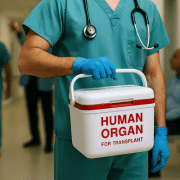
Animal-To-Human Organ Transplantation Is Advancing, And Could Save Millions Of Lives

Getting an organ transplant is an incredible feat of medical advancement, however, it’s incredibly hard to achieve. With over 100,000 people on the national waiting list in the US, thousands of patients die every year while waiting, and thousands of others aren’t even able to be added to the list.

brain

Software Program Powered by Artificial Intelligence May Revolutionize Treatment of Aneurysms

A medical software program powered by artificial intelligence called PreSize can potentially revolutionize the treatment of brain aneurysms. Scientists found that PreSize outperformed experienced neurosurgeons at predicting where to place a treatment stent in a patient’s brain.

Weakness in an artery wall typically causes aneurysms, which, if discovered before rupturing, can be medically monitored or surgically closed with a tiny metal clip. Brain aneurysms are more common in people over the age of 40 but can occur at any age.

Alternatively, a flexible mesh tube of metal called a stent can be implanted inside the artery via catheter insertion guided by X-ray imaging. These stents typically utilize shape memory alloys, which spring open upon being unsheathed.

Researchers analyzed data from previous brain aneurysm operations, during which a “multitude” of different stents were used, to better understand the devices’ behavior under different conditions.

Dr Katerina Spranger, founder and chief executive of the company that developed the software, Oxford Heartbeat, told the UK’s PA news agency that the placement of the device is critical during treatment.

“It’s extremely important to get the device correct, in terms of the correct size and also correct implantation. Currently, the way they do it, there is a lot of guesswork involved.”

According to Dr. Spranger, there is a high risk of complications from these complex devices, the most common of which are blood clots, which can lead to strokes.

“If the device is, for example, undersized, it can detach from the blood vessels and start traveling around the circulatory system of the body, which is huge complication. Or if it’s oversized, it can almost rupture the vessel.”

Embed from Getty Images

PreSize provides doctors with a reconstructed image of a patient’s brain and a catalog of digital device replicas that mimic the behavior of various stents.

“This is another key to the complexity of the problem because all those devices are very different. Each manufacturer has their own proprietary technology. In the virtual environment, the algorithms put the two together – the complex anatomy of the patient and mechanics of the device. It can predict what’s going to happen if you put a particular device into a particular location.”

The PreSize platform allows clinicians to load a patient’s scan and test out different devices right inside the operating room to determine which will be most effective.

“We do a lot of research, a lot of experiments, to make sure that the digital twins actually correspond to the actual device’s behavior. We designed it so that it’s extremely intuitive and extremely accurate. Fit for a high-stress surgical environment because the patient is usually already on the table.”

According to Dr. Spranger, the best device can be determined in just three minutes using PreSize instead of the usual 10-15 minutes.

“A fraction of a millimeter can make or break a surgery. We knew that for a software to be successful in such a high-stress environment, it has to be super easy. We designed it so that it can be used without even any training. They get real-time feedback. For example, if they want to try another device, reposition the device, elongate the device, choose another – it immediately reacts and immediately tells them ‘this is how it’s going to look.’”

Dr. Spranger predicts that the use of software in the medical field will soon become a “standard of care” due to its high accuracy, marking it as “a medical device of a new generation.”

Embed from Getty Images

According to The Independent, 375 people have had procedures using PreSize. Seven hospitals across England, Scotland, Germany, Finland, and Ukraine have been taking advantage of the new technology.

PreSize was found to be more accurate than human clinicians at predicting where a stent will “land” in the brain, according to research published in the BMJ Journal of Neurointerventional Surgery.

In the study, eight neurointerventionalists were given 3D images and data showing a stent’s initial landing location for 51 cases.

The medics were given the stent’s origin and instructed to plot its course as they usually would, using the information provided and the stent’s dimensions to make an educated guess as to where it would ultimately land.

PreSize could predict its final landing location with a 95% accuracy rate, while the neurointerventionalists had an 81% accuracy rate.

England’s healthcare system is currently using AI to help clinicians read scans and X-rays to speed up diagnoses and decision-making on treatments. However, Dr. Spranger recommends “rigorous testing” before deploying new systems.

“AI has the potential to revolutionize healthcare, but before we adopt it, we must rigorously test new systems. Medical device software companies like ours should be held to account to address any distrust about AI.”

NY Doctors Perform First Double Hands And Face Transplant 

This Wednesday, doctors at NYU Langone Medical Center announced that after 23 long hours in surgery they had performed the first successful face and double hands transplant on 22-year-old Joe Dimeo.

Back in 2018, 20-year-old Joe Dimeo fell asleep at the wheel of his car on Route 22 in New Jersey, causing him to lose control, hit a curb and flip his vehicle over, completely engulfing it in flames. Luckily a bystander was able to pull Dimeo out of the car before it exploded, but the young adult still suffered third-degree burns over nearly 80% of his body. 

The damage was so severe that he was left without eyelids, ears, and parts of his fingers. The scarring from the burns limited his range of motion and partially covered his eyes making it difficult to see. It’s for these reasons that Dimeo was so motivated to work with his doctors in performing this historic surgery. 

Dr. Eduardo Rodriguez is the head of the team that completed the surgery, and told the media this Wednesday that Dimeo is “the most highly motivated patient [he’s] ever met.” The surgery actually occurred in August of last year, however, the team of doctors wanted to wait and ensure that Dimeo’s body wouldn’t reject the transplants before calling the surgery a complete success. 

Embed from Getty Images

“There have been over a hundred hand transplants performed successfully, and close to 50 face transplants, so fundamentally there was no reason why they couldn’t occur together, successfully.”

There have only ever been two other attempts to complete a double hand and face transplant simultaneously worldwide but both were unfortunately unsuccessful. “We needed to avoid infection, we needed to have this operation occur as fast as possible, we had to be very selective with the donor, and we had to implement every state of the art technology that would ensure complete success of Joe’s operation, and that’s exactly what we did.”

“Joe is healthy, he’s young, he’s strong, he loves to exercise, he eats healthy, and he has that one special element which is going to be required for this operation, a high level of motivation and a tremendous sense of hope.”

The operation took 80 healthcare professionals spread across six surgical teams and two adjoining operating rooms to complete. One of the operating rooms was used to carefully retrieve the hands and facial tissue from the dying donor, which are then typically replaced with 3D prosthetics according to Rodriguez. 

Embed from Getty Images

“We always begin the operation with a moment of silence to honor the donor family, to respect their great loss, to never forget the donations that have been made. In all these operations it’s important to recognize that someone must give up their life so that others can continue living,” Rodriguez said. 

In the other room Dimeo was being meticulously prepared to receive the transplants. The surgery itself is long, grueling, and dangerous, and if done incorrectly would have resulted in the end of Dimeo’s life as well. Rodriguez explained that for each hand they had to replace “21 tendons, three major nerves, five major vessels, and two major bones,” and that’s not even including the face. 

After 23 hours in surgery and 45 days in intensive care, followed by two months of impatient rehab, Dimeo learned to open his new eyelids, more his new hands, and smile for the first time in years. Dimeo also recently spoke with the press about wanting to share his story and tell people to never give up on life. 

“I want to share my story to give people hope in the world. I’d like to recognize the selflessness of my donor, and how none of this would be possible without his sacrifice. Thank you. I feel like I’ve been given a second chance at life. There’s no excuse to not be motivated, or not to do my therapy. My hands aren’t there yet. I have to keep practicing, it’s kind of like when you’re a baby, they’re just moving their hands all the time until they get that ability to do stuff. I’ve got new hands now, just like them. There’s always light at the end of the tunnel. You never give up.”

Red Heart with Stethescope

Research Shows Lifestyle Changes and Medicine as Effective as Surgery for Heart Disease

According to a recent large study, stents and coronary artery bypass surgery are not more effective treatment options than intensive drug treatment and lifestyle changes that incorporate healthy habits, causing a new controversy in the medical field of cardiology. The subject of the best way to treat people with narrow coronary arteries has long been the subject of fierce discussion among doctors and researchers, with most doctors opting to implant stents into clogged arteries in order to treat people who have heart disease. Stents are tubes made out of wire mesh that force arteries open, allowing blood to flow more vigorously through the body. This type of surgery is very common, and it is even performed when patients have no symptoms or only experience pain after exerting themselves.

Embed from Getty Images

The findings of the study were released on Saturday during the American Heart Association’s annual scientific conference, and the study was the largest and one of the most rigorous of its kind ever conducted. Though the study found that surgery is often lifesaving for people who had heart attacks, the procedure may be performed more often than is medically necessary, as less invasive options produce similar positive health outcomes in certain populations. Among these options are the use of drugs that lower cholesterol, which contributes to the buildup of plaque within the arteries, which in turn increases one’s risk of heart attack or stroke. Stents or bypass surgery, however, are more effective than drugs and lifestyle changes for frequent chest pain.

While the findings discourage the use of surgery in patients who are asymptomatic, they may also encourage the procedure in people who have frequent chest pain

The findings are likely to have an impact on the conversations doctors have with their patients about the best course of treatment for a wide range of heart problems. While lifestyle changes, combined with medicine, are the ideal treatment for people with heart disease who experience no or only minor symptoms, these changes can be difficult for patients to make and keep over time. Changing one’s diet, for instance, generally involves a significant shift in the way one thinks about food, and committing to an exercise routine can be especially challenging for people who are busy. Interventional cardiologists perform surgeries like stent procedures, whereas preventative cardiologists prescribe drugs and encourage lifestyle changes; these recent findings are likely to inspire disagreements between these two specializations.

While the findings discourage the use of surgery in patients who are asymptomatic, they may also encourage the procedure in people who have frequent chest pain, as implanting stents was shown to be effective both in reducing chest pain and lowering the risk of a cardiovascular event. The study also highlighted the importance of smoking cessation in reducing one’s risk for heart attacks and strokes, as quitting smoking is perhaps one of the most significant lifestyle changes a person can make to improve their health overall, especially as he or she ages. 

Embed from Getty Images

While implanting stents is an effective treatment option in some cases, it is not totally effective; in the study, patients who had stents implanted suffered heart attacks at a rate of 5.3% whereas the group receiving medical therapy only underwent heart attacks at a rate of 3.4%. However, after four years had passed, the group with invasive procedures fared better than the other group, having heart attacks at a rate of 13.3% as opposed to 15.5%. While these findings need to be studied further, they may be the result of the fact that many people fail to maintain lifestyle changes over the course of several years. For treating chest pain, stents had a clear advantage over the other therapies, as they relieved chest pain in 50% of patients whereas medical and lifestyle therapy relieved chest pain in only 20% of patients. That being said, both options have been shown to be effective treatments for a number of heart problems, and thanks to modern medicine, people suffer from untreated heart issues at a lower rate than in the past.