Posts

Gwyneth Paltrow Faces Backlash Over Luxury Israeli Real Estate Campaign

Gwyneth Paltrow is drawing criticism online after appearing in a promotional campaign for an upscale residential tower being developed in Herzliya, Israel. The controversy follows the Oscar-winning actress’s discussion of her political views during a June 2 episode of her Goop Podcast. Speaking with Trae Stephens, co-founder of military technology company Anduril, Paltrow described herself as politically independent.

Bulgaria Wins 70th Eurovision Song Contest With Dara’s ‘Bangaranga’

Bulgarian singer Dara won the 70th Eurovision Song Contest this past weekend with her dance-party hit “Bangaranga.” This is the first-time the Southeast European country has won the competition.

beruit

Netanyahu Says Talks Coming as Israeli Strikes Hit Beirut, Kill Over 300 After Iran Ceasefire

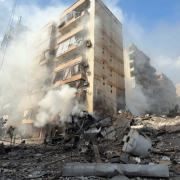
Israeli airstrikes struck central Beirut on Wednesday in what officials described as the most intense bombardment of the capital in the current phase of the Israel-Hezbollah war, killing at least 300 people and wounding over 1,000 more, according to Lebanon’s health ministry. The strikes hit densely populated commercial and residential districts without warning, transforming what had been a busy midday in the seaside city into a scene of devastation.

Gas Prices Top $4 as Middle East Conflict Disrupts Oil Supply

Gas prices across the United States have surged past a key threshold, placing renewed financial strain on consumers and adding pressure to the broader economy. On Tuesday, the national average for regular gasoline climbed above $4 per gallon for the first time since August 2022, capping weeks of steady increases tied to escalating tensions in the Middle East.

The rise has been swift. Since late February, average prices have jumped by roughly 35%, according to AAA data, following disruptions to oil supply linked to the ongoing conflict involving U.S. and Israeli forces and Iran. Although the United States does not rely heavily on Middle Eastern oil, the global nature of energy markets has pushed domestic prices higher.

Industry analysts say the psychological impact of the $4 mark could alter consumer behavior. “We have this obsession with gas prices because they dictate a lot of ‘Can we drive? Can we do things we enjoy?’ And now some of that is at risk,” said Patrick De Haan, an analyst at GasBuddy.

“As we get to a month of increases and prices are much higher, the amount of pressure on Americans’ budgets and their spending is going to ramp up.”

The effects are uneven nationwide. In California, drivers are paying an average of $5.89 per gallon, while Oklahoma residents pay far less at about $3.27 per gallon. Differences in taxes, refining expenses, and distribution systems continue to shape regional price disparities.

Embed from Getty Images

At the same time, diesel prices have also spiked, reaching $5.42 per gallon—up sharply from $3.76 before the conflict. Because diesel fuels are used for shipping and freight, the increase is expected to ripple through the economy, raising costs for goods ranging from groceries to furniture.

“It’s going to mean more expensive bills for truckers, tractors and trains that move the U.S. economy with diesel fuel. It’s going to mean consumers are likely greeted by rising grocery prices — and broadly speaking, a rise in U.S. inflation.”

Economists are increasingly concerned that sustained increases in fuel prices could accelerate inflation while slowing economic growth. Polling reflects that anxiety; more than half of Americans surveyed by Reuters/Ipsos reported that higher gas prices have already affected their household finances, with one in five saying the impact has been severe.

For President Trump, the situation presents both economic and political challenges. After previously highlighting falling fuel costs earlier in his term, the current surge serves as a visible reminder of the war’s consequences. “It is the biggest headache for whoever happens to be in power when something like this happens,” said Kate Gordon, a former senior adviser at the Department of Energy and now chief executive of California Forward.

Embed from Getty Images

While she noted that presidents typically have limited influence over gas prices, Gordon emphasized that this situation is unusual.

“Usually, a hurricane hits the gulf and gas prices go up, and then whoever’s in power gets blamed for it,” she said. In this case, she added, Trump is “going to get blamed anyway because he’s in power, but also he made the decision to go to war in Iran.”

The administration has attempted to respond with several measures to stabilize prices. These include plans to release 172 million barrels from the Strategic Petroleum Reserve, to ease restrictions on maritime shipping, and to temporarily suspend certain sanctions on oil shipments already in transit. Officials have also relaxed some summertime fuel-blend requirements to reduce pump prices.

Even so, structural factors are pushing prices upward. Seasonal demand is increasing as Americans prepare for spring and summer travel, while the switch to more expensive summer-blend gasoline further adds to costs. Meanwhile, domestic crude futures—though down from their peak during the crisis—remain more than 50% higher than they were at the end of February.

Abroad, countries more dependent on Middle Eastern oil supplies are already taking steps to curb consumption, including encouraging drivers to limit travel.

Experts say meaningful relief is unlikely until global supply routes stabilize. In particular, attention remains focused on the Strait of Hormuz, a critical shipping corridor for oil exports. “Opening the strait is the answer until it’s not,” Gordon said. “It’s the answer until someone attacks it again.”

For now, consumers are left adjusting to higher costs that are difficult to avoid. “There are some things you can change on the margins, but it’s not easy to change where you live, where you work, where you go to school,” Gordon said. “You can be more efficient, but it’s kind of a baked-in cost.”

iran

Trump-appointed Intelligence Chief Resigns Over Iran War, Citing Lack of “Imminent Threat”

A top US intelligence official appointed by President Donald Trump resigned Tuesday, publicly breaking with the administration over its decision to go to war with Iran and intensifying scrutiny of the intelligence used to justify the conflict.

“After much reflection, I have decided to resign from my position as Director of the National Counterterrorism Center, effective today,” Joe Kent wrote in a post on X.

In a resignation letter attached to the post, Kent sharply criticized the rationale for the war.

“I cannot in good conscience support the ongoing war in Iran. Iran posed no imminent threat to our nation, and it is clear that we started this war due to pressure from Israel and its powerful American lobby,” he wrote.

Kent’s departure marks the first major resignation of Trump’s second term tied directly to a policy dispute, and it comes as lawmakers and analysts question whether the administration overstated the threat posed by Iran.

The administration has maintained that military action was necessary to counter an “imminent threat.” Trump cited that justification following the initial strikes, and officials said the US acted to prevent potential Iranian attacks on American forces in the region.

However, those claims have been challenged. In briefings to Capitol Hill, Pentagon officials said Iran was not planning to strike unless it was attacked first. Kent echoed that skepticism in his resignation letter, accusing Israeli officials and media narratives of shaping a misleading picture.

“This echo chamber was used to deceive you into believing that Iran posed an imminent threat to the United States, and that should you strike now, there was a clear path to victory. This was a lie and is the same tactic the Israelis used to draw us into the disastrous Iraq war that cost our nation the lives of thousands of our best men and women. We cannot make this mistake again.”

Embed from Getty Images

Trump responded dismissively to Kent’s resignation, framing it as a matter of national security judgment.

“When somebody is working with us that says they didn’t think Iran was a threat, we don’t want those people,” Trump said from the Oval Office. “They’re not smart people, or they’re not savvy people.”

He added that Kent stepping down was a “good thing” and described him as “very weak on security.”

The war has exposed fractures within Trump’s political base.

Several prominent conservative figures, including Megyn Kelly and Tucker Carlson, have criticized the administration’s approach to Iran and its close alignment with Israel. Influential podcast hosts such as Joe Rogan, Theo Von and Tim Dillon, all credited with helping energize Trump’s 2024 campaign, have also voiced skepticism.

Despite that backlash, polling suggests most Republican voters support the war. An NBC News survey conducted after the conflict began found that 77% of Republicans  and 90% of self-identified MAGA Republicans backed the strikes on Iran.

The same poll showed 69% of Republicans sympathized more with Israelis than Palestinians. Still, favorable views of Israel among Republicans have declined, dropping to 54% from 63% in 2023.

Sen. Mark Warner of Virginia, the top Democrat on the Senate Intelligence Committee, criticized Kent’s broader record but agreed with his assessment of the intelligence.

“I strongly disagree with many of the positions he has espoused over the years, particularly those that risk politicizing our intelligence community. But on this point, he is right: there was no credible evidence of an imminent threat from Iran that would justify rushing the United States into another war of choice in the Middle East.”

Kent’s exit also draws renewed attention to his contentious record in government.

Embed from Getty Images

Before leading the National Counterterrorism Center, he served as a senior aide to Director of National Intelligence Tulsi Gabbard. He rose in prominence as a vocal supporter of Trump’s false claims about the 2020 election.

His tenure was marked by clashes with other officials. Last year, FBI Director Kash Patel and Justice Department leaders rebuked Kent after he attempted to access FBI systems to investigate the assassination of conservative activist Charlie Kirk, pursuing theories of possible foreign involvement.

Officials warned that such access could jeopardize the prosecution of Tyler Robinson, the Utah man charged in the killing.

Kent also faced scrutiny during his 2022 congressional campaign over past interactions with extremist figures. He repeatedly distanced himself from Nazi sympathizer Greyson Arnold and Holocaust denier Nick Fuentes, saying he was unfamiliar with Fuentes and did not seek his endorsement.

At his confirmation hearing, Sen. Patty Murray described him as a “conspiracy theorist who espouses white supremacist views and is patently unqualified for this important role in just about every way imaginable.” He was ultimately confirmed by a 52-44 vote in the Senate.

Despite the controversies, Kent brought extensive national security experience to the role. He served 11 combat tours during a 20-year Army career before becoming a CIA officer.

He is also a Gold Star spouse. His first wife, Shannon, a Navy cryptologist, was killed in a 2019 suicide bombing in Syria.

The administration’s rationale for the conflict has evolved over time.

Trump has variously framed the war as a response to threats of Iranian military action, an effort to curb nuclear and missile development, and a broader push to weaken a regime that has supported attacks on Americans. He has also expressed support for Iranian protesters seeking political change, even as officials insist the war is not aimed at regime change.

Kent’s resignation now adds a high-profile internal challenge to those shifting justifications and is likely to deepen questions about how the US entered the conflict in the first place.

stocks

Global Stocks Slide as Fears Grow of Prolonged Iran Conflict

Mounting concerns that fighting in the Middle East could drag on sent global markets sharply lower Tuesday, as investors reassessed the economic fallout of an expanding conflict.

US equities swung wildly before closing down for a second straight session. The Dow Jones Industrial Average finished 355 points lower, a drop of 0.73%, after plunging more than 1,200 points earlier in the day. The S&P 500 slipped 0.78%, and the Nasdaq Composite fell 0.82%, each trimming losses that had topped 2% at their worst.

Market volatility intensified. The VIX, widely viewed as Wall Street’s fear indicator, climbed 9% to its highest level in three months.

The selloff was not confined to the United States. European and Asian markets also declined for a second day. The pan-European Stoxx 600 lost 3.08%. Japan’s Nikkei 225 dropped 3.06%. South Korea’s Kospi sank 7.24%, its steepest one-day decline since April. South Korean markets had been closed on Monday for a public holiday.

Investor anxiety deepened as military operations entered a fourth consecutive day. Israel announced it was carrying out “simultaneous strikes in Tehran and Beirut,” aimed at Iranian military targets and the Iran-backed group Hezbollah.

Embed from Getty Images

Sources told CNN that US embassies in Saudi Arabia and Kuwait were struck amid Iranian bombardment. In response to escalating security risks, non-emergency US government personnel in Jordan, Bahrain, Iraq, Qatar, Kuwait and the United Arab Emirates have been ordered to leave.

President Donald Trump signaled uncertainty about the duration of the campaign. In a letter to Sen. Chuck Grassley on Monday, he wrote, “It is not possible at this time to know the full scope and duration of military operations that may be necessary.”

“These strikes were undertaken to protect United States forces in the region, protect the United States homeland, advance vital United States national interests, including ensuring the free flow of maritime commerce through the Strait of Hormuz, and in collective self-defense of our regional allies, including Israel.”

Taking questions Tuesday at the White House, Trump defended the decision to strike Iran, describing it as “something that had to be done.” He asserted that “just about everything’s been knocked out” in reference to Iran’s military infrastructure and voiced surprise that Iran chose to retaliate against neighboring countries.

Energy markets reflected fears of supply disruptions. Iran said Monday it would target any vessel attempting to move through the Strait of Hormuz, a strategic chokepoint that carries roughly 20% of global oil consumption. With hostilities ongoing, shipping companies and insurers have grown wary of sending vessels through the narrow waterway.

Embed from Getty Images

Crude prices extended their rally. US oil rose 5.9% Tuesday to $75.40 per barrel, building on a 6.3% gain the previous day. Brent crude climbed 5.8% to $82.14 per barrel, reaching its highest level since July 2024. Gasoline prices increased 11 cents to $3.11 a gallon.

“That the current war may be ‘inflationary’ is what’s panicking traders today,” Thierry Wizman, global FX and rates strategist at Macquarie Group, wrote in a note.

He added that earlier assumptions of a limited conflict are now in doubt.

“The view of a short war been upended today because of suggestions from the US administration that the war may be prosecuted for longer than a few weeks.”

Natural gas markets surged as well. European natural gas futures jumped 20% after soaring 38% Monday. In the US, natural gas futures advanced 6%, following a 3.5% rise a day earlier. Diesel prices outpaced those moves domestically, with futures climbing 12% Tuesday after nearly a 12% gain on Monday.

Currency and bond markets signaled shifting expectations around inflation and interest rates. The US dollar index gained 0.8% and is up 1.6% for the week, as traders weighed whether higher energy prices could delay Federal Reserve rate cuts. The 10-year Treasury yield rose as investors sold bonds and assessed the inflationary impact of higher oil prices.

Gold, often considered a refuge during turmoil, fell 4.25%, reversing Monday’s 1.2% climb to a one-month high, underscoring the sharp and uneven swings gripping financial markets.

gaza

Returning Gaza Flotilla Participants Report Mistreatment in Israeli Jails, Lawyers Cite Systemic Violations

An Italian activist detained after joining a Gaza-bound humanitarian flotilla has accused Israeli authorities of subjecting him and other participants to “gratuitous cruelty and humiliation” while in custody — allegations that Israel has strongly denied.

Lorenzo D’Agostino, one of hundreds of activists arrested when Israeli forces intercepted the Global Sumud Flotilla last week, said in an interview with CNN that detainees were forced to kneel or sit for hours on concrete in front of Israeli flags, kept in cold temperatures with little clothing, and had their belongings seized or destroyed. He described guards binding his wrists so tightly that circulation was nearly cut off.

“We were shocked by the level of humiliation and gratuitous cruelty that these people used on us. The way we were treated was pushing the mistreatment and the humiliation to the limit that they could afford.”

He added that because he is Italian, from a country allied with Israel, the guards “knew they couldn’t harm us physically” without drawing backlash.

“People coming from countries that are not allied (with Israel) were harmed physically. I was sharing my cell with a Turkish citizen (another activist) whose arm was broken, and he was left without painkillers for two days.”

Israel’s Foreign Ministry has rejected the allegations as “brazen lies,” asserting that “all the detainees’ legal rights are fully upheld.” The ministry called the flotilla a “pre-planned PR stunt” and said claims of abuse were part of a “fake news campaign.”

Embed from Getty Images

The Global Sumud Flotilla, a coalition of more than 40 vessels carrying food, water, and medical supplies toward Gaza, set sail in late August and early September in an effort to break the years-long blockade of the Palestinian territory. Israel, which maintains that the blockade is legal under international law, has described the flotilla as a provocation intended to delegitimize its security measures.

Among the roughly 450 people detained was Swedish climate activist Greta Thunberg, who, according to D’Agostino and legal representatives, was also subjected to degrading treatment. D’Agostino said Thunberg was forced to kneel on concrete in front of an Israeli flag and surrounded by others as police took photos of her.

Lubna Tuma, an attorney with the Adalah Legal Centre representing the detainees, said Thunberg and another activist were separated from the group and photographed with the flag “as an act of humiliation.”

Thunberg was deported on Monday along with 170 others. Speaking at Athens International Airport after her release, she said she could “talk for a very, very long time about our mistreatment and abuses in our imprisonment,” but added that “this is not the story.”

“What happened here is that Israel, while continuing to escalate their genocide and mass destruction, once again violated international law by preventing humanitarian aid from reaching people who are being starved.”

Israel has repeatedly maintained that its military operations in Gaza are conducted in accordance with international law and denies accusations of genocide.

Embed from Getty Images

D’Agostino also alleged that while he was in detention, Israel’s far-right National Security Minister Itamar Ben Gvir visited the flotilla participants and called them “terrorists” and “supporters of killers.” He said guards appeared to become “especially cruel” in Ben Gvir’s presence, tightening his restraints to the point where blood flow to his hands nearly stopped.

Later that day, Ben Gvir publicly criticized Prime Minister Benjamin Netanyahu’s decision to deport the activists, calling it “fundamentally mistaken.” “I believe they must be kept here in an Israeli prison for several months so they can breathe the air of the terrorists’ wing,” Ben Gvir said in a post on X.

Other deported activists have shared similar accounts. Goretti Sarasibar told Reuters that detainees were shown videos of Hamas’s October 7 attacks and were denied food for an entire day. Dutch activist Marco Tesh described being unable to breathe after guards “put something to my face” while his hands were tied behind his back.

Another activist, Rafael Borrego, displayed deep handcuff marks on his wrists and said guards routinely stormed cells with guns and dogs.

“At any time that any of us called a police officer, we risked that seven or more fully armed people entered to our cell, as they did on mine, pointing us with weapons at our heads, with dogs ready to attack us, and being dragged to the floor. This happened on a daily basis.”

By Monday, most of the detained activists had been deported, but their accounts have drawn concern from human rights advocates and governments whose citizens took part in the flotilla. Israel has continued to deny all accusations of mistreatment, reiterating that detainees’ rights were protected and dismissing their testimonies as more “fake news.”

Around the world, there have been widespread protests in response to the interception of the flotilla.

Spain Confirms It Will Boycott Eurovision 2026 If Israel Participates 

Spain has become the latest country to announce that they will not be participating in next year’s Eurovision song contest if Israel participates. The head of Spain’s broadcaster, RTVE, stated that “the genocide currently taking place makes it impossible for us to look the other way.”

Spain is the first of the “big five” Eurovision contestants to make this declaration. The “big five” refers to the nations that contribute the most money to the song contest event; the other four countries are France, Germany, the United Kingdom, and Italy. 

Embed from Getty Images

Slovenia, Ireland, and the Netherlands have also made the choice to not participate should Israel compete. The vote for Spain was held the same day as a UN commission of inquiry concluded that Israel was committing genocide in Gaza. 

José Pablo López, president of RTVE, said that the broadcasters that make up the European Broadcasting Union (EBU), which runs the contest, should no longer remain silent about the situation occurring in Gaza. 

“As joint organizers of the Eurovision song contest, we share a collective responsibility,” he said. 

“While Israel has regularly participated in the competition, the current events and the genocide currently taking place make it impossible for us to look the other way.”

“It is not accurate to claim that Eurovision is merely an apolitical music festival. We are all aware that the contest carries significant political implications. The Israeli government is equally aware of this fact and leverages the event on the international stage,” he added. 

Israel denied that it’s committing genocide in in Gaza, and its ambassador to the UN, Daniel Meron, said the report made by the UN commission of inquiry was “scandalous and fake,” the Guardian reports.

The EBU opened up a consultation process back in July with the 37 broadcasters who took part in Eurovision last year to discuss and debate Israel’s participation in the 2026 contest. Typically broadcasters have to inform the EBU about their participation by October, however, this year the deadline has been extended to December.  

López stated that RTVE is hoping Spain’s “visible, meaningful stand” would be taken seriously and properly received by other EBU members, and lead to a decision to be made sooner rather than later. 

“Our hope is that a decision can be reached well before December, as the EBU must be aware of the serious damage being done to the Eurovision song contest, which will mark its 70th anniversary in 2026,” he stated

“Therefore, we hope this decision will be made earlier and that the EBU won’t be subjected to the stress of a last-minute vote in London in December. We believe that, for the good of the festival and the values ​​it has championed since its inception, this matter must be resolved before the scheduled assembly.”

Embed from Getty Images

Eurovision is one of the biggest television events in the world, garnering over 160 million viewers this year. 2026’s contest will take place in Vienna in May. 

Russia was banned from the contest after its invasion of Ukraine in 2022 while Israel has been able to compete over the past two years despite the multitude of international concerns.

RTV, Slovenia’s public broadcaster, was the first to announce that they wouldn’t participate in Eurovision, followed by RTÉ in Ireland, and then Avrotros in the Netherlands. 

Avrotros stated: 

“The broadcaster also expresses deep concern about the serious erosion of press freedom: the deliberate exclusion of independent international reporting and the many casualties among journalists.”

Iceland’s public service broadcaster, RÚV also said they “reserved the right to withdraw” from Eurovision after claiming they were considering their position in the competition. 

Director of culture and factual content at Finnish public broadcaster, Yle, Johanna Törn-Mangs, said: 

“The humanitarian situation in Gaza is tragic, and we sincerely hope for an end to the suffering as soon as possible. Israel’s participation in Eurovision has been a significant topic of discussion in Finland and we have been consistently informing the EBU about the conversations happening here.”

“The EBU is therefore well aware of the public discussion in Finland. At Yle, we have received – and continue to receive – weekly feedback on this issue, both supporting and opposing Israel’s continued participation in the Eurovision song contest.”

The director of Eurovision, Martin Green, recently spoke about their recognition of the concerns regarding Israel’s participation in the contest. 

“We understand the concerns and deeply held views around the ongoing conflict in the Middle East. We are still consulting with all EBU members to gather views on how we manage participation and geopolitical tensions around the Eurovision song contest … It is up to each member to decide if they want to take part in the contest and we would respect any decision broadcasters make.”

visa

Bob Vylan’s US Visas Revoked For Anti-IDF Chants At Glastonbury 2025

Punk-rap duo Bob Vylan has made headlines this week after their performance at Glastonbury 2025. However, it wasn’t so much their performance that has created conversation, but their chants of “death, death to the IDF,” which has now led to the duo having their US visas revoked and the opening of a potential criminal investigation.

war

Russia Says U.S. Strike on Iran Would ‘Radically Destabilize’ Region Amid Escalating Israel-Iran Conflict

As tensions between Israel and Iran spiral, with fears it could turn into a full-blown war, Russia has issued a stark warning that any U.S. military strike on Iran would unleash chaos across the region and risk worldwide consequences. The caution comes amid reports that former President Donald Trump is weighing a potential attack on Iran’s nuclear facilities, demanding Tehran’s “unconditional surrender.”