Posts

online

Australians Spend The Most Money In The World To Sell Their Homes Online 

According to reports, Australians pay the most expensive advertising fees in the world in order to sell their homes online. In Australia, the housing market for sellers is dominated by two major companies: Real Estate Australia Group (REA Group) and Domain. Costs for listing a property can reach up to $4,000 for a listing in the inner-city. 

Sarah Martin, a senior correspondent for Guardian Australia, reported that the REA Group is a $27 billion company and earned a net annual profit of $460.5 million in August. These profits are also due to average price increases reaching 13% within the past year. 

Embed from Getty Images

Australia is one of less than five global markets where the seller of the home has to pay for advertising costs for the listings. 

“REA is the best in the world at this, REA is the most profitable real estate portal in the world … and organizations in every country around the world look to them for best practice – they are masters at this,” Mike DelPrete, a US-based industry expert, said.

“They are just printing money.”

In other global markets, the cost to advertise a property listing is typically covered by the real estate agent’s selling fee. 

“In Australia, many agents sign up to ‘premiere all’ advertising packages, which bind home vendors into buying the most expensive listing – close to $4,000 a property in inner-city Melbourne and Sydney,” Martin wrote

She also reported that compared to 15 years ago the prices are more than 50 times higher than what they used to be for a major listing. 

Embed from Getty Images

“They [REA Group] are getting deeper into the transaction rather than sticking with just advertising, and working hard to increase agents’ reliance on their services,” the Real Estate Institute of Australia’s president, Leanne Pilkington, said.

A REA Group spokesperson said “real estate agents could choose from a range of differently priced advertising packages, with a standard advertisement as low as $200. REA’s per listing costs are priced to reflect the additional value delivered to vendors and agents in digital prime experiences.”

“Our pricing structure reflects our focus on investment in new products, services, and features which support the consumer experience and drive consumer engagement.”

“Generally speaking, restrictions on access to platforms such as realestate.com.au will only raise concerns under the Competition and Consumer Act where those restrictions lead to a substantial lessening of competition,” the spokesperson said.

social

Children In Australia To Potentially Be Blocked From Social Media As A Part Of New Pilot Trial 

In May, Australia’s federal government announced a $6.5 million pilot trial regarding “age assurance technology” as a means of preventing children from accessing harmful and adult content online. 

Prime Minister Anthony Albanese initially announced that the pilot would work to “identify available age assurance products to protect children from online harm, and test the efficacy, including in relation to privacy and security.”

Embed from Getty Images

“The outcomes will inform the existing work of Australia’s eSafety Commissioner under the Online Safety Act – including through the development of industry codes or standards – to reduce children’s exposure to age-inappropriate material,” he stated

Now, the Australian government has expanded the trial program to look into potentially blocking children from accessing social media altogether. They’re currently in discussions with Meta, who owns Facebook and Instagram. 

Multiple campaigns have started with the launch of this trial which worked to push the government to look into banning children under the age of 16 from social media. The government is now looking into how this could potentially be possible and what it would truly look like if it occurred, according to reports.

Communications department acting secretary for online safety, Bridget Gannon, stated that the government will be “consulting with experts, with children, with parents, to understand their concerns and their interests on this issue, and really pulling it together with some policy advice to the government on possible ways forward.”

“We want to understand how different technologies work at those younger ages for that social media work,” she said as reported by the Guardian

Embed from Getty Images

Gannon also stated that the department has been speaking with multiple social media platforms like Meta, however, none of those companies are legally required to take part in the trial. In fact, Meta has already hinted that they are reluctant to take on the requirement of verifying the age of all of their users across their platforms. 

Instead, Meta believes that age verification should be the responsibility of app stores like Apple and Google. 

While individuals involved in the trial and within the committee have made the argument that these companies should feel obligated to comply with the trial, regardless of legal responsibility.

Gannon said it would be in these companies best interest to be involved in the trial as it will be informing them on how new codes will be developed and enforced as well. 

She also stated that the department will be working with technology experts to accurately assess how effective various technologies will work and what their impact may be. They will also work to analyze how easy it would be to regulate and distribute that technology over private networks.

houses

Australia Planning To Target Current Housing Crisis In National Budget

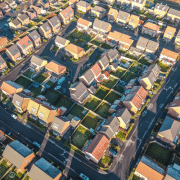
Australia is planning to address their climbing home prices in its national budget, as many citizens are currently struggling with the lack of affordable homes on the market.

horizontal falls

Sacred Australian Natural Wonder Implements New Ban To Stop Tourists From Visiting 

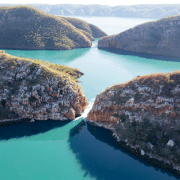
The Horizontal Falls in Australia are known for their coastal geography and powerful tide forces that, in the past, many visitors paid to see up close. Now, the falls are leaning back on allowing tourists to visit due to safety concerns, and complaints from the indigenous population in the area who have claimed for a while that the boat tours “desecrate” the falls.

airport

Australians Experience 50% Rise In Airfare Travel Costs To Europe 

According to data collected by travel booking site Kayak, Australians looking to travel to Europe are seeing fares around 50% higher than what they cost last year, despite the fact that there’s also been an increase in available seats this summer and fuel prices improving within the past few months. 

Kayak used data from early January, up until this month, to conclude that the average price for return economy airfare from Australian cities to Europe would be around $2,500. This marks a 46% increase on average airfares for 2022, as well as a 63% increase when compared to pre-pandemic pricing. 

In general, this summer travel season is already gearing up to be increasingly expensive as well as busy for many major destinations around the world, but especially in Europe. 

Embed from Getty Images

David Beirman, an adjunct fellow professor at the University of Technology in Sydney, Australia who also specializes in tourism, stated that this increase, while jarring, isn’t exactly surprising. 

“Airlines for a long time were making next to no money on international flights, especially for economy passengers. Most carriers were still working to financially recover from the steep losses of Covid, even if some such as Qantas have been posting record profits of late. Those two years of lost revenue is what consumers are paying for now,” Beirman explained. 

“Covid was an extreme lesson in what could happen when things go wrong. So they have been forced to be more realistic about their pricing now, as irritating as it is to the traveling public,” he continued. 

“Sadly what has happened since Covid is that travel has gone from being something very democratic that just about anyone earning even a modest salary could afford to being a plaything of the elite or for people paying huge amounts of money just to see loved ones.”

Embed from Getty Images

“They’ve had to recruit staff and pay them much more money than they used to get. Maybe by 2024 or 2025 people will be a bit more choosy, less eager to travel, and prices will come down but at the moment it’s very much a sellers market and airlines are, rightfully or wrongfully, taking advantage of that,” Beirman said.

Simon Elsegood, head of research at the Center for Aviation, said “while fuel prices have come back down substantially [and] we’ve seen a portion of the leisure market move up to premium economy and other classes, it’s not been enough to compensate airlines from lost business travel.”

“Air fares are a sore point because they are so much more expensive than 12 months ago but I don’t feel like people are getting a raw deal. It’s very difficult to price gouge between Europe and Australia because there are so many route options.”

“It’s just the way the market has to be at the moment. Yes, they’re making money now but they also lost billions during the pandemic. They’re not a charity and they have to make sure their shareholders are also taken care of,” he concluded

runway

Denni Francisco Is The First Indigenous Designer To Host A Solo Show At Australia Fashion Week 

Australia fashion week will host its first solo show for an Indigenous designer in its 23-year history this May. Denni Francisco of the Indigenous clothing label Ngali is gearing up to hold her first solo show in an honor she’s calling “exciting, exhilarating, and a little bit terrifying.”

“When you’re the first at doing something it comes with a degree of responsibility. There are cultural elements that come with everything we do, so it’s not just the creativity, it’s about ensuring it all comes together in a culturally appropriate way.”

Embed from Getty Images

Francisco is a proud Wiradjuri woman, and has won designer of the year at the National Indigenous Fashion Awards twice. 

This will mark the third time Francisco has had a showing at Australian Fashion Week, but will be the first time she’s had her own standalone show; previously she was featured as one of six designers on the Indigenous Fashion Projects runway show. 

Francisco previously was able to show between 6-8 designs during her featured showings in 2021 and 2022, this year, however, she’s planning a show of 30 looks in what she’s referred to as a “collective effort” between her and her team. 

“We’re already talking to the First Nations accessory designers and looking at what we can do with them. Everything that Ngali does, we’re looking at how we can bring in more of our mob, so it won’t just be Ngali. It will be more of our creatives coming together,” she explained. 

Embed from Getty Images

Australia’s Fashion Week this year will present 45 designers over a five-year program, a slightly more scaled down plan when compared to previous fashion weeks. 

Natalie Xenita of global entertainment conglomerate IMG, which has staged Australian fashion week since 2005, said “this schedule was based on feedback from the industry. We’ve been careful to curate the schedule this year so that it’s … manageable, and that each designer that’s showing can get their cut through.”

For the past two years of Australian Fashion Week, IMG didn’t charge designers to participate in the program, a rule that will continue into this year’s showing. 

“It’s a really important long-term strategy for us, because the industry is still recovering from the massive impact of the pandemic,” Xenita explained. 

Australia Will Reopen Borders To Vaccinated International Travelers 

Australian Prime Minister Scott Morrison announced this week that Australia will open its borders up fully for vaccinated international travelers starting later this month. The decision was made after Prime Minister Morrison met with the government’s national security committee. 

“The National Security Committee and Cabinet has decided today that Australia will reopen our borders to all remaining visa holders on the 21st of February,” Morrison said.

Embed from Getty Images

Australia has remained mostly closed since early 2020 when the pandemic began. Through travel program collaborations with New Zealand, Singapore, South Korea, and Japan, they’ve been able to slowly start reopening their borders for vaccinated travelers. 

As it currently stands, citizens, permanent residents and their families, as well as international students, backpackers, and migrant workers are allowed to enter the country if they can provide proof of two doses of an approved Covid-19 vaccine. Tourists will have to abide by the same rules as well. 

“The condition is you must be double vaccinated to come to Australia. That’s the rule. Everyone is expected to abide by it. State-based caps on quarantine will continue and those caps will still be determined by state and territory governments,” Morrison explained. 

Embed from Getty Images

Morrison went on to explain how visa requirements are different from the vaccination requirements being put in place for entry into the nation: “Your visa is one thing, but your entry into Australia requires you also to be double vaccinated and I think events earlier in the year should have sent a very clear message I think to everyone around the world that that is the requirement to enter into Australia.”

Morrison also explained that one of the biggest goals with the reopening it to help the travel industry recover within the country: “I know the tourism industry will be looking forward to that, and over the next two weeks they’ll get the opportunity both for visitors to be coming and for them to be gearing up to welcome international visitors back to Australia.”

Currently about 80% of eligible adults in Australia are fully vaccinated, a majority of which occurred after Tourism Australia released an ad campaign titled “Our Best Shot For Travel” across all online and physical news platforms to encourage citizens to get their inoculations so they could return to some level of normalcy when it comes to traveling. 

As of February 7th, Australia has over 2.7 million confirmed cases of Covid-19, of which there were also around 4,200 deaths. 

Australia’s Prime Minister Says International Travelers Won’t Be Welcome Until At Least 2022

Prime Minister Scott Morrison outlined plans for lifting some of Australia’s toughest Covid-19 this week. Part of this outline stated that foreign tourists won’t be welcomed back until at least 2022. The country will instead be prioritizing the return of skilled migrants and students by reopening external borders when they reach a certain rate of vaccination.  

Morrison’s benchmark for reopening will be once 80% of the population aged 16 and older are fully vaccinated. He also announced plans to allow vaccinated Australian citizens and permanent residents to fly overseas in November; citizens haven’t been able to leave since March 2020. 

Embed from Getty Images

Australia has been reporting the lowest level of immigration since World War II due to these strict travel restrictions. Australian universities and businesses have been struggling to cope with the lack of international students and tourists who typically support these institutions financially. 

Australia’s travel restrictions, however, has allowed life to return to a fairly normal place due to the lack of infection. As of right now some of its biggest cities, like Sydney and Melbourne, are currently experiencing shutdowns due to minor outbreaks. These shutdowns are what has helped keep Australia’s rate of infection low. 

The difficulty with restricting citizens from international travel is that half of Australia’s population was born overseas, or has at least one immigrant parent. Morrison said the priority will be to get migrants and international students back before tourists, but did not specify when he thinks those groups will be allowed back. 

Before the pandemic, the Australian Tourism Export Council made 33 billion American dollars in a year. That sort of revenue could help Australia’s recovery efforts immensely, which is why the Council is hoping international visitors will be able to return by March. 

Embed from Getty Images

As of right now, however, the lack of specificity in the plan to reopen borders has many workers within Australia’s tourism/travel industry worried. 

“International tourist arrivals have to be part of the plan. Even if they’re not the first priority, we’d like to see how this is going to be worked out. There are many businesses that are just hanging on,” said Daniel Gschwind, chief executive of the Queensland Tourism Industry Council.

Morrison said that the “government would work toward a complete quarantine-free travel for certain countries, such as New Zealand, when it is safe to do so,” but did not give a clear timeline as to when that will happen. Any international travelers that are able to travel into Australia currently must quarantine in a hotel for two weeks. 

Australia is currently battling outbreaks of Covid-19 and its variants while rushing to get as many citizens vaccinated as possible. It’s initial vaccine rollout was slow, but is starting to gain some momentum now.

Australia And New Zealand Rethinking ‘Covid Zero Strategy’ Amid Spreading Of Delta Variant 

Australia and New Zealand are rethinking their current Covid-19 strategies due to a surge in new cases caused by the spreading of the Delta variant. Initially both countries had strategies implemented that would bring the total number of cases down to zero before any type of social gatherings would be allowed, however, Australian Prime Minister Scott Morrison recently claimed that he believes it’s unlikely his country will ever return to zero cases. 

“Australia’s focus needs to shift to hospitalization rates rather than case numbers. The highly infectious nature of delta raised some pretty big questions about New Zealand’s approach of eliminating the disease,” Covid-19 Response Minister Chris Hipkins said.

Embed from Getty Images

In the beginning of the pandemic both Australia and New Zealand were advocates for the Covid Zero strategy. This meant that both nations closed their borders and implemented local guidelines to focus more on slowing down community-level transmission without having to worry about international visitors. 

This strategy was extremely successful, and prevented massive waves of new infections and deaths, like we saw here in the US. However, the spreading of the new delta variant has challenged this strategy greatly. In fact, Australia recently reported its highest number of daily infections for a second day straight. New Zealand is currently under the strictest lockdown measure that they’ve been in since the beginning of the pandemic. 

“With a virus that can be infectious within 24 hours of someone getting it, that does change the game a bit. With our Level Four lockdown, we are very well placed to be able to run it to ground, but we have to be prepared for the fact that we can’t do that every time there is one of these.”

Embed from Getty Images

Hipkins explained that the Covid Zero strategy had worked wonderfully pre-delta, but now it’s looking like a less adequate way to combat the new variant. The spreading of this variant also has to do with the vaccination rates in both nations. 

In both New Zealand and Australia less than 30% of the population is fully vaccinated. Australia’s Morrison claims vaccination rates need to reach 70-80% of the eligible population before restrictions are lifted again. 

Writing in the Daily Telegraph newspaper, Morrison said rising cases “need not impact our plan to reopen, and reopen as soon as we can.”

“So while right now our national strategy is necessarily about suppressing the virus and vaccinating as many people as possible, a one-eyed focus on just case numbers overlooks the fact that less people are getting seriously ill, let alone dying.”

New Zealand Prime Minister Jacinda Ardern recently laid out a plan that would ease lockdown restrictions as the government speeds up its vaccination rollout. Their goal is to reopen their borders by 2022.

Australia’s Covid-19 Delta Outbreak Worsening Despite Lockdown Measures 

Sydney, Australia is already debating extending their current lockdown as Australian health officials continue to report a daily rise in Covid-19 cases. These daily rises are specifically fueled by the highly contagious Delta variant of the virus that’s been spreading around the world. 

New South Wales state reported 112 new cases of Covid-19 despite the fact that Sydney, the country’s largest city, is currently entering its third week of lockdown. Case numbers have been reaching record highs every day. New infections luckily dropped slightly this Sunday, from 45 to 34. 

Embed from Getty Images

State Premier Gladys Berejiklian said the “progress of that figure in coming days would determine whether Sydney’s lockdown would be extended. That’s the number we need to get as close to zero as possible. It is really up to us. The health expert advice will be based on what those numbers look like. I can’t be clearer than that.”

Total infections in this particular outbreak are reaching 700. 63 individuals are currently hospitalized while 18 are in intensive care. 

Lockdown measures in Sydney include school closures, stay-at-home orders, and of course mask mandates and social distancing procedures anywhere essential workers are present. Many small business owners are worried about the economic impact of another lockdown if the government doesn’t provide any economic assistance. 

Embed from Getty Images

Australia was able to previously contain their Covid-19 flare-ups with strict lockdowns, speedy contact tracing efforts, and social distancing rules. The nation has experienced 31,200 cases and 911 deaths since the pandemic began. 

Only 11% of Australia’s adult population of 20.5 million have been fully vaccinated. Critics believe a lack of communication with the public and vaccine shortages in general have led to the outbreak the nation is currently enduring. 

Federal health guidance in Australia currently recommends the AstraZeneca vaccine be restricted to individuals over the age of 60 while the Pfizer vaccine is limited to individuals between the age of 40 and 60. 

In New South Wales, vaccine centers and pharmacies will be able to give the AstraZeneca vaccine to anyone over the age of 40. The state government also claimed they would be opening a vaccination hub in western Sydney, which is the epicenter of the outbreak.