Returning Gaza Flotilla Participants Report Mistreatment in Israeli Jails, Lawyers Cite Systemic Violations
An Italian activist detained after joining a Gaza-bound humanitarian flotilla has accused Israeli authorities of subjecting him and other participants to “gratuitous cruelty and humiliation” while in custody — allegations that Israel has strongly denied.
Lorenzo D’Agostino, one of hundreds of activists arrested when Israeli forces intercepted the Global Sumud Flotilla last week, said in an interview with CNN that detainees were forced to kneel or sit for hours on concrete in front of Israeli flags, kept in cold temperatures with little clothing, and had their belongings seized or destroyed. He described guards binding his wrists so tightly that circulation was nearly cut off.
“We were shocked by the level of humiliation and gratuitous cruelty that these people used on us. The way we were treated was pushing the mistreatment and the humiliation to the limit that they could afford.”
He added that because he is Italian, from a country allied with Israel, the guards “knew they couldn’t harm us physically” without drawing backlash.
“People coming from countries that are not allied (with Israel) were harmed physically. I was sharing my cell with a Turkish citizen (another activist) whose arm was broken, and he was left without painkillers for two days.”
Israel’s Foreign Ministry has rejected the allegations as “brazen lies,” asserting that “all the detainees’ legal rights are fully upheld.” The ministry called the flotilla a “pre-planned PR stunt” and said claims of abuse were part of a “fake news campaign.”
The Global Sumud Flotilla, a coalition of more than 40 vessels carrying food, water, and medical supplies toward Gaza, set sail in late August and early September in an effort to break the years-long blockade of the Palestinian territory. Israel, which maintains that the blockade is legal under international law, has described the flotilla as a provocation intended to delegitimize its security measures.
Among the roughly 450 people detained was Swedish climate activist Greta Thunberg, who, according to D’Agostino and legal representatives, was also subjected to degrading treatment. D’Agostino said Thunberg was forced to kneel on concrete in front of an Israeli flag and surrounded by others as police took photos of her.
Lubna Tuma, an attorney with the Adalah Legal Centre representing the detainees, said Thunberg and another activist were separated from the group and photographed with the flag “as an act of humiliation.”
Thunberg was deported on Monday along with 170 others. Speaking at Athens International Airport after her release, she said she could “talk for a very, very long time about our mistreatment and abuses in our imprisonment,” but added that “this is not the story.”
“What happened here is that Israel, while continuing to escalate their genocide and mass destruction, once again violated international law by preventing humanitarian aid from reaching people who are being starved.”
Israel has repeatedly maintained that its military operations in Gaza are conducted in accordance with international law and denies accusations of genocide.
D’Agostino also alleged that while he was in detention, Israel’s far-right National Security Minister Itamar Ben Gvir visited the flotilla participants and called them “terrorists” and “supporters of killers.” He said guards appeared to become “especially cruel” in Ben Gvir’s presence, tightening his restraints to the point where blood flow to his hands nearly stopped.
Later that day, Ben Gvir publicly criticized Prime Minister Benjamin Netanyahu’s decision to deport the activists, calling it “fundamentally mistaken.” “I believe they must be kept here in an Israeli prison for several months so they can breathe the air of the terrorists’ wing,” Ben Gvir said in a post on X.
Other deported activists have shared similar accounts. Goretti Sarasibar told Reuters that detainees were shown videos of Hamas’s October 7 attacks and were denied food for an entire day. Dutch activist Marco Tesh described being unable to breathe after guards “put something to my face” while his hands were tied behind his back.
Another activist, Rafael Borrego, displayed deep handcuff marks on his wrists and said guards routinely stormed cells with guns and dogs.
“At any time that any of us called a police officer, we risked that seven or more fully armed people entered to our cell, as they did on mine, pointing us with weapons at our heads, with dogs ready to attack us, and being dragged to the floor. This happened on a daily basis.”
By Monday, most of the detained activists had been deported, but their accounts have drawn concern from human rights advocates and governments whose citizens took part in the flotilla. Israel has continued to deny all accusations of mistreatment, reiterating that detainees’ rights were protected and dismissing their testimonies as more “fake news.”
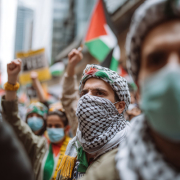
Around the world, there have been widespread protests in response to the interception of the flotilla.

Moumita Basuroychowdhury is a Contributing Reporter at The National Digest. After earning an economics degree at Cornell University, she moved to NYC to pursue her MFA in creative writing. She enjoys reporting on science, business and culture news. You can reach her at moumita.b@thenationaldigest.com.