Posts

How Ancient Lake Salda In Turkey Is Helping NASA Learn About Mars

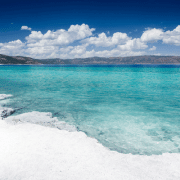
Known for its wondrous landscape, turquoise waters, and wildlife population, Lake Salda in Turkey is quite the tourist attraction. Beyond its beauty, the lake is actually helping scientists learn more about Mars, as Lake Salda is the only location on Earth that is comparable to the Jezero Crater on the Red Planet.

Dr. Ani Kalayjian MeaningfulWorld

Helping Survivors Find Meaning in Trauma | Dr. Ani Kalayjian

Trauma is a silent epidemic that affects millions of people around the world. In times of natural disasters, armed conflict, humanitarian crises or interpersonal violence, the aftermath can leave individuals and sometimes communities with deep emotional scars. To help survivors transform their suffering and find resilience, psychologist Dr. Ani Kalayjian founded the international non-governmental organization MeaningfulWorld.

Sona Van Poet

Poetry As a New Religion | Sona Van

The intersection between poetry and activism has become even more prominent in recent years, as poets worldwide use their work to amplify marginalized voices and challenge oppressive systems. In the face of political turbulence and historical trauma, Armenian-American poet Sona Van has used her words and her voice to bring attention to the Armenian Genocide, the ongoing conflict in Artsakh, and the struggle for recognition and justice.

rescue

Over 60 Dead And Dozens Missing In Italy Migrant Tragedy 

Italy’s southern coast was the site of a major migrant tragedy in which 62 people have been reported dead while dozens remain missing. At least seven children have died after a boat broke up within stormy seas off the Calabrian coast this past Sunday. 

The boat was reported to have 170 passengers on it with around 80 surviving, while the remaining unaccounted for individuals are feared to have also passed away. 

The United Nations and Doctors Without Borders were at the scene of the accident, where they reported a majority of the victims were Afghan, Pakistani, and Iraq; all groups were seeking asylum in the EU. 

Embed from Getty Images

Monday, two coast guard vessels performed search and rescue from north to south off Steccato di Cutro while a helicopter assisted from the air. Firefighters located three additional bodies on Monday as well. 

“I think no, because the sea conditions are too difficult. But we can never abandon this hope,” said provincial fire Commander Roberto Fasano. 

Italy is a major destination for migrant smugglers, specifically traffickers from the Libyan shores and Turkey. According to the UN, “ arrivals from the Turkish route accounted for 15% of the 105,000 migrants who arrived on Italian shores last year, with nearly half of those fleeing from Afghanistan.”

Potential refugees from Turkey have been known to take risky journeys through the Mediterranean to avoid Greece, where authorities have been pushing back on migrant entry. 

The EU’s Frontex border agency confirmed on Saturday that they saw the migrant ship heading for the Calabrian coast, and Italian authorities were immediately notified. While the ship was initially reported to look overcrowded, there were no reports of danger. 

Embed from Getty Images

After boat remains were found on the shores near Crotone, Frontex declared a rescue operation to search for survivors. 

“It was impossible to conduct any possible maneuver to get close (to the migrant ship) or to carry out a rescue due to the sea conditions. We always have to consider that rescues carried out by institutional rescue teams must avoid putting at risk the lives of the rescuers while they are trying to rescue others,” Interior Minister Matteo Piatedosi said. 

Firefighter Inspector Giuseppe Larosa said the “first rescue crews to arrive were devastated by how many children had drowned, and observed that the bodies of the dead had scratches all over them, as if they had tried to hang onto the boat to save themselves.”

“It was a spine-chilling scene, the reaction of the survivors haunted [me]. The thing that struck me the most was their silence. The terror in their eyes and the fact that they were mute. Silent,” Larosa stated. 

Rescue efforts are currently still being made to account for all 170 passengers of the vessel.

earthquake

Turkey And Syria Facing Years Of Rebuilding Following 7.8 Magnitude Earthquake 

Turkey and Syria are currently enduring the aftermath of a 7.8 magnitude earthquake that left both nations in complete devastation. 

“We’ve done a bit of mapping of the size of the affected area, it’s the size of France,” said the director of disasters, climate, and crises at the International Federation of the Red Cross, Caroline Holt, to CNN.

“We haven’t yet seen the full extent of the damage and of the humanitarian crisis unfolding before our eyes,” said Antonio Guterres, the United Nations Security-General. 

The World Health Organization estimated up to 23 million people could be impacted by the disaster. More than 100 aftershocks have been recorded within a day and a half following the initial earthquake, one of which had a magnitude of 7.5.

Embed from Getty Images

As of last Friday more than 22,000 deaths have been reported. While Turkey has experienced earthquakes in the past, citizens are angry that the government doesn’t have a more solid preparation plan in place that could’ve protected more people.

Ajay Chhibber, an economist who was World Bank director for Turkey, told CNN that “it’s like a bad movie [that’s] coming back again. Similar to this week’s event, a past 1999 earthquake tremor struck in the early hours but it occurred in the country’s northwest – a densely populated area closer to Istanbul. It lasted around 45 seconds, leaving more than 17,000 dead and an estimated 500,000 people homeless.”

More than 6,000 buildings have collapsed. Chhibber stated that “Turkey is capable of moving very, very swiftly if they can get their act together on this.”

Ismail Baris, professor of social work at Istanbul’s Uskudar University and former mayor of Golcuk at the time of the quake, told CNN that “in addition to the collapsed private and public buildings, the city’s water transport pipes, water supply network, sewage system [and] storm water system were completely destroyed, as well as 80% of the city’s roads.”

“Across the border in Syria, rebuilding efforts will be even more complicated. Syrians face“nightmares on top of nightmares, and the World Food Program has described the situation in the northwest of the country as a catastrophe on top of catastrophe,” Guterres warned this past weekend.

Embed from Getty Images

“We have the perfect humanitarian storm in Syria,” said Caroline Holt.

Pre-earthquake, the UN has estimated that more than 4 million people were already dependent on humanitarian aid due to the civil war which has been impacting Syria since 2011. “After 12 years of constant pain, suffering and living in a vulnerable context, your ability to withstand – especially in winter – the harsh conditions that you’re facing [is diminished],” Holt told CNN.

“The conflict – or conflicts – are much worse in that area of Syria than in that area of Turkey,” said Ilan Kelman, professor of disasters and health at University College London. 

“While Turkey has political problems of its own, they do have a comparatively strong government and comparatively strong military in comparison to Syria, which is at war. Turkey also has greater pre-earthquake resources. Neither country is especially rich, but Turkey at least has that baseline where they’ve not been in a major conflict dividing the country for 12 years. They have not been isolated through sanctions,” Kelman said.

“While disasters like this wreak havoc, they also create opportunities to prevent such havoc being wrought again. There is a man-made part of every natural disaster,” according to Chhibber.

“We do have examples where people have taken the opportunity to say there has been a disaster, and we want to help people, so let’s try to reconstruct in such a way that we are supporting peace. At the moment, I do not see either government responding in that way, and I do not see the world responding in that way,” Kelman said.

earthquake

Over 2,700 Killed after Two Major Earthquakes Rock Syria and Turkey

Over 2,700 people were killed, and thousands more were injured when two major earthquakes struck Turkey and Syria on Monday. Hundreds of buildings collapsed and buried residents under their wreckage.

NATO

Tensions Emerge at NATO Summit

Seventy years after the founding of NATO, a military alliance originally meant to protect western Europe from the Soviet Union, world leaders gathered in London with the intent of discussing policy goals. However, tensions between the various leaders overshadowed this plan, as conflicts between leaders became apparent both during speeches given by these leaders and the conversations they had with each other, some of which was captured by a hot mic and circulated online. President Trump, whom the other leaders appeared to criticize in conversations amongst themselves, abruptly decided to cancel a press conference at the close of the meeting, instead returning to Washington prematurely. As justification for the sudden cancellation, Trump cited the fact that he had already spoken with the media for a substantial period of time. Trump’s sudden decision to abandon the summit speaks to the tensions felt between world leaders with respect to the American president, and ultimately represents a failure of world leaders to see eye-to-eye with Trump.

Tensions arose even before the summit began, as French president Emmanuel Macron declared that the organization had become “brain dead” as a result of American indifference to the military alliance. According to Macron, Europe can no longer rely on the United States to defend NATO allies, as the current administration cannot be trusted. Trump responded to Macron’s incisive comments by calling them “insulting” and “nasty.” Later, Macron said that he stood by his comments.

Embed from Getty Images

NATO’s secretary general, Jens Stoltenberg, addressed the tensions over the meeting, making a call for unity and assuring his audience that NATO was strong and agile enough to overcome these tensions. Stoltenberg then described NATO’s goals for North America and Europe, which include continuing the international fight against terrorism, arms control, fighting Russia, and dealing with the rise of China. Referencing the internal divisions between world leaders who are members of NATO, Stoltenberg pointed out that there has always been differences between world leaders since NATO began, such as disputes about the 1956 Suez crisis and the war in Iraq.

While meeting Trump, Prince Charles appeared to subtly give the American president the middle finger

Things only became more tense as the meeting progressed. Donald Trump and Emmanuel Macron held a joint press conference, during which Macron criticized the American president for his handling of the conflict in Turkey and the Islamic State fighters in Syria as well as a developing trade dispute between France and the United States. Macron’s criticism of American leadership led Trump to defend NATO, an unusual position for a president who has spoken at length about his opinion that NATO is outdated and obsolete. Macron also fact-checked Trump in real-time; when Trump claimed that the ISIS prisoners being held in Syria are “mostly from Europe,” Macron responded that they in fact come from Syria and Iraq. Trump responded to these criticisms by appearing to threaten to send ISIS fighters to France, causing Macron to say, “Let’s be serious.” Despite the conflict between the two leaders, the joint conference ended up running long, causing Macron to be late for the next event.


Embed from Getty Images

Shortly afterwards, several leaders engaged in a conversation, appearing to gossip about Trump, part of which was captured on a video which generated significant attention online. During this conversation, which included Macron as well as English Prime Minister Boris Johnson and Canadian Prime Minister Justin Trudeau. During the brief portion of the conversation which has become publicly available, Johnson asks Macron why he was late, leading Trudeau to make a comment about Trump’s excessively long press conferences. Apparently referencing Trump, Trudeau commented that “you just watched his team’s jaws drop to the floor.” Though Trump’s name was not mentioned during this portion of the conversation, it was clear to many observers that the person these leaders were discussing was President Trump. While Johnson denied having participated in this conversation about the American president, Trudeau confirmed that he had in fact discussed Trump with others, clarifying that his comment about his team’s jaws dropping was a reference to the President’s decision to host the G7 summit at Camp David. After the video circulated online, Trump fired back against Trudeau, calling him “two-faced,” later adding that he thought he was “very dishonest and weak.”

Tensions between the leaders also arose in more subtle ways. While meeting Trump, Prince Charles appeared to subtly give the American president the middle finger, though the gesture may have been unintentional. Trump also left Johnson and Stoltenberg waiting for nearly six minutes on stage at the beginning of the meeting, as he arrived late. And when Macron shook Melania Trump’s hand, he used both hands and lingered for a moment, which was perceived by some as a power play against Trump. Though the interaction between the two is minor, Trump has been known to use somewhat aggressive body language in his interactions with others, leading other world leaders to develop strategies for handling this quirk. While trying to read the intentions of others based on their body language is not entirely reliable, there exist a countless number of examples of how the tensions between leaders of the world right now manifest in various ways, many of which transpired during this year’s NATO meeting.

Speech

Greta Thunberg Delivers Impassioned Speech to World Leaders at U.N.

Just days after leading the largest climate protest in history and testifying before Congress about climate change, 16-year old activist Greta Thunberg delivered an impassioned, angry, and scathing speech directed at world leaders at the UN today. Thunberg, whose home country is Sweden, has captured the imagination of American youth for her emissions-free voyage by boat to the US, her outsider’s view of American society, which she observes as being characterized by excessive waste and denial of climate change, and for her blunt, impolite, and unapologetic manner of speaking. Despite her sudden rise in popularity and widespread admiration, Thunberg has urged adults not to celebrate her, instead shifting the focus towards the problem that has animated her protests. As her written testimony for Congress, Thunberg submitted the 2018 global warming report from the Intergovernmental Panel on Climate Change, saying “I don’t want you to listen to me. I want you to listen to the scientists.”

Embed from Getty Images

Last night, Thunberg in cooperation with a team of activists, projected a message onto the side of the U.N. building in 30 languages in advance of today’s summit. The message, signed with Thunberg’s name, insisted that for the sake of humanity global economic and political systems would have to undergo rapid and drastic change, urging leaders to “wake up” and saying that “everything needs to change and it has to start today.”

Although she has drawn criticism from people who have claimed she is naive, Thunberg readily admits she is not an expert in climate science, but insists that scientists ought to be listened to, and that world leaders have failed to heed their warnings. During her speech today, Thunberg was unapologetic, as she excoriated world leaders for their failure to act and essentially accused them of robbing her and her generation of their future. “How dare you,” Thunberg said, seemingly fighting back tears, “you have stolen my dreams and my childhood with your empty words, and yet I’m one of the lucky ones. People are suffering. People are dying. Entire ecosystems are collapsing.” 

Thunberg warned that the consequences of continuing not to act would be remembered by her generation and generations to come.

In addition to castigating world leaders for their inaction on what she understands to be an urgent matter, Thunberg warned that the consequences of continuing not to act would be remembered by her generation and generations to come. “You are failing us, but young people are starting to understand your betrayal,” she said. “And if you choose to fail us, I say: We will never forgive you.” Thunberg also described the goals set by nearly every country in the world to reduce their carbon emissions as inadequate, noting that even if countries reach the targets set at the Paris Climate Accords, there is only a 50% chance that global warming will not exceed 1.5 degrees celsius. Also, Thunberg chided current strategies for dealing with climate change for relying on her generation to invent and deploy technologies to remove carbon from the atmosphere, essentially leaving them with the burden of cleaning up their mess.

Alongside her emotional speech, which Thunberg delivered next to a panel of climate change experts, she and 15 other child plaintiffs filed a legal complaint against five countries, alleging that they violated a treaty protecting the rights of children by knowingly contributing to climate change. The complaint is addressed to Germany, Brazil, France, Argentina, and Turkey, five countries that have signed the Convention on the Rights of the Child, and asserts that these countries had an obligation to “prevent the deadly and foreseeable consequences” of climate change, and have long had the opportunity to do so but chose not to. On her Twitter account, Thunberg urged media outlets to report not just on her contributions to climate change activism, but to report on the countless number of other child activists and victims of climate change. This lawsuit resembles one filed by young people in the United States against the federal government, arguing that the government has a responsibility to protect young people from climate change. The lawsuit is currently being deliberated by judges from the Court of Appeals for the Ninth Circuit, and its outcome could have drastic effects on environmental law in the United States.