Posts

recycle

The Importance Of Proper Electronic Recycling 

In the digital age, most of us have the experience of our old devices piling up in bins and drawers as we upgrade them over the years. While electronics can be recycled, it can feel difficult to figure out the specifics of how to properly dispose of each individual item, but it’s important that we do.

According to the United Nations’ most recent estimates, the world generates millions of tons of electronic waste (e-waste) annually. In 2022, for example, people around the world produced 137 billion pounds of e-waste with only 22% of it being properly recycled. 

Embed from Getty Images

The Environmental Protection Agency echoed those estimates, claiming that less than a quarter of e-waste is recycled in the US every year. 

When e-waste goes to regular landfills, the devices can emit harmful materials that can hurt our environment. They also contain metals that are hard to source, so recycling is the best option to maintain sustainability. 

Rick Neitzel, an environmental health sciences professor, said: 

“The way that we’re creating and using and disposing of these devices has generated this completely unsustainable waste stream, and there’s no signs of that abating at all. In fact, the trend continues to accelerate.”

If more electronics were properly recycled, it could also drive down to costs of some newer electronics. 

Electronics have such a wide range of materials and types, making recycling seem daunting. Recyclers need to be able to extract each component and material efficiently, which can be a complex, energy-intensive, and expensive process, Neitzel said. 

Components such as steel, aluminum, copper, gold, silver, plastics and even glass, can be recovered and reused, said John Shegerian, founder of Electronic Recyclers International, to AP

“These electronics — which could and have historically ended up in our landfills or in other inappropriate places — can leak all the stuff that’s contained there within: Mercury, lead, cadmium, beryllium, arsenic. All these things are horrible if they get into our environmental ecosystem,” Shegerian said.

Embed from Getty Images

If one of your devices is newer and still in working condition, manufacturers can potentially refurbish and resell it. There are organizations that will also refresh and reset these devices to give them to those in need or community-type centers to be utilized for free by many. 

If you think your device can no longer be refurbished, checking in with a manufacturer is still a great place to start when it comes to being guided in the right direction on properly disposing your device. 

“The manufacturers are where we want this stuff to end up because they know their products, they know best and most efficiently how to recycle them,” Neitzel said.

There are major retailers that also offer recycling services. Stores like Best Buy and Staples often accept big and small devices for recycling, and can even help with larger items like refrigerators and televisions. 

Many local governments also have information regarding where to drop off certain electronics in your specific area, so make sure to check out your community websites and local offices for information as well. 

“Typically, if you’re dropping them off at a government-run electronic waste collection station, you can be confident in that,” Neitzel said.

There are many online resources that you can also use to mail-in your old devices to have them properly disposed of. Many websites such as Waste Management, Amazon, Best Buy, and others will send you boxes directly to your door to fill up and mail out for disposal.

battery

New Research Finds That Lithium Ion Batteries Contain ‘Forever Chemicals’ That Threaten The Environment 

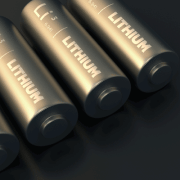
New research which was recently published in the journal Nature found that lithium ion batteries contain “forever chemicals,” also referred to as toxic PFAS. These chemicals have shown to be a dangerous source of chemical pollution that threatens the environment as well as human health, according to the study. 

The study itself focused on an unregulated subclass of PFAS known as bis-FASI that previously had very little research published about them. This subclass is used in lithium ion batteries which are often disposed of in landfills, creating a major source of pollution. 

Embed from Getty Images

According to Jennifer Guelfo, one of the researchers who co-authored the study: “The nation faces two critical challenges – to minimize aquatic pollution and increase our use of clean and sustainable energy, and both are worthy causes. 

“But there’s a bit of tug-of-war between the two, and this study highlights that we have an opportunity now as we scale up this energy infrastructure to do a better job of incorporating environmental risk assessments.”

PFAS are often used for making products that are resistant to water, stains, and heat. They are referred to as “forever chemicals” because they do not naturally break down and were found to accumulate in humans. 

“The chemicals are linked to cancer, birth defects, liver disease, thyroid disease, plummeting sperm counts and a range of other serious health problems,” wrote Tom Perkins for the Guardian

Embed from Getty Images

Public health advocates have been trying to find and advertise alternatives to the toxic chemicals for clean energy technology, like batteries and wind turbines. 

The research stated that there aren’t a lot of disposal standards or regulations available for PFAS battery waste. This lack of governance has led to a majority of PFAS battery waste to end up in landfills that easily leak into waterways, accumulate locally, or are transported long distances, according to the report

The study also stated that bis-FASI specifically can be reused and recycled, however, only about 5% of lithium batteries are properly disposed of to do so. By those margins, 8 million tons of battery waste by 2040, unless recycling standards are changed and enforced. 

“This says that we should be taking a closer look at this class of PFAS,” Guelfo said.

The researchers took samples of water, soil, and air surrounding a 3M plant in Minnesota. “The soil and water levels were concerning, and detection of the chemicals in snow suggests the chemicals easily move through the atmosphere,” Guelfo said.

Travel Couple

How to Travel More Sustainably

As the effects of climate change continue to manifest in the form of increasingly destructive extreme weather events, including the massive wildfires currently affecting Australia, people are becoming increasingly interested in how to reduce their own carbon emissions to mitigate their personal impact on the crisis. While travelling the world is a personal goal and aspiration for many of us, it unfortunately also represents one of the most serious contributors to climate change, as the carbon emissions released during travel can be substantial. Luckily, there are a number of changes that travelers can make during their trips to reduce their carbon output while still being able to visit attractive destinations.

Embed from Getty Images

Although travel by airplane is the quickest and often only viable way to reach many of the world’s most popular travel destinations, it also causes substantial carbon emissions. That being said, some airlines are better than others in this regard, as airlines like United, Qantas, and KLM use sustainable aviation biofuel instead of traditional jet fuel, which is less damaging to the environment. Travelling by train generates up to ten times fewer carbon emissions than travelling by plane, and while choosing this form of travel limits your selection of destination severely, it also makes for a cheaper and generally more enjoyable mode of transport. If you’re interested in avoiding air travel for environmental reasons, it’s likely a good idea to research travel destinations near train stations, which include major cities and national or state parks. Alternatively, if you’re interested in going on a cruise, there exist a few environmentally-friendly options, including Alaskan Dream Cruises and Aqua Expeditions, which work to protect the environments of the communities they visit. If your ideal vacation involves immersing yourself in nature, you generally don’t have to travel far to do so, as the United States is home to countless parks, forests, and natural wonders. If it’s practical to do so, opt to travel within your destination via bicycle, which has no environmental impact whatsoever.

Travelers interested in minimizing their environmental impact should also take their accommodations into account. Staying at a hotel generally uses more energy and produces more carbon emissions than staying at home, but this doesn’t have to be the case. Some hotels adopt environmentally-friendly policies to reduce their impact on the local ecosystem and the global environment more broadly, making them a good choice for the environmentally-conscious. Angama Mara, a hotel in Kenya, has a zero-plastic policies, as do Edition Hotel properties, which can be found in cities around the world. Some hotels also work to restore natural areas, such as Brazil’s Pousada Literária de Paraty, which helps to sustain the local bird population by planting foliage. Alternatively, you can minimize your carbon emissions by camping, but make sure to leave your campsite in at least as good a condition as you found it.

Embed from Getty Images

Lastly, it’s important to take into consideration the environmental impact of your activities at your destination with an aim to limit energy use and waste. Deciding to use reusable containers instead of disposable ones can dramatically reduce waste, as can taking shorter showers and reusing towels. According to Bee + Hive, a sustainable tourism association, tourists in a developing country use 1,800 liters of water per night, whereas a village of 700 only uses 500 liters of water per month. As roughly 2 billion people around the world do not have access to clean running water, it’s important to be mindful of your water usage, particularly when visiting developing or poor countries. One way to do so is to ask your hotel about how they approach water conservation and the steps you can take to limit waste as a guest. 

Scientist

11,000 Scientists Unite In Declaration Of Climate Emergency

Over 11,000 scientists have come together from across the globe in a united effort to declare a climate emergency, and have warned of the potential for ‘untold suffering’ that may come if we continue to ignore the state of our planet.

The warning was issued by scientists from the University of Sydney, Australia, Oregon State University and Tufts University in the US and the University of Cape Town in South Africa, backed up by over 11,000 signatories from 153 countries.

With thousands of scientists agreeing on the fact that planet Earth is facing destruction, it is vital that the problem is addressed. 2019 has been the year of climate change awareness with Extinction Rebellion protests sweeping the country and a climate emergency being declared. As more and more people are galvanised by climate action, questions are being asked concerning what can be done. Who is responsible and what can we do ourselves to prevent climate change becoming irreversible?

Embed from Getty Images

By now we all know how damaging plastic can be for the environment. In fact, it is the number one cause of beach and ocean pollution, killing marine life, plants and ecosystems. Plastic is an epidemic which must be defeated in order to tackle climate change head on in order to save thousands of species and habitats. The biggest culprit is microplastics which are pieces of plastics less than five millimeters in length commonly found in drinking supplies, bottled water, oceans, lakes and rivers. Whilst also found in the human body, they are less harmful to us than they are to oceans and other water sources as they damage the marine ecosystems. The problem is intensifying as fishing and shipping industries spread.

Poorly regulated incineration of plastic waste not only negatively impacts marine ecosystems, but also human health. In 2019 alone, scientists have estimated that the production and incineration of plastic will release more than 850 million tonnes of greenhouse gases into the atmosphere; by 2050 it is estimated this could rise to 2.8 billion tonnes. It has been suggested that a system should be implemented to fine polluters for their impact of their produce on the environment, forcing corporations to be responsible for their impact on climate change.

Whilst it is important that corporations cut down on their plastic use, there are simple ways you can help from home to decrease the global demand for plastic. In England, 35 million water bottles are used every day with over half ending up in landfills, putting more microplastics in the environment. If everyone cut down their use of single use plastic water bottles by investing in a good reusable bottle, the demand for single use plastics will decrease. Other ways to help easily at home include using reusable shopping bags, ditching face wipes and opting for a wooden toothbrush.

Embed from Getty Images

Greenhouses gases are also a major culprit, trapping heat in the atmosphere and causing drastic habitat changes to those in colder climates. Greenhouses gases are caused by burning fossil fuels; emitting coal, natural gas and oil; decaying waste in landfills and the process of agricultural and industrial activities. Gases remain in the atmosphere from a few years to thousands of years, causing lasting damage to ecosystems and human health. Greenhouse gases essentially thicken the Earth’s blanket, trapping heat inside.

Since the Industrial Revolution, the average temperature globally has risen by around 1°C, a rapid change as previous temperature changes are thought of have happened over much longer periods of time. The ten hottest years in the UK since 1884 have all happened in the last 17 years whilst globally the 20 warmest years on record have all occurred in the past 22 years.

In order to avoid further dramatic increases to the average surface temperature of planet Earth, it is vital that greenhouse gas emissions are cut and renewable energy sources are implemented. Greenhouse gasses can also be reduced by better land practices, cutting carbon dioxide levels in the air. An easy way to do this would be to reduce beef farming which has a significantly high impact on greenhouse gas emissions globally.

It is estimated that if we continue to burn fossil fuels at the same rate, we could see the average global temperature rise by more than 4°C by 2100. The drastic consequences arising from this would change planet Earth forever. For example, the extinction risk of global warming is formidable with thousands of species thought to be at risk as a result.

Making simple changes at home, while helpful, is unlikely to help stop climate change becoming irreversible. Massive changes are required on the part of global corporations and governments to address the situation that threatens to destroy our only home.

Food Waste

AI Pioneer Winnow Vision Helps to Combat Global Food Waste

Winnow Vision is building artificial intelligence tools to help chefs run more profitable and sustainable kitchens by cutting food waste in half. Its recent success in securing $12m in fundraising follows an $8m loan from The European Investment Bank (EIB) which in total means the firm has raised a staggering $20m in the last month.

Ingenious was the latest to announce that its Infrastructure Ventures EIS Service has invested in Winnow, the technology company behind Winnow Vision, the artificial intelligence tool helping chefs cut food waste in half, as it completes its series B round of funding at $12m. Other co-investors in this fund raising round include Ingka Investments, Mustard Seed, Circularity Capital, D-Ax in addition to Ingenious. This follows a recent loan from The European Investment Bank (EIB) and in total means the firm has raised $20m in the last month, allowing it to focus on global markets. Ingenious co-invested in the latest funding round through the Infrastructure Ventures EIS Service, representing its third investment to date.

Winnow believes that food is far too valuable to waste and that technology can transform the way food is used. For this reason, their mission is to help the hospitality industry tackle avoidable food waste by connecting the kitchen, empowering chefs to run a more efficient operation.

Embed from Getty Images

According to the Winnow website, food prices have risen by 120% since 2000 and most commercial kitchens simply don’t know how much they waste – traditional manual tracking using pen and paper is prone to error and costs staff valuable time while generating only marginal reductions in waste. In fact, commercial kitchens waste up to as much food as they generate in profits! The hospitality sector wastes 600,000 tonnes of food per year compared to the retail sector (including supermarkets) which wastes 400,000 tonnes of food per year (WRAP). What’s more, almost two thirds of the food waste the hospitality sector sends to landfill could have been avoided (DEFRA Food statistics pocketbook 2013 refers to waste from hotels, pubs, restaurants and quick service restaurants).

Launched in a single staff restaurant in 2013, Winnow has been adopted by more than 1,000 sites globally and is now operating in 40 countries with offices in London, Dubai, Singapore, Shanghai, Cluj-Napoca and Iowa City. Winnow’s latest AI product Winnow Vision, the most advanced food waste technology on the market, has been developed to automate waste tracking, enabling chefs to run more profitable and sustainable kitchens. With global clients already adopting Winnow Vision, from IKEA stores through to the Armani Hotel in Dubai, the demand by companies to drive down food waste in 2019 is increasing.

Winnow’s systems have already reached and surpassed human levels of accuracy in identifying wasted foods.

Kitchens using Winnow tend to see a 40-70% reduction in food waste within 6-12 months, driving food cost savings between 2-8% in total, which improves profit margins whilst operating in an ethical manner.

Guy Ranawake, Investment Director at Ingenious, commented: “We are very happy to support Winnow and look forward to seeing the growth of the company which aligns strongly with our investment strategy and sector focus, including resource efficiency.”

Marc Zornes, CEO at Winnow, said: “We are very excited about driving the business forward in our global fight against food waste and we are grateful for the continuous support of our investors. This year we launched our ground-breaking AI product Winnow Vision, and chefs using Winnow around the world are saving $33m worth of food from going to waste annually. We have set a target to save our customers $1bn by 2025, and this investment will accelerate our technology development and business development approach to help achieve this ambition.”

Embed from Getty Images

Winnow Vision works by taking photos of wasted food as it’s thrown away and uses the images to train itself to recognise what has been discarded. Winnow’s systems have already reached and surpassed human levels of accuracy in identifying wasted foods. This means for clients, over time, these systems will enable their kitchens to automatically register food waste without any human interaction. Food will be thrown in the bin and the data will be captured automatically.

The transaction was led by Ingenious’ infrastructure division and represents the third investment from the Infrastructure Ventures EIS Service, following the backing of Over-C, an analytics company focused on operational performance in the workforce management market and Reactive Technologies, a world leading technology platform facilitating the transition to a low carbon future.

Ingenious is an FCA regulated alternative investment manager that specialises in media, infrastructure, real estate and education. Founded in 1998, the company has raised and deployed over £9 billion of capital on behalf of clients across all the operating divisions since inception. Ingenious’ infrastructure division has deployed over £720m in energy infrastructure projects since it was established in 2011 across the UK, Republic of Ireland and Australia. A dedicated team of some 30 investment professionals have experience across investment, finance, law, accountancy and engineering. The infrastructure management team benefits from lengthy experience in the origination, execution and management of investments in the infrastructure sector and related technologies, including energy, mobility, digital and resource efficiency.