This summer, dozens of biodegradable pods containing about 1,000 mosquitos each were dropped by drone in the forests of Hawaii. While releasing a high population of mosquitos into a natural environment may seem like a questionable choice, it’s all in the name of conservation and wildlife protection.
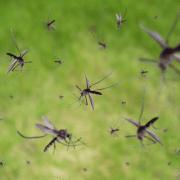
The mosquitos themselves are non-biting male mosquitos that carry a common bacterium that will ensure new eggs don’t hatch when the males mate with wild females, according to reports from CNN.
The main goal for this is to help control the archipelago’s invasive mosquito population which is greatly impacting the native bird population, particularly among rare Hawaiian honeycreepers.
The birds play a central role in Hawaiian culture, as they are key pollinators and seed dispersers. Reports indicate that at one time, there were more than 50 known species of honeycreepers in Hawaii, and now there are only 17 left, and they are mainly endangered.
Embed from Getty Images
Just last year, the ‘akikiki, a small gray bird, was practically extinct in the wild, and less than 100 of the yellow-green ‘akeke’e are estimated to still be alive. According to Dr. Chris Farmer, Hawaii program director for the American Bird Conservancy (ABC), one of the biggest “existential threats” is avian malaria, which is spread by mosquitoes.
Mosquitos themselves are not actually native to Hawaii, and were initially reported on the islands in 1826. It’s believed that they were unintentionally carried over to the islands by whaling vessels and “caused waves of extinction,” according to Farmer. Many native birds have no resistance to malaria, including the honeycreepers.
Mosquitos are also known to thrive in warmer tropical habitats, so the low elevations of Hawaii’s islands are a perfect breeding ground. Farmer stated that the higher mountains of the islands offer refuge for honeycreepers and other avian species.
“With climate change, we are seeing warmer temperatures and we’re watching the mosquitoes move up the mountains. [In places like Kauai] we’re watching the populations of birds there just completely plummet.”
“It’s a constant march of mosquitoes moving up as the temperatures allow them and the birds getting pushed further and further up until there’s no habitat left that they can survive in. If we don’t break that cycle, we’re going to lose our honeycreepers,” Farmer emphasized.
Conservationists have long been looking for a way to maintain and protect the honeycreeper population by controlling mosquitos. Farmer stated that this has been no easy feat, as mosquitos are far spread throughout the large landscape of the islands.
Pesticides have been one solution, however, they also damage other native insect populations that are integral to the multiple ecosystems throughout Hawaii.
Mosquitos in general are also a major threat to human health, as they spread diseases such as malaria, dengue fever, the zika virus, and more. The recent move to drop drones among Hawaii is a part of a solution known as the Incompatible Insect Technique (IIT).
The IIT involves releasing male mosquitos that contain a strain of bacteria that causes non-viable eggs to be laid when they mate with females. Over time, with repeated releases, the wild population should decline.
In 2016, ABC teamed up with Birds, Not Mosquitos, a multi-agency partnership dedicated to protecting Hawaiian honeycreepers. The agencies decided that IIT would have the greatest success rate when it came to helping protect the bird population while investigating how to combat avian malaria.
Embed from Getty Images
“The mosquito that transmits avian malaria is different from the one that transmits human malaria,” explained Farmer.
Due to this difference, Farmer and his team began testing various strains of Wolbachia, the naturally occurring bacteria in the male mosquitos, to determine which would provide the greatest success rate.
The process was extensive and took many years due to a “combination of the science, community engagement and the regulatory process. Naturally, whenever you say, ‘I want to release millions of mosquitoes in the forest,’ people have a lot of very legitimate questions.”
“We have a rough estimate for how many mosquitoes there are in the wild, and we try to release 10 times as many of these Wolbachia mosquitoes, so (that they) find these females and are able to mate with them, and then their eggs don’t hatch. Right now, we’re releasing 500,000 mosquitoes a week on Maui and 500,000 mosquitoes a week on Kauai,” says Farmer.
“[This is] the first known instance of specialized mosquito pods being dropped by drones. We have more flexibility with deployment timing in areas that generally have very unpredictable weather and it’s safer because no humans need to ride in the aircraft to deploy the mosquitoes,” says Adam Knox, project manager for ABC’s aerial deployment of mosquitoes.
“[It also] reduces costs, team flight times, emissions and noise, which in turn means cheaper, more sustainable deployments,” he stated.
Farmer is predicting it will be about a year before they see real results of the most recent deployment, and they’re hoping that will buy them enough time for the bird population to recover. He’s confident that they’ll see at least some improvement, which could mean amazing things for the future of conservation.
“We have the ability to save these species. If we don’t save these birds in this decade, then they probably won’t be here for the future. And so the ability to make a difference in the world, make a difference in the future, motivates us all.”
Eric Mastrota is a Contributing Editor at The National Digest based in New York. A graduate of SUNY New Paltz, he reports on world news, culture, and lifestyle. You can reach him at eric.mastrota@thenationaldigest.com.